How To Register For Vat In Uk
So, you've taken the plunge. You've turned that brilliant idea, that little side hustle, that creative spark into a real thing. Congratulations! Whether you're brewing artisanal kombucha in your shed, designing bespoke jewellery that’s blowing up on Etsy, or offering your freelance coding wizardry to clients across the globe, the entrepreneurial spirit is alive and kicking. But as your business grows, so do the little administrative tasks that come with it. And one of those slightly-less-glamorous-but-totally-essential things is VAT registration.
Now, don't let the acronym send you into a cold sweat. VAT, or Value Added Tax, is essentially a tax on consumer spending. Think of it as a little bit of the money your customers spend on your goods or services going back into the pot that funds our beloved NHS, our parks, and those wonderfully quirky roundabouts. For businesses, it means charging VAT on most sales and then reclaiming VAT you've paid on business expenses. Simple, right? Well, mostly. Let's break down how you navigate the sometimes-confusing world of registering for VAT in the UK, all while keeping your vibe as laid-back as a Sunday morning in a countryside pub.
When Does the VAT Party Really Start?
The golden rule here is that you must register for VAT if your business's taxable turnover (that's the total value of everything you sell that isn't exempt from VAT) goes over the current VAT threshold. This threshold is set by HMRC (Her Majesty's Revenue and Customs – think of them as the friendly neighbourhood tax guardians). As of April 2024, this magical number is £90,000 in any rolling 12-month period. Keep an eye on the HMRC website because this figure can, and does, change, usually announced in the Budget.
Must Read
But what if you're just starting out and don't think you'll hit that big £90k mark straight away? Or what if you know you'll be over it in the next 30 days? This is where things get a bit more granular. You need to consider your turnover over a rolling 12 months. So, if at any point in a 12-month period, your turnover hits or exceeds £90,000, you need to register. It’s not just about looking at a single financial year, but a continuous 12-month cycle.
There’s also the scenario where you anticipate your turnover will exceed £90,000 in the next 30 days alone. In this situation, you have to register from the date you realised this would happen. Proactive thinking, much like remembering to water your plants, can save you hassle later.
Even if your turnover is below the threshold, you can choose to register voluntarily. Why on earth would you do that, you ask? Well, if you’re buying a lot of things for your business that have VAT on them (think fancy equipment, supplies, software subscriptions) and your customers are VAT-registered businesses themselves, then registering allows you to reclaim that VAT. It's like getting a little rebate on your business shopping. It can be a strategic move, especially if you're in a business-to-business (B2B) space. It’s a bit like getting a discount card for your business expenses, but with more paperwork.
The deadline for registering, once you're over the threshold, is generally one month and one day after the end of the month in which you exceeded the threshold. So, if you hit the magic £90,000 mark on, say, May 15th, you need to be registered by July 1st. Get this wrong, and HMRC might charge you penalties. Nobody wants that, especially when there are more exciting ways to spend your hard-earned cash, like investing in a truly ergonomic chair or finally buying that professional-grade espresso machine for the office kitchen.
So, How Do I Actually Do It? The Registration Rhapsody
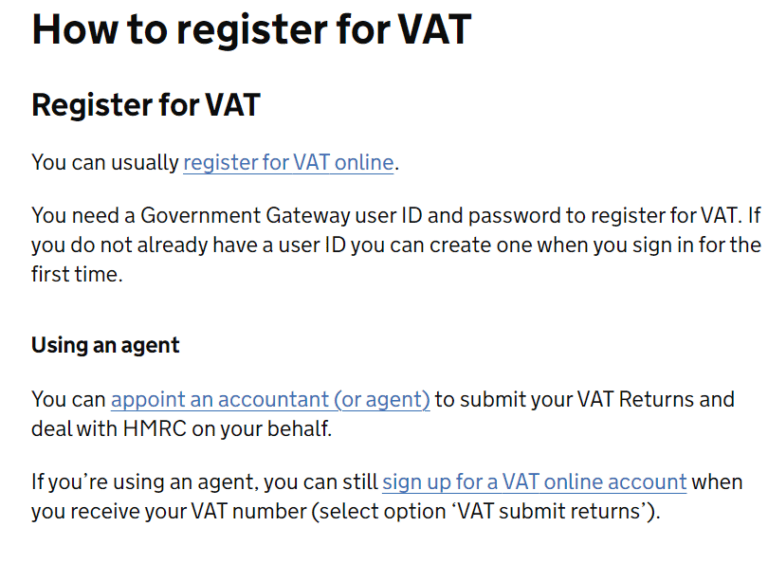
Alright, deep breaths. Registering for VAT is done online through HMRC’s website. It’s not a trek to a dusty government office; it’s all digital, much like ordering your weekly groceries or catching up on your favourite streaming series. You’ll need to set up a Government Gateway account if you don’t already have one. This is your digital passport to interacting with HMRC. Think of it as your business's official online ID.
Once you’re logged in, you’ll be guided through the VAT registration application. The key thing here is to have all your business information ready. This includes:
- Your Unique Taxpayer Reference (UTR). This is a 10-digit number assigned to your business by HMRC. If you're a sole trader, it's usually the same as your National Insurance number.
- Your business name and address.
- The date you became VAT registered (or the date you expect to exceed the threshold).
- Details of your business activities. Be specific here – it helps HMRC understand what you do. Are you selling handmade soaps or offering graphic design services?
- An estimate of your annual taxable turnover.
- Your bank account details.
The process is designed to be as straightforward as possible. It's a series of questions, much like a quiz, but with slightly higher stakes. Be honest and accurate with your answers. If you're unsure about anything, it's always better to seek clarification from HMRC or a qualified accountant. Trying to wing it with tax matters is like trying to assemble IKEA furniture without the instructions – it might eventually work, but there’s a high probability of frustration and missing pieces.
The Digital Dance: Making it Work Online
The online portal is your main stage for this performance. You'll need to navigate to the 'Register for VAT' section. If you already use other HMRC online services, your Government Gateway login should grant you access. If you're new to this digital realm, you'll need to create a Government Gateway account first. This usually involves providing some personal details and setting up a password.

Once you’re in, follow the prompts. It’s a bit like filling out an online form for a new social media account, but with less emphasis on your favourite emoji. You’ll be asked about your business structure (sole trader, partnership, limited company), your turnover projections, and the date you started trading or expect to become VAT registered. Accuracy is paramount. Think of it as proofreading an important email before hitting send – one wrong digit can lead to a cascade of confusion.
After submitting your application, HMRC will process it. They usually aim to get back to you within a couple of weeks. If approved, you’ll receive a VAT registration number. This nine-digit number is your golden ticket. It's what you'll put on your invoices and mention when you contact HMRC about VAT. Guard it like you guard your Netflix password – it’s essential for your business operations.
If, for some reason, your application isn't straightforward, HMRC might ask for more information. This is not a cause for alarm. It just means they want to be absolutely sure about your business’s situation. Think of it as a polite request for a bit more context, perhaps like a friend asking for more details about your weekend plans.
What Happens After Registration? The Ongoing Saga
So, you've got your VAT number. Congratulations! You've officially joined the VAT club. But what does this mean for your day-to-day? Well, it means you'll now need to charge VAT on your taxable goods and services to your customers. The standard VAT rate in the UK is currently 20%, but there are reduced rates and zero rates for certain goods and services (like some food items, books, and children's clothing – a little nod to making life a bit easier for families).
You’ll need to keep detailed records of all your sales and purchases, including VAT. This is where good bookkeeping practices come in. Imagine your business as a well-oiled machine; accurate records are the lubricant that keeps everything running smoothly. You'll issue VAT invoices to your customers, clearly showing the VAT charged, and you'll receive VAT invoices from your suppliers.
Then comes the fun part: filing your VAT returns. These are typically submitted quarterly to HMRC. This is where you declare the VAT you've charged (output tax) and the VAT you've paid on business expenses (input tax). If your output tax is more than your input tax, you owe HMRC the difference. If your input tax is more, you're usually due a refund. It's a bit like balancing your own books, but with a national remit.
The deadline for submitting your VAT return and paying any VAT due is usually one month and seven days after the end of your VAT accounting period. So, if your quarter ends on March 31st, you'll typically have until May 7th to file and pay. Again, missing deadlines can lead to penalties, so setting calendar reminders is a wise move. It's the adult equivalent of setting a reminder for your birthday to buy presents.
Different Strokes for Different Folks: VAT Schemes
HMRC understands that not all businesses are created equal, and they offer various VAT schemes to simplify things. The most common ones include:
- The Standard VAT Scheme: This is the default for most businesses. You charge VAT on sales and reclaim VAT on purchases.
- The Flat Rate Scheme: This is designed for smaller businesses. You pay a fixed percentage of your gross turnover (including VAT) to HMRC, and you generally can't reclaim VAT on your purchases. The percentage varies depending on your business sector. It can be simpler, but you need to check if it’s beneficial for you. Think of it as a simplified pricing plan, a bit like your mobile phone contract.
- The Cash Accounting Scheme: This allows you to pay VAT to HMRC based on when your customers pay you, rather than when you issue an invoice. It can help with cash flow, especially if you have customers who pay late. It’s like getting paid for your work before you have to pay the taxman.
- The Annual Accounting Scheme: For very small businesses, you only submit one VAT return a year, though you may make monthly or quarterly payments. This is for those who want to minimise their VAT admin as much as possible.
Choosing the right scheme can make a big difference to your administrative burden and your bottom line. It’s worth spending a bit of time researching which one best suits your business model. If you’re feeling a bit lost in the scheme maze, a good accountant can be your guide.
The Fun Bits (Yes, Really!) and Practical Pointers
Who knew tax could be this… engaging? Well, while the numbers might not have the same allure as a perfectly brewed latte, understanding VAT is crucial for the health of your business. Here are a few fun facts and tips to keep the process smooth:
- The Origin Story: VAT originated in Germany in the early 20th century and was first adopted by France in the 1950s. It's now used in over 160 countries worldwide. So, you're joining a global party!
- Keep Your Receipts Pristine: When reclaiming VAT on expenses, you need valid VAT receipts. For larger purchases, this is a no-brainer, but for smaller ones, it’s easy to lose them. Invest in a good filing system, whether it’s a digital cloud-based one or a good old-fashioned folder. Think of it as curating your business’s financial museum.
- The Power of the Accountant: While you can do it yourself, a good accountant can save you time, money, and a whole lot of stress. They can advise on the best VAT scheme, help with registrations and returns, and spot opportunities you might miss. They are the seasoned navigators in the often-choppy waters of business finance.
- Check Your Invoices: Make sure your invoices have all the correct information, including your VAT number. A missing detail can cause issues for your customers and for you when reclaiming VAT. It’s like sending a postcard without your address – it might look pretty, but it won’t get to where it needs to go.
- Stay Updated: VAT rules can change. Make sure you're signed up for HMRC email alerts or regularly check their website for updates. Ignorance is rarely bliss when it comes to tax.
- The Digital Tax Account: HMRC has a Digital Tax Account (DTA) which acts as a central hub for most of your tax affairs. You can use it to register for VAT, manage your VAT affairs, and check your VAT history. It's your personal dashboard for all things tax.
A Little Reflection: VAT and the Fabric of Life
Thinking about VAT registration can feel like another mountain to climb when you’re already busy scaling your business Everest. But if you reframe it, it’s a sign of success. It means your business is growing, your product or service is in demand, and you’re contributing to the wider economy. That £90,000 threshold isn’t a hurdle; it’s a milestone.
Just as the rain nourishes the soil, allowing flowers to bloom and trees to grow, the taxes collected through systems like VAT help nurture the society we live in. It’s the collective effort that keeps our communities functioning. So, while the paperwork might not feel like the most glamorous part of your entrepreneurial journey, it’s an integral part of building something sustainable and impactful. It’s the grown-up, responsible stuff that underpins the freedom to pursue your passions and create value in the world. And that, in its own quiet way, is pretty darn satisfying.