How Do You Strum On A Ukulele

I still remember the first time I tried to strum a ukulele. I was at a friend's beach bonfire, and she, naturally, produced this tiny, four-stringed marvel. Everyone gathered around, expecting a sweet, melodic serenade. What they got was… well, let's just say it sounded like a squirrel trying to escape a tumble dryer. My fingers were all thumbs, my wrist felt like it was made of lead, and the sound that came out was a jumble of enthusiastic thwacks and slightly terrified plinks. My friend, bless her heart, just patted my shoulder and said, "That's… a start." Oh, it was a start, alright. A start to a long and occasionally embarrassing journey of figuring out how to actually make music on this cheerful little instrument.
So, if you, like me, have found yourself staring at a ukulele with a mixture of adoration and utter bewilderment, wondering how on earth those little strings are supposed to produce anything resembling music, then you've come to the right place. Because today, we're diving headfirst into the glorious, sometimes chaotic, and surprisingly accessible world of ukulele strumming.
Let's be honest, when you think of ukulele music, you probably picture sunshine, happy vibes, and maybe a hula dancer or two. It's inherently joyful, isn't it? And at the heart of that joy is the strum. It's the engine of the ukulele sound. Get it right, and suddenly those simple chords you've been wrestling with start to sing. Get it wrong, and… well, you might end up sounding like that squirrel.
Must Read
The Anatomy of a Strum (It's Not Rocket Science, I Promise!)
Alright, so before we get our strum on, let's have a quick peek at what's actually happening when you move your hand across those strings. It's a pretty simple motion, really. You're basically using your fingers or a pick to strike the strings, usually in a downward or upward direction. But the magic isn't just in the physical act; it's in the rhythm, the dynamics, and the feel you bring to it.
Think of your strumming hand as your rhythm section. It's keeping the beat, adding texture, and generally making the whole thing sound like more than just four notes plucked in sequence. It's the part that makes people tap their feet, nod their heads, and maybe even start singing along (even if they don't know the words). Pretty important stuff, right?
The Tools of the Trade: Fingers vs. Picks
Now, before we get too far, we need to talk about the great ukulele debate: fingers or pick? This is where things can get a little personal, and honestly, there's no "right" answer. It's all about what feels good to you and what sound you're aiming for.
Playing with your fingers: This is probably the most common way to strum a ukulele, especially for beginners. It's natural, it's versatile, and it gives you a warm, mellow tone. You'll typically use your index finger for downstrokes and a combination of your index and middle fingers (or just the index again) for upstrokes. Some people even use their thumb! It’s all about finding what’s comfortable and allows for a smooth transition between strums. The great thing about fingers is that you've always got them with you, so you can practice strumming even when you've misplaced your pick (which, let's be honest, happens more often than we'd like to admit).
Side comment: Don't be afraid to experiment with different fingers! I’ve seen folks use their fingernails for a bit more attack, or the fleshy part of their finger for a softer touch. It’s your hand, your ukulele, your rules.
Playing with a pick: If you're coming from a guitar background, you might be more inclined to reach for a pick. Ukulele picks are usually thinner and softer than guitar picks, and they can give you a brighter, more defined sound. They can also be great for playing faster or more intricate strumming patterns. However, some ukulele purists argue that picks can sound a bit too harsh or "plinky" on the ukulele, and that the warmth of finger strumming is what gives the uke its charm. Again, it's a matter of preference!
Side comment: If you do go the pick route, I’d recommend starting with a felt pick or a very thin plastic one. You can always go thicker later if you decide that's your jam.
The Downstroke: Your Foundation
Okay, let's start with the most fundamental strumming motion: the downstroke. This is where most of your strumming will originate. It's the backbone of your rhythm. The key here is to make it a relaxed, fluid motion.
Imagine your wrist is a hinge, and your strumming hand is an extension of that hinge. You don't want to be stiff and jerky. Think of a gentle, sweeping motion from your wrist, not your whole arm. You're aiming to brush across all four strings simultaneously.

Try this: hold your ukulele and find a simple C chord. Now, just focus on the downstroke. Use your index finger (or a pick) and let it brush down across all the strings. Don't dig in, don't press too hard. Just a light, even stroke. Listen to the sound. Is it clear? Does it sound like one unified strum, or a series of individual, somewhat angry plucks?
Side comment: If it sounds like the latter, don't despair! It takes a little practice to get that smooth, consistent sound. Just keep trying. Consistency is key here.
The angle of your strumming finger (or pick) is also important. You want it to be at a slight angle, so it grazes the strings rather than hitting them flat. This will help prevent that "thwack" sound and create a more pleasant tone. Think of it as caressing the strings, not attacking them.
The Upstroke: The Counterbalance
Now, for the upstroke. This is the counterpart to the downstroke, and it’s just as crucial for creating a full and interesting rhythm. The upstroke is generally lighter than the downstroke, and it often hits fewer strings, or at least hits them with less emphasis.
When you're doing an upstroke, you're usually moving your finger (or pick) upwards across the strings. Again, keep that wrist loose! It's a quick, often lighter movement. Many beginner strumming patterns involve a downstroke followed by an upstroke.
Let’s try a basic pattern: Down, Up. Play your C chord. Strum down. Then, bring your finger back up across the strings. Listen to the difference. The downstroke is usually louder and more resonant, while the upstroke is softer and more of a transition. The goal is to create a sense of flow between the two.
Side comment: The upstroke doesn't have to be perfect. Sometimes it’s just about filling the space between downstrokes. Don't overthink it too much at first!
Putting Them Together: Basic Strumming Patterns
This is where the real fun begins. Once you've got a handle on downstrokes and upstrokes, you can start combining them to create rhythms. There are a million strumming patterns out there, but let's start with a couple of the most common and versatile ones.
The "Island Strum" (or "Hawaiian Strum")
This is the quintessential ukulele strum. It's simple, it's effective, and it sounds undeniably ukulele-ish. The pattern is:

Down - Down - Up - Up - Down - Up
Say it with me: "Down, down, up, up, down, up." It's a little bit of a mouthful, but once you get the hang of it, it feels wonderfully natural. Practice this on your C chord. Focus on keeping a steady beat. You can count it out loud: "1, 2, and, 4, and." Or just feel the pulse. The "and" beats are where your upstrokes often fall.
Side comment: Don't worry if your upstrokes are a little weak or uneven at first. The important thing is to get the timing and the overall flow. You'll refine the dynamics with practice.
Once you're comfortable with this pattern on one chord, try switching chords! This is where it all comes together. Play a C chord, strum the pattern, then switch to an F chord and do it again. Then maybe a G7, and back to C. This pattern works beautifully for so many songs.
The "Down, Down, Up" Strum
This is an even simpler pattern, and it's a great starting point if the Island Strum feels a bit too complex right now. The pattern is:
Down - Down - Up
This one is pretty self-explanatory. It’s a solid, driving rhythm that works for a lot of folk and pop songs. You'll find yourself using this one a lot when you want a straightforward, percussive feel.
Side comment: Try to make your downstrokes a bit stronger and your upstroke a little lighter. This creates a nice contrast and gives the strum more character.
The "Down - Up - Down - Up" (Or "All Down, All Up")
This pattern is exactly what it sounds like. You're just strumming down and up in a steady rhythm.
Down - Up - Down - Up - Down - Up - Down - Up
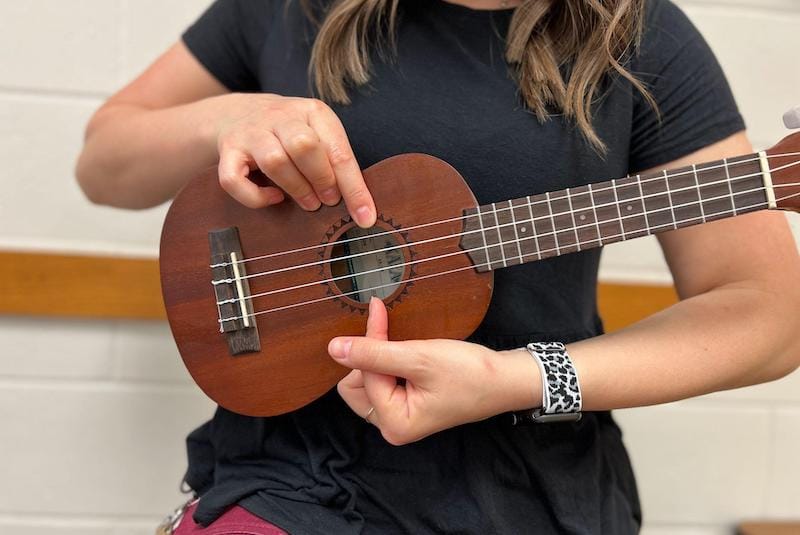
This is a very basic, almost metronomic strum. It's good for practicing your timing and coordination. You can vary the emphasis: sometimes you might hit the downstrokes harder, and sometimes you might want to make the upstrokes more prominent. It’s a good building block for more complex rhythms.
Side comment: This is also a fantastic pattern for practicing chord changes. You can focus on keeping the strum going smoothly while you switch chords underneath.
The Importance of Dynamics and Feel
So far, we've been focusing on the mechanics. But the real soul of ukulele strumming comes from dynamics and feel. This is what separates a mechanical strum from a musical one.
Dynamics: This refers to how loud or soft you strum. Think about how you would sing a song. You wouldn't sing every note at the same volume, right? You'd add emphasis, soften certain phrases, and build to crescendos. You can do the same with your strumming. Experiment with hitting the strings harder on certain beats (often the downbeats) and softer on others. This adds interest and emotion to your playing.
Side comment: Try playing the same chord with the "Island Strum" pattern but make the first two downstrokes loud, and the rest soft. Then try the opposite! See how the mood of the chord changes.
Feel: This is a bit more abstract, but it's essentially the groove and the personality you bring to your strumming. It’s about how you interpret the rhythm and make it your own. Are you playing a happy, upbeat song? Then your strumming might be light and bouncy. Are you playing something more melancholic? Then perhaps a softer, more deliberate strum would be more appropriate.
This comes with practice and listening. Listen to how other ukulele players strum. Pay attention to their rhythm, their dynamics, and the overall feel they create. Try to emulate them, then find your own unique voice.
The Strumming Hand's Secret Weapon: Muting
This is a little trick that can instantly elevate your strumming: muting. This is where you use your strumming hand to briefly dampen the strings after you've strummed them. This creates a percussive, "chunky" sound that's very characteristic of ukulele music.
How do you do it? After you've strummed down, you can slightly press the fleshy part of your strumming hand (the side of your palm, near your little finger) onto the strings. You're not trying to kill the sound completely, just to shorten the sustain and create a more controlled, rhythmic "thud."

Try the "Down, Down, Up" strum again. After each downstroke, try a quick, light mute. It should sound something like "CHUNKA-CHUNKA-chik." It adds a lovely rhythmic punctuation.
Side comment: This takes a bit of practice to get right. Too much mute, and your ukulele will sound dead. Too little, and you won't hear the effect. Find that sweet spot!
Practicing for Perfection (or at Least Progress!)
So, how do you go from squirrel-on-a-tumble-dryer to a strumming ukulele virtuoso (or at least someone who can play a song without making people wince)? Practice, practice, practice!
Start slow: When you're learning a new strumming pattern, play it very slowly. Focus on accuracy and rhythm before speed. A metronome is your best friend here. Seriously, get one. Or use an app. Your future self will thank you.
Practice with chords: Once you're comfortable with a strumming pattern on open strings or a single chord, start applying it to chord progressions. This is where it gets challenging but also where the music starts to come alive.
Record yourself: This can be painful, I know. But listening back to yourself is one of the most effective ways to identify what’s working and what’s not. You'll hear things you wouldn't notice while you're playing.
Learn songs: The best way to practice strumming is to use it in context. Find simple songs that you love and try to replicate their strumming patterns. There are tons of tutorials online for easy ukulele songs.
Side comment: Don't be afraid to simplify strumming patterns for songs. If a song calls for a really complex strum, and you're struggling, a simpler one will still sound great!
Most importantly: Have fun! If you're not enjoying yourself, you're probably not going to stick with it. Ukulele is meant to be fun. Embrace the process, laugh at your mistakes, and celebrate every small victory. That first time you strum a chord change smoothly, or play a whole song without messing up the rhythm – that’s pure magic. And it all starts with those simple up and down movements of your hand.
So go forth, my ukulele-wielding friends! Strum with confidence, strum with joy, and soon enough, you'll be the one bringing that cheerful four-stringed magic to beach bonfires and beyond. And who knows, maybe your strumming will be so good, people will think you’ve actually hired a professional squirrel wrangler.