Work Out How Many Tiles I Need
Alright, gather ‘round, fellow adventurers in the land of home improvement! Today, we’re embarking on a quest that’s as thrilling as a surprise tax audit and as potentially mind-bending as trying to assemble IKEA furniture blindfolded. We’re talking about the age-old riddle, the eternal conundrum, the… ”How Many Tiles Do I Actually Need?!”
Now, I know what you’re thinking. “Tiles? Seriously? That sounds about as exciting as watching paint dry… unless, of course, the paint is drying in a really interesting, mosaic-like pattern.” And you wouldn’t be entirely wrong. But here’s the thing: get this calculation wrong, and your wallet will weep more tears than a sad clown at a puppy convention.
Imagine this: you’ve spent weeks poring over Pinterest boards, dreaming of that perfect bathroom oasis or kitchen backsplash. You’ve picked the exact shade of teal that screams “sophistication” and “slightly worried about that leaky faucet.” You’ve ordered your gorgeous tiles, they arrive in a majestic truck, and you… can’t finish the job. Because you’re short. By like, a single tile. A single, precious, now-out-of-stock tile.
Must Read
This, my friends, is a tragedy of epic proportions. It’s the DIY equivalent of showing up to a costume party as “Half-Finished Project.” So, let’s dive in, shall we? Let's arm ourselves with knowledge and emerge victorious from the tile-estimation battlefield.
The Magical World of Square Footage (It’s Not That Magical)
First things first, we need to talk about measuring. This isn’t rocket surgery, but it does require a tape measure and a willingness to engage your brain for more than five minutes. Grab that trusty tape measure – the one you usually use to measure your waistline after a holiday binge, but let’s pretend it’s for a nobler cause now.
You need to measure the area you’re tiling. For a simple square or rectangular space, like a floor, it’s straightforward: measure the length, measure the width, and then multiply those two numbers. Length x Width = Area.
So, if your kitchen is 10 feet long and 8 feet wide, your area is 80 square feet. See? Not so scary. You’re basically a mathematician now. Feel free to put on a tweed jacket and stroke your chin thoughtfully.
![TILE CALCULATOR [How Many Tiles do I Need?]](https://concalculator.com/wp-content/uploads/2019/07/Tile-calculator.jpg)
But What About Those Awkward Shapes?
Ah, yes. The dreaded “non-rectangular” space. This is where things get… interesting. Is your bathroom shaped like a boomerang? Does your shower alcove resemble a particularly lumpy potato? Don’t panic! We’re going to break it down.
Think of it like dissecting a particularly stubborn piece of broccoli. You chop it into smaller, manageable pieces. For oddly shaped rooms, you’ll need to divide the space into simpler shapes: squares, rectangles, and triangles. Calculate the area of each of these smaller shapes, and then… you guessed it… add them all together.
Pro tip: If you’re dealing with a lot of nooks and crannies, drawing a little diagram on a piece of paper can be a lifesaver. Imagine you’re a cartographer charting unknown lands, but instead of gold, you’re looking for the glorious, unbroken expanse of tile.
The Sacred Ritual of the "Box"
Now, tiles don’t usually come as individual little soldiers. Oh no. They come in boxes. And each box will tell you how many square feet of glorious flooring (or wall-faring fabulousness) it covers. This information is usually printed right there on the box, like a tiny, tile-shaped treasure map.
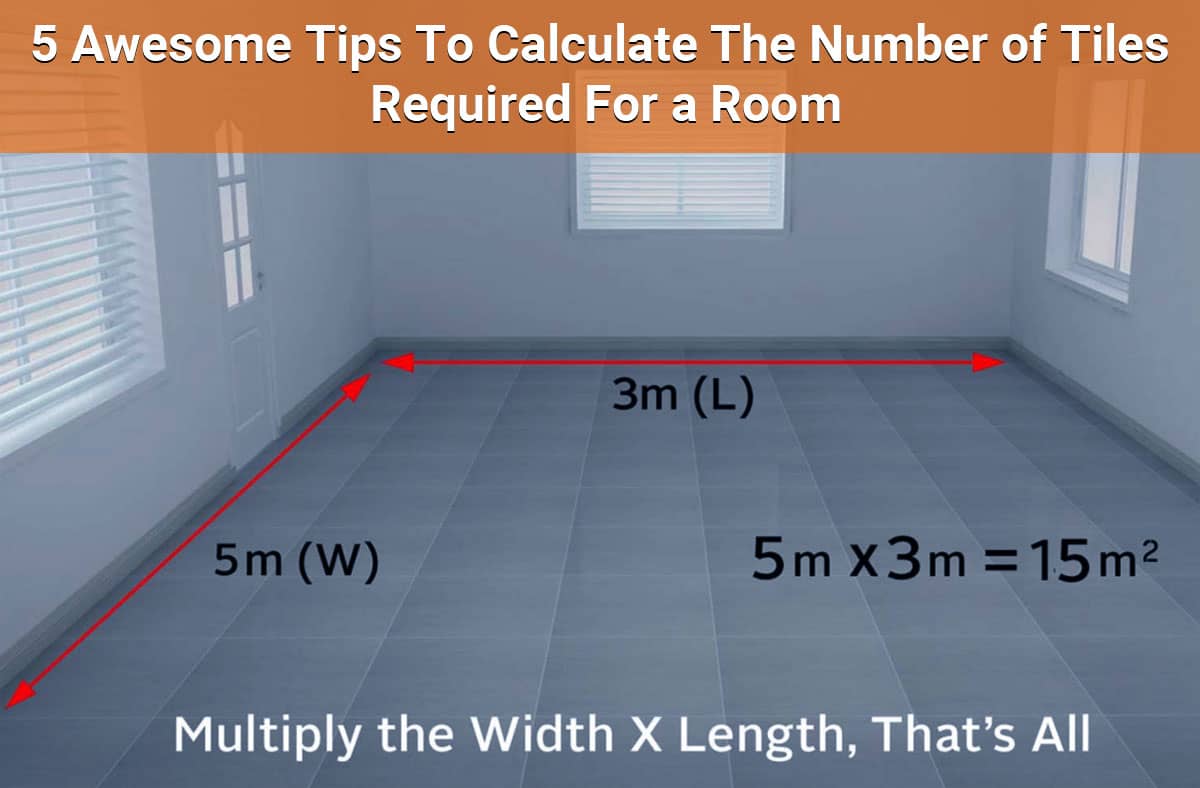
So, you’ve got your total area in square feet, and you know how many square feet a box covers. To get a rough idea of how many boxes you need, you’d divide your total area by the square footage per box. Total Area / Square Feet Per Box = Number of Boxes.
If your kitchen is 80 square feet and each box covers 10 square feet, you’d need 8 boxes. Easy peasy, lemon squeezy. Or, in this case, easy peasy, tile-y cheesy.
Wait, There’s a Catch, Isn’t There? (There Always Is.)
Oh, you know there’s a catch. Life, much like a poorly laid tile job, is rarely perfectly straight. The catch, my friends, is called waste. And it’s a cruel mistress.
When you’re cutting tiles to fit around pipes, corners, or those suspiciously oddly-shaped appliances you bought because they were on sale, you’re going to have offcuts. These are the sad little remnants of tiles that can’t be used for anything useful. They’re the tile equivalent of that single sock that mysteriously disappears from the laundry.

The amount of waste can vary wildly depending on the complexity of your space and the size of your tiles. For simple, straightforward jobs, you might get away with just 5% waste. But for more intricate patterns, curved walls, or if you’re a bit… enthusiastic with your tile cutter, you might be looking at 10-15% or even more!
This is where the “add a bit extra” rule comes into play. Think of it as your superhero cape, protecting you from the dreaded tile shortage. Most people recommend adding at least 10% extra for waste. So, if you calculated you need 8 boxes, you should probably buy 9. Or even 10, just to be safe. It’s better to have a few spare tiles than to be staring at a gaping hole in your floor, weeping softly into a grout bag.
The Quirky World of Tile Sizes and Patterns
Did you know that the size and shape of your tiles can actually affect the amount of waste? Who knew! Larger tiles, for example, can sometimes lead to less waste in large, open areas because you have fewer cuts. But in smaller, more intricate spaces, those big slabs can be a nightmare to maneuver and cut precisely.
And what about patterns? Laying tiles in a diagonal pattern, for instance, looks incredibly chic, doesn't it? But it also significantly increases waste because you'll be making a lot more angled cuts. Herringbone patterns? Gorgeous, but they’ll make your waste percentage do a little happy dance of its own.

So, before you get too excited about that incredibly complex mosaic you saw online (seriously, who has that much patience?), consider the practicalities. Unless you're aiming for a challenge that rivals climbing Mount Everest in flip-flops, stick to simpler patterns for your first few tiling adventures.
Don't Forget the Grout (It's the Unsung Hero)
While we're talking about tiles, let’s spare a thought for their silent partner: grout. You’ll also need to estimate how much grout you need. This is usually measured by volume (e.g., bags) and depends on the width of your grout lines and the depth of your tiles. Manufacturers often provide guidance on their packaging, so keep an eye out for that.
And while you’re at it, think about adhesive! Yep, another thing to calculate. Again, check the manufacturer’s recommendations. It's all about being prepared, like a scout master at a meteor shower.
The Final Tally: Add It All Up!
So, let’s recap the superhero strategy:
- Measure your space(s) accurately.
- Calculate the total square footage, breaking down odd shapes into simpler ones.
- Note the square footage per box of your chosen tiles.
- Divide total area by square footage per box to get a baseline number of boxes.
- Add at least 10% (or more for complex jobs/patterns) for waste. This is your “Oh No!” buffer.
- Consider the impact of tile size and pattern on waste.
- Don't forget to estimate grout and adhesive needs!
And there you have it! You’ve navigated the treacherous waters of tile estimation. You are now armed with the knowledge to prevent yourself from becoming a cautionary tale whispered among tile shops for generations to come. Go forth, my friends, and tile with confidence (and maybe an extra box or two, just in case the universe throws a rogue tile at you).