How To Hit A Golf Ball Far
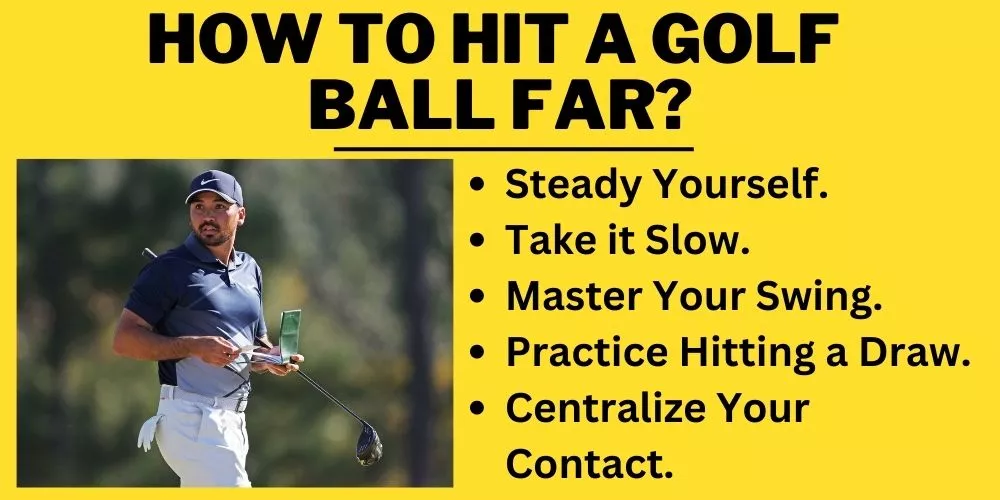
Alright, gather 'round, you magnificent humans! Let's talk about something that can make you feel like a majestic eagle soaring through the air, or… well, more like a startled pigeon doing an emergency landing. I'm talking about hitting a golf ball far. Like, "did that just go into orbit?" far. Or at least, "further than Brenda from accounting's shame-swing" far. We've all been there, staring down a fairway that looks like a postage stamp, and you just… thwack… and it dribbles ten feet. Humiliating? Absolutely. But fear not! Today, we're ditching the sad little dribbles and aiming for the stratosphere. Think of me as your caffeinated, slightly unhinged golf guru, spilling the beans over a latte.
First things first, let's dispel a myth. Hitting it far isn't about brute strength. If it were, my Uncle Barry, who can bench press a small car, would be on the PGA Tour. No, it's about efficiency. It's like a well-oiled machine, or a perfectly timed dad joke – everything has to line up. You can be built like a twig and still launch a ball like a cannon if you do it right. So, put down the protein shake and pick up your… well, your golf club. We're going to unlock your inner lumberjack, but with more finesse.
The Secret Sauce: It's All in the Swish!
So, what's the magic trick? Is it whispering sweet nothings to your driver? Is it performing a rain dance for favorable winds? Nope. It's mostly about your swing. Shocking, I know. But not just any swing. We're talking about a swing that's like a perfectly executed pirouette, not a toddler tripping over their own feet.
Must Read
Let's break it down. Imagine your golf club is a medieval flail, and the ball is a particularly annoying goblin. You want to build up speed, right? You don't just jab at the goblin. You swing it in a wide arc, letting gravity and momentum do the work. That's what we're doing with the golf club. It’s all about creating that beautiful, sweeping motion.
The Takeaway: Don't Be a Robot!
Your swing starts before you even think about hitting the ball. It starts with the takeaway. This is where you lift the club away from the ball. Now, some folks treat this like they're defusing a bomb – slow, jerky, and full of existential dread. Please, no! Think of it as a gentle, flowing movement. Imagine you're drawing a giant, graceful circle in the air. Your arms and shoulders should work together, like a synchronized swimming team. You want to feel like you're turning your body, not just yanking the club with your hands. If your takeaway looks like you're trying to start a stubborn lawnmower, we’ve got problems.

And here's a fun fact: did you know that the average PGA Tour player generates over 100 miles per hour of clubhead speed? That's faster than a cheetah can sprint! You might not reach those speeds (unless you've been secretly training with Usain Bolt), but you can certainly improve your efficiency. So, let that takeaway be smooth, a gentle prelude to the main event.
The Backswing: The Coil of Power
Next up, the backswing. This is where you load up like a spring. Think of yourself as a coiled snake, ready to strike. As you bring the club up and back, you want to feel a good rotation in your torso. Your shoulders should turn significantly more than your hips. This creates what we call "torque" – a fancy word for stored-up power. Imagine a rubber band getting stretched. The more you stretch it, the more energy it has when you let it go. That’s your backswing. You want to feel a good stretch in your core. If your backswing looks like you’re trying to scratch your own back with a pool noodle, you’re doing it wrong.
A common mistake here is to lift the club with your arms only. This is like trying to lift a piano with just your fingertips. Ineffective and likely to result in a strained relationship with gravity. Focus on turning your body. Your lead shoulder should turn in and under your chin. This will give you a much deeper coil and, subsequently, more power.

The Downswing: Unleash the Dragon!
Now, the moment of truth: the downswing. This is where all that coiled energy gets unleashed. It's not a sudden, violent jerk. It's a controlled explosion. The sequence is crucial here. It starts from the ground up. Your lower body initiates the move, followed by your torso, then your arms, and finally the clubhead. It’s like a domino effect, but way more satisfying. If your downswing looks like you’re trying to swat a fly with a fly swatter, you’re going to be disappointed.
Think about uncoiling your body. Your hips lead the charge, followed by your chest, and then your arms and club come through like a lightning bolt. And here's a surprising fact: the clubhead actually travels much faster than your hands! It’s like a whip. The handle moves, and the tip goes flying. Your job is to let the club do its thing. Don’t try to force the clubhead through the ball. Let the momentum and the uncoiling of your body do the heavy lifting.

Impact: The Moment of Truth (and a Slight Crunch)
This is it! The impact zone. Where the magic (or the sad little dribble) happens. At impact, you want your weight to be shifting forward onto your lead side. Your hips should be open, and your hands should be slightly ahead of the clubhead. This is called "releasing the club" or "lag," and it's what gives you that extra oomph. If you're still standing on your back foot at impact, it's like trying to punch with your elbow. Not ideal.
Imagine you're trying to cut down a tree with an axe. You don’t just stop at the trunk, right? You follow through. That's what you want to do here. You want to continue the motion through the ball. It's not about stopping at impact; it's about a smooth transition through it. And for those of you who think you need to steer the ball at impact, let me tell you, that’s the fastest way to turn a potential bomb into a bloop. Trust the swing you've built.
The Follow-Through: The Grand Finale!
Finally, the follow-through. This is the exclamation point on your swing. It’s where the energy dissipates naturally. Your club should finish high, with your belt buckle facing the target. It’s like a victory pose! If your follow-through looks like you’ve suddenly remembered you left the oven on, you’re probably cutting your swing short. A full, balanced follow-through is a sign of a good, complete swing.

Think of it as completing the arc. You’ve built up all this speed and energy, and the follow-through allows it to release smoothly. It’s also a great indicator of balance. If you’re falling over after your shot, your balance was probably off during the swing. So, make your follow-through a confident, stylish flourish. Channel your inner Beyoncé, but with a golf club.
A Few More Whispers of Wisdom
Before we wrap up this epic quest for distance, a couple of bonus tips. Grip is important. Don't strangle the club like it owes you money. A firm but relaxed grip is key. Too tight, and you’ll restrict your wrists. Too loose, and it’ll fly out of your hands (and possibly into a nearby spectator’s sandwich). And finally, practice. You won't become a long-drive champion overnight. Go to the range, hit balls, and focus on these principles. It’s like learning to cook. You don’t become Gordon Ramsay by watching one episode of MasterChef.
So there you have it, my friends. The secrets to hitting the ball farther than you thought possible. It's about smooth takeaways, powerful coils, explosive downswings, and confident follow-throughs. Now go forth and unleash your inner Hulk… but a controlled, golf-swinging Hulk. And if you happen to send one into the next zip code, don't say I didn't warn you!