How To Find The Pitch Of A Roof

Ever stared up at your roof, maybe while sipping your morning coffee on the porch, and wondered, "What is the pitch of that thing?" It sounds like something a musician would ask about a guitar, right? "Hmm, this roof is a bit flat, maybe a C minor?" But nope, it's a very real thing for your house. And honestly, it’s not as complicated as it sounds. Think of it like trying to figure out how steep a slide is at the playground. You don't need a degree in astrophysics to tell if it's going to be a gentle glide or a full-on, pants-on-fire rush to the bottom.
Finding the pitch of your roof is basically about understanding how much it rises for every bit of horizontal distance it covers. It's like asking, "For every foot it goes out, how many inches does it go up?" Simple, right? And why would you even care about this? Well, it’s pretty important for a few reasons. If you're thinking about getting solar panels, the pitch can affect how much sun they soak up. If you’re unlucky enough to need a new roof, the pitch dictates how tricky and expensive the job will be. Even something as simple as cleaning your gutters might feel a little different depending on how steep your roof is.
Let's ditch the jargon and get real. Imagine you're trying to explain how steep your roof is to a friend. You wouldn't pull out a protractor and a spirit level, would you? You'd probably say something like, "Oh, it's pretty steep, you can barely walk on it without feeling like you're going to do a superhero landing off the edge." Or maybe, "Nah, it's super flat, you could probably have a picnic up there and not worry about rolling away." That's essentially what we're trying to quantify with "pitch."
Must Read
There are a few ways to get a handle on this, and none of them involve scaling your roof like a seasoned roofer (unless you're feeling particularly adventurous, and even then, safety first, people!). The easiest way, and the one that requires the least amount of drama, is to simply look at your house plans. Remember those? The ones you probably shoved in a drawer somewhere and forgot about? Dig 'em out. They're like a treasure map to your house's vital stats. If you're lucky, the roof pitch will be clearly listed. It'll probably look something like "6/12" or "4:12." More on what those numbers mean in a sec. It's like finding the secret ingredient in your grandma's famous cookies – suddenly, everything makes sense.
If your house plans have gone rogue, or you never had them in the first place (don't worry, we've all been there), there are still ways to get the job done. You can head down to your local building department. They usually keep records of permits and plans for most houses. It might feel a bit like going to the library, but instead of checking out a novel, you're checking out your house's blueprint. Just be prepared for a bit of paperwork. Sometimes, you might even find that the pitch is listed on your original mortgage documents, though that's a long shot and would require some serious detective work.
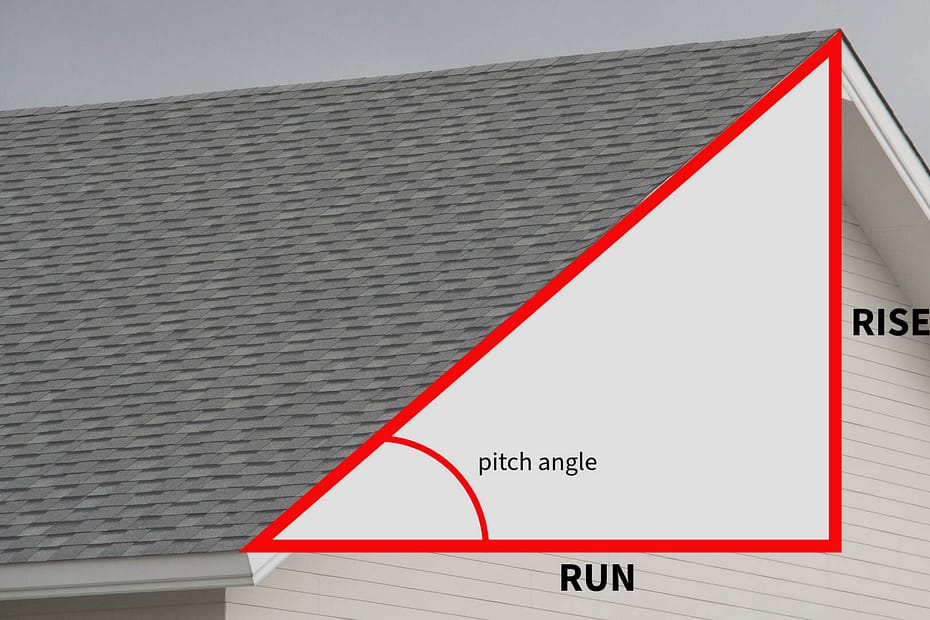
Now, let's talk about those funky numbers like "6/12" or "4:12." This is where the magic happens, or at least where the geometry comes in. The second number, the "12," is always the horizontal distance. Think of it as your baseline. The first number is the vertical rise. So, a "6/12" pitch means for every 12 inches (or feet, or whatever unit you're using) of horizontal distance, the roof rises 6 inches. It's like a secret code that tells you exactly how steep your roof is. A "4/12" pitch is less steep than a "6/12," and a "12/12" pitch is super steep – that's a 45-degree angle, like a perfectly angled ramp.

Imagine you're measuring the slope of a ramp for a remote-control car. You'd measure how far it extends horizontally and then how high it gets at the end. Roof pitch works on the same principle. The "12" is your "run," and the number before it is your "rise." So, if you see "6/12," it’s a 6-inch rise for every 12-inch run. Easy peasy, right? It's not rocket surgery, just a little bit of math that helps you understand your home's anatomy better. It’s like learning the names of your own bones – makes things much clearer when you need to figure out what’s going on.
So, what if you're stuck without plans and don't fancy a trip to the dusty archives? Don't despair! We can get hands-on (safely, of course!). This is where a simple tool and a bit of careful observation come in. You'll need a level (the kind that has a bubble) and a tape measure. And, crucially, someone to help you, or at least a very sturdy ladder and a prayer. Safety first is the mantra here, folks. If you're not comfortable on a ladder, or if your roof looks like it's about to take flight in a strong breeze, do not attempt this. Call a professional. Your life and limbs are worth more than knowing your roof's pitch.
If you're good to go, the idea is to measure the rise over a known run. You can do this from the ground with a long level, or carefully from a stable ladder. Let's say you can safely get to a point where you can place your level against the roofline. You'll place the level horizontally against the underside of the roof sheathing or a rafter. Then, you'll use your tape measure to measure the vertical distance from the bottom of the level to the roof surface at a specific horizontal distance. This is where the "12" comes into play.

Here's the slightly more involved, but still totally doable, method using your level and tape measure. You'll need to find a spot where you can position your level and have a clear view of a horizontal distance of 12 inches. This might require you to be on the roof itself, which, again, requires caution. If you can do it safely from a ladder, even better. You'll place your level against the roof, making sure it’s perfectly horizontal. Then, you'll measure 12 inches along the top edge of the level (this is your horizontal "run"). At the end of that 12-inch mark, you'll measure the vertical distance straight down to the roof surface. That measurement is your "rise."
So, if you measure 12 inches horizontally along the level, and then the roof drops down 6 inches at that point, congratulations! You’ve just discovered you have a 6/12 pitch roof. If it drops 4 inches, you have a 4/12 pitch. It's like being a detective, but instead of a magnifying glass, you have a spirit level and a tape measure. The key is to ensure your level is truly level. If the bubble is off-center, your measurements will be too. Think of it as trying to pour a perfectly flat pancake; everything has to be just right.
Another slightly less precise but sometimes easier method, especially if you can’t get perfectly close, involves trigonometry, but don't let that word scare you! We’re talking basic angles. If you have a smartphone, there are tons of angle finder apps. These apps use your phone’s accelerometer to tell you the angle of whatever you’re holding it against. You can carefully place your phone (or a piece of wood with your phone taped to it) against the roofline. The app will give you an angle in degrees. Once you have the angle, you can convert it to a pitch. For example, a 26.56-degree angle is roughly a 6/12 pitch.
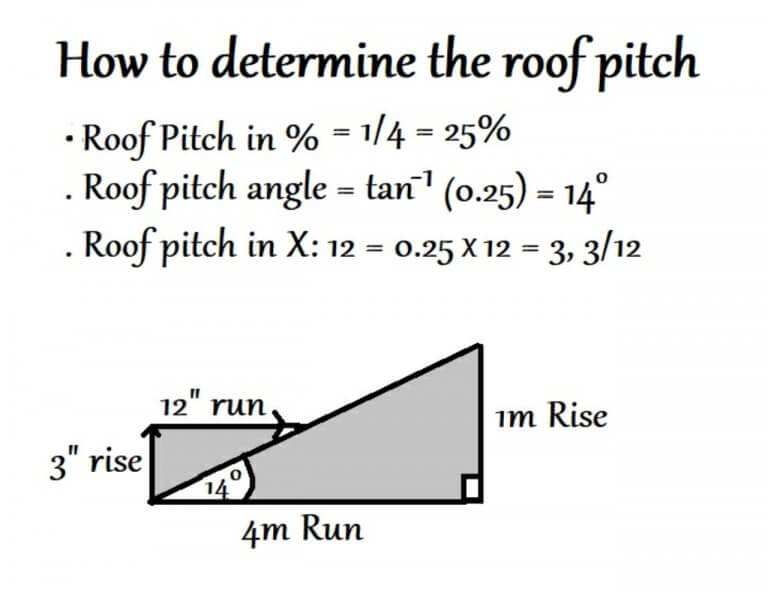
To convert degrees to pitch, you use a little bit of trigonometry. The formula is basically: pitch = tan(angle) * 12. So, if your angle finder says 26.56 degrees, the tangent of that angle is approximately 0.5. Multiply that by 12, and you get 6. See? Easy! It’s like finding out your favorite song has a hidden harmony you never noticed before. This method is often more accurate if you can get a good, stable reading. Just be sure your phone is held firmly and at the angle of the roof.
For those who like a more visual approach, you can even use a ruler and a plumb bob (a weight suspended from a string). Tie the plumb bob to the edge of a ruler. Hold the ruler flat against the roof surface. The plumb bob will hang straight down due to gravity. You can then mark where the string intersects the ruler, indicating the angle. Measure the distance from that mark to the end of the ruler that was at the roof edge, and you can work out the pitch. This is a bit more old-school, like writing a letter by hand, but it gets the job done if you’re feeling nostalgic for analog tools.
One word of caution: when measuring from the ground, you might encounter issues with the overhang. The "eaves" of your roof, the part that sticks out, can throw off your measurements if you're not careful. It's generally best to try and measure the pitch of the main roof slope itself, not the overhang. So, if you can get close enough to the wall where the roof starts to angle upwards, that's your sweet spot.
Why all this fuss about pitch? Well, it’s good to know for a few practical reasons. If you’re looking to install solar panels, the pitch, along with the roof's orientation (facing south is usually best in the Northern Hemisphere), significantly impacts how much electricity you can generate. A steeper pitch might mean less direct sunlight in the winter, while a gentler pitch might get too hot in the summer. It’s a balancing act, much like deciding whether to wear shorts or long pants on a spring day.
When it comes to roofing repairs or replacement, the pitch is a major factor in cost and complexity. Steep roofs are harder and more dangerous to work on, meaning contractors will charge more for labor. They have to use more safety equipment, and the job takes longer. So, a "10/12" pitch roof will almost certainly cost more to re-shingle than a "3/12" pitch roof, assuming the same square footage. It’s like the difference between a quick jog around the block and a full-blown marathon – one requires a lot more effort and specialized gear.
Even for something as mundane as gutter cleaning, the pitch can play a small role. A steeper roof might shed water and debris more quickly, meaning your gutters might not fill up as fast. A flatter roof, however, can be a breeding ground for leaves and other gunk, requiring more frequent attention. It’s a subtle difference, but it’s all part of understanding your home. It's like knowing your car's fuel efficiency – it just helps you manage things better.
So, the next time you're gazing up at your roof, you won't just see shingles and maybe a stray bird's nest. You'll have a little secret knowledge about its pitch, its steepness, its character. It’s a bit of insight that can be surprisingly useful, and it doesn’t require you to become an amateur roofer overnight. Just remember, safety is paramount. If you have any doubts about getting up there, leave it to the pros. But for those who are comfortable and equipped, uncovering your roof's pitch is a simple, satisfying puzzle that connects you just a little bit more to the place you call home. It’s like finally figuring out the punchline to a joke you’ve heard a thousand times – a little ‘aha!’ moment that makes everything click.
![Roof Pitch Calculator [Calculates Roof Slope, Angle, Rafter Length]](https://weekendbuilds.com/wp-content/uploads/Roof-slope-calculator.jpg)