
How To Find Midpoint Of A Line
Ever found yourself staring at a beautiful, perfectly straight line – maybe the edge of a pristine picnic blanket, or the gleaming horizon on a calm day – and just felt a pull to find its exact center? No? Just me? Well, even if you haven't actively sought it out, understanding how to pinpoint the midpoint of a line is one of those surprisingly handy skills that pops up in the most unexpected places. Think of it as your secret superpower for DIY projects, planning the perfect seating arrangement, or even just winning at a friendly geometry bet at your next brunch.
In the grand scheme of life, we’re all just navigating our own unique lines. Some are smooth and effortless, like a perfectly executed pirouette. Others are a bit more… wiggly, like a toddler's drawing of a cat. But no matter the shape or the journey, understanding the midpoint can offer a sense of balance, a point of reference, a place to recalibrate. It’s about finding that sweet spot, that place of perfect equilibrium.
So, let's ditch the dusty textbooks and the stuffy lectures. We're going to approach finding the midpoint of a line with the same relaxed vibe you bring to your favorite coffee shop – a little bit of learning, a dash of fun, and a whole lot of practical application.
Must Read
The Basics: It's Easier Than You Think
At its core, finding the midpoint of a line is all about averaging. Yep, you heard that right. We're not performing brain surgery here; we're just finding the average of the two ends. And just like the average score in your favorite video game tells you how well you're generally doing, the average of the line's endpoints tells you where its exact middle lies.
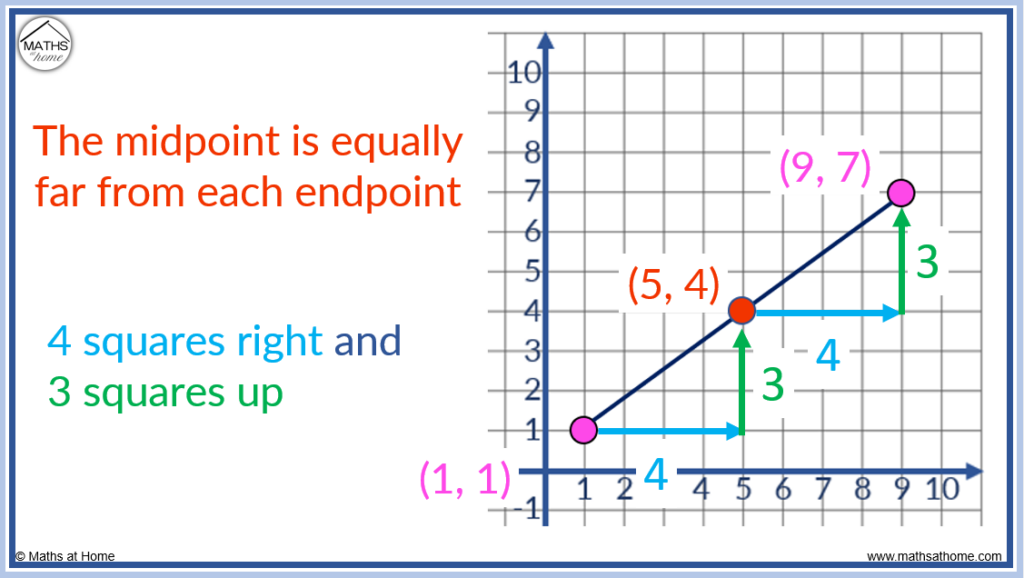
Let's visualize this. Imagine you have a line segment. It has a starting point and an ending point. To find the midpoint, we need to know the coordinates of these points. In the world of geometry, we often talk about points on a graph using (x, y) coordinates. Think of it like giving a precise address on a map. The 'x' tells you how far left or right you are, and the 'y' tells you how far up or down.
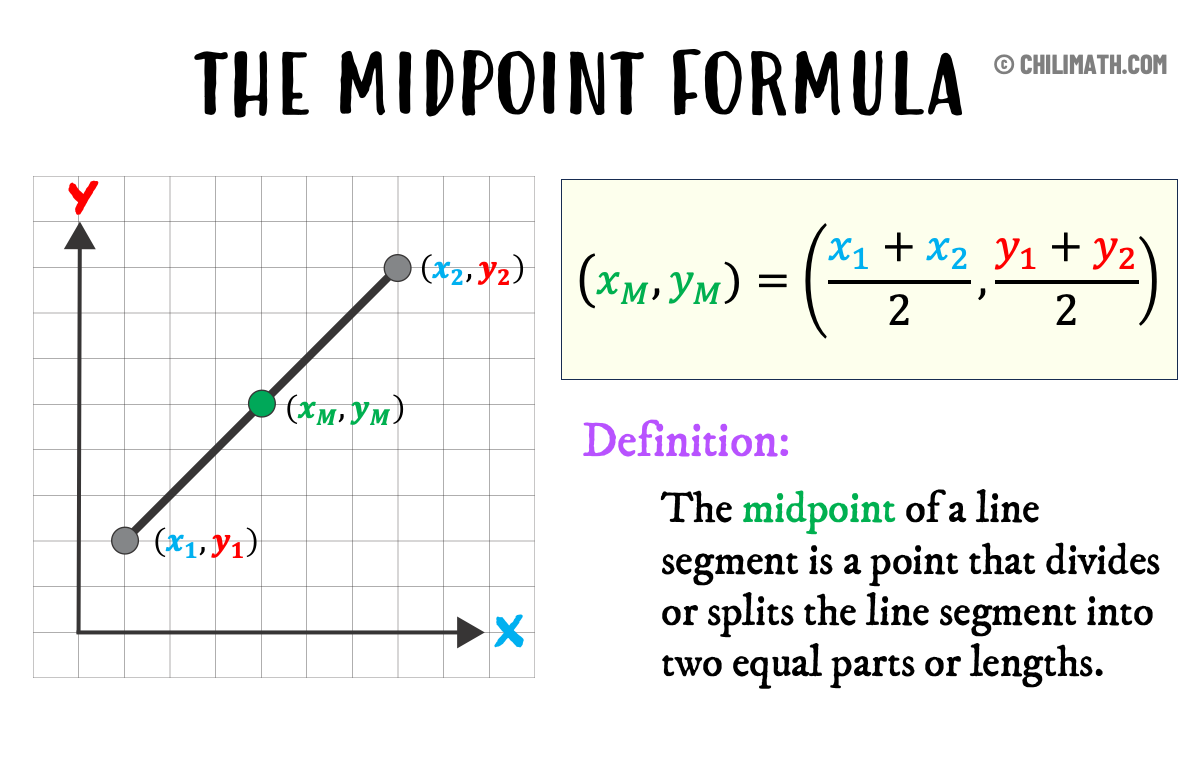
So, let's say your line segment starts at point A, with coordinates (x1, y1), and ends at point B, with coordinates (x2, y2). Our mission, should we choose to accept it (and we totally should!), is to find the coordinates of the midpoint, let's call it M, with its own (x_m, y_m).
The Magic Formula (Don't Panic!)
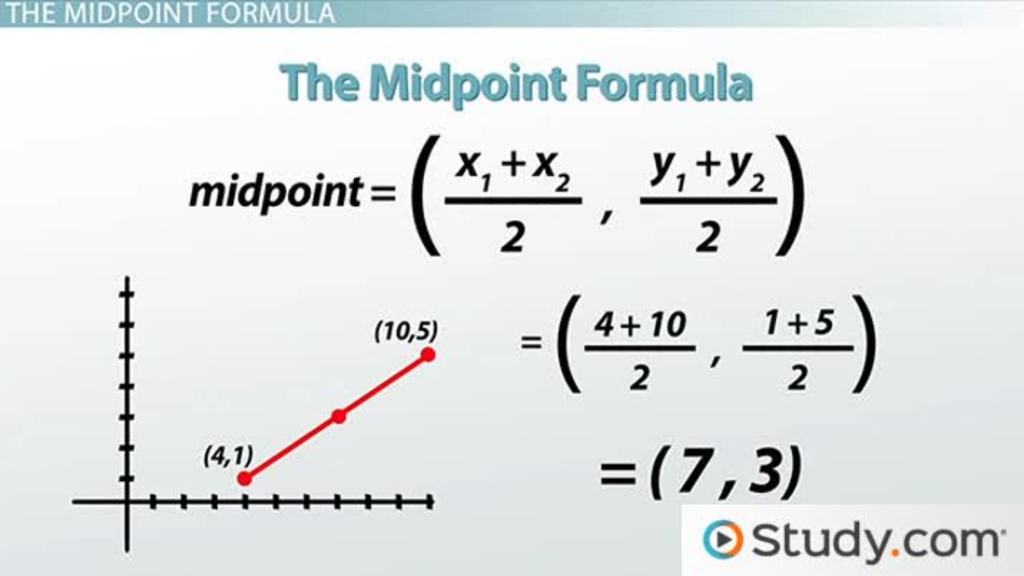
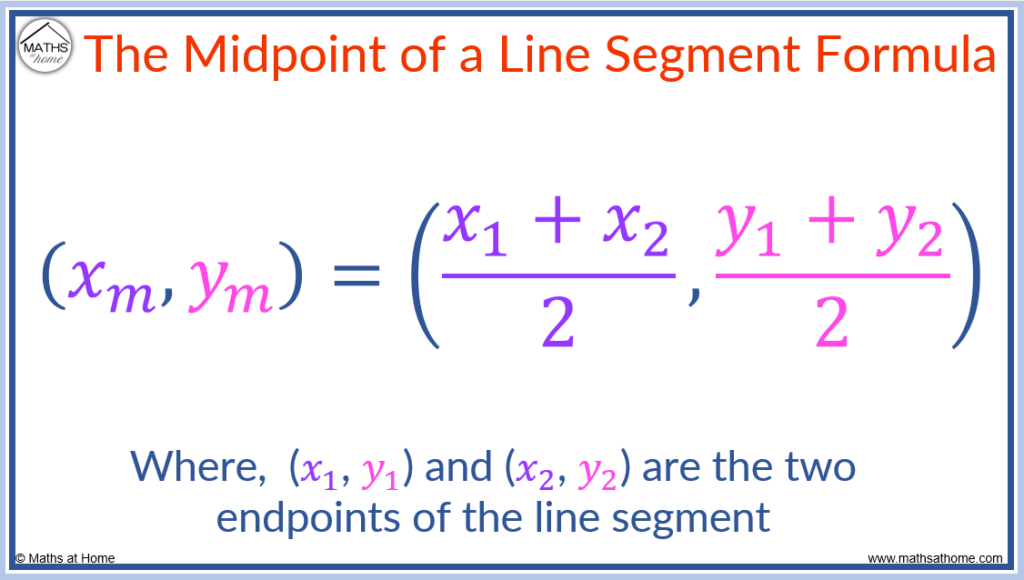
Here's where the magic happens, and it’s surprisingly elegant. To find the x-coordinate of the midpoint (x_m), we simply average the x-coordinates of the two endpoints:
x_m = (x1 + x2) / 2
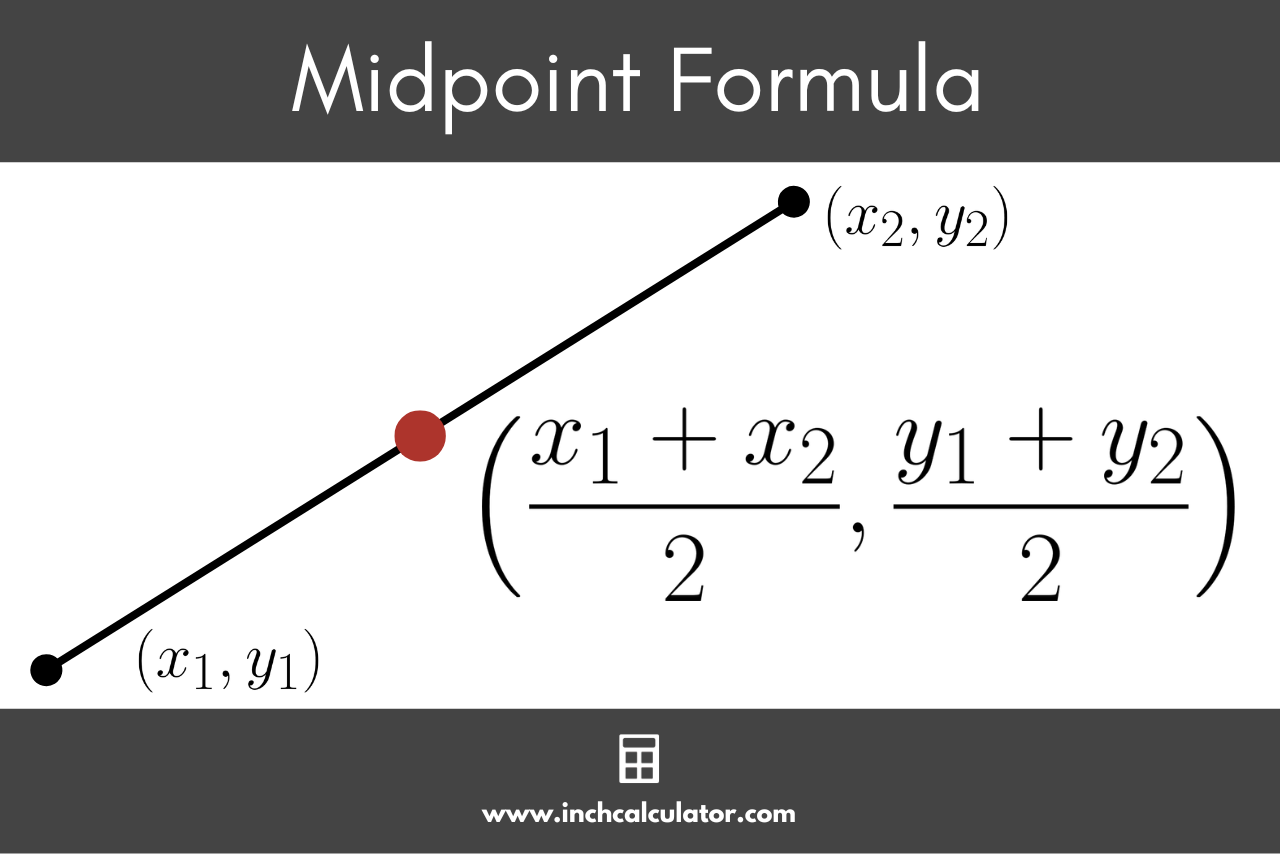
See? Just add the two x-values together and divide by two. It’s like you’re splitting the distance between them exactly in half. Easy peasy, lemon squeezy.
And for the y-coordinate of the midpoint (y_m), we do the exact same thing, but with the y-coordinates:
y_m = (y1 + y2) / 2
So, the midpoint M has the coordinates ((x1 + x2) / 2, (y1 + y2) / 2). That’s it! You’ve just unlocked the secret to finding the midpoint. It’s like discovering the recipe for the perfect chocolate chip cookie – simple, repeatable, and utterly satisfying.
Putting It Into Practice: Beyond the Graph Paper
Okay, so we've got the formula. But how does this translate into real-world awesomeness? Let's ditch the abstract and get our hands dirty (figuratively, of course).
DIY Dreams: The Anchor of Your Projects
Imagine you're building a bookshelf, hanging a picture frame, or even just trying to center a rug in your living room. You've got two points you need to align, and you want that perfect middle. This is where our midpoint formula shines.
Let's say you're hanging a mirror that's 4 feet wide. You want to center it perfectly on a wall that's 12 feet wide. You could eyeball it, sure, but where's the fun in that? Let's use math!
If the wall extends from, say, the 0-foot mark to the 12-foot mark, those are your two endpoints. The midpoint of the wall is (0 + 12) / 2 = 6 feet. So, the center of your wall is at the 6-foot mark.
Now, your mirror is 4 feet wide. To center it, you need to place its center at the 6-foot mark. This means 2 feet of the mirror will be to the left of the center point, and 2 feet will be to the right. So, the mirror should start at the 4-foot mark (6 - 2) and end at the 8-foot mark (6 + 2). Bingo! Perfectly centered.
This same logic applies to countless projects. Whether you’re laying out garden beds, marking the center of a stage for a performance, or even just trying to find the exact middle of a piece of fabric for a quilt – the midpoint formula is your trusty sidekick. It’s like having a tiny, invisible measuring tape that's always accurate.
Spatial Reasoning: More Than Just Furniture Placement
Our brains are naturally wired for spatial reasoning. We intuitively understand distance and direction. The midpoint formula simply formalizes this intuition, giving us a precise tool.
Think about navigation. Even without fancy GPS, ancient mariners used celestial bodies to find their position. While not exactly a midpoint calculation, it’s all about understanding reference points and distances. In a more modern, everyday sense, understanding the midpoint helps us orient ourselves in space.
When you're driving, and you see two lanes merging, your brain quickly assesses the space between them and where the "middle" of the merge is. This is an unconscious application of midpoint thinking. Being able to consciously apply it can make planning routes, understanding maps, and even just navigating a crowded room much more efficient.
Cultural Quirks and Fun Facts
Did you know that the concept of finding the middle ground has deep roots in philosophy and human interaction? The idea of a "golden mean" or a balanced approach, central to many ethical systems, is a philosophical echo of finding the midpoint. It’s about avoiding extremes and finding a harmonious center.
Even in ancient Greece, mathematicians were fascinated by lines and points. Euclid’s "Elements," a foundational text for geometry, laid out many of these principles. While they might have used geometric constructions with compass and straightedge, the underlying idea of bisecting a line (which is essentially finding its midpoint) was a key concept. It's pretty cool to think that a skill you can learn on a Tuesday afternoon has a lineage stretching back thousands of years.
And here's a little something fun: If you have a line segment drawn on a piece of paper, you can actually fold the paper so that the two endpoints meet. The crease you make will be the perpendicular bisector of the line, and where that crease crosses the line is its midpoint. It’s a fun, tactile way to visualize it without any numbers! It’s like a geometric magic trick.
When Lines Get Complicated: A Glimpse Ahead
Now, for the most part, we're dealing with nice, straight lines on a flat plane. But what if your line is a curve? Or what if you're dealing with three dimensions? These are more advanced topics, of course, and they involve calculus and more complex algorithms.
But even in those scenarios, the fundamental idea of finding a central point or an average remains. It’s a testament to the power of fundamental mathematical principles. They are the building blocks for much more complex structures. Think of it like learning your ABCs – once you've got those down, you can read anything from a children's book to a Shakespearean sonnet.
So, don't be intimidated if you encounter a curved path or a 3D object. The spirit of finding the midpoint is still there, just expressed in a more intricate language.
Embracing the Midpoint in Everyday Life
Life, much like a winding road, isn't always a perfectly straight line. We have our ups and downs, our twists and turns. And sometimes, the most challenging part is just finding our bearings, finding our center.
The midpoint formula, in its simplicity, offers a tangible way to think about balance and equilibrium. It reminds us that even in the midst of complexity, there’s often a point of perfect balance to be found. It’s about finding that sweet spot where two opposing forces meet, where a journey finds its pause.
So, the next time you’re faced with a perfectly straight line, whether it’s literal or metaphorical, remember the midpoint. It’s a small concept with a big reach, a handy tool for the practical builder, the curious mind, and anyone who appreciates a little bit of elegant order in their world. It’s a reminder that sometimes, the simplest solutions lie right in the middle of things.

