So, you’re dreaming of ditching the alarm clock, trading in your spreadsheets for sunshine, and maybe even mastering the art of the perfectly timed nap – all before your friends even start talking about their 401(k)s? Retiring at 50! It sounds like a mythical land, a tropical island accessible only to lottery winners and trust fund babies, right? Wrong! Well, maybe a little bit of lottery winning would help, but seriously, it’s way more achievable than you might think, and frankly, way more fun.
Let’s talk numbers, but don’t let your eyes glaze over like you’re looking at a tax form. We’re not going to dive into calculus or anything that requires a calculator with more buttons than a spaceship. We’re talking good old-fashioned common sense and a sprinkle of financial pixie dust. The magic number, the secret handshake to the "early retirement club," is a bit like asking how many jellybeans are in a jar. It depends on the jar, right? But we can give you a really good ballpark estimate that’ll have you packing your bags (or at least mentally planning your epic relaxation schedule).
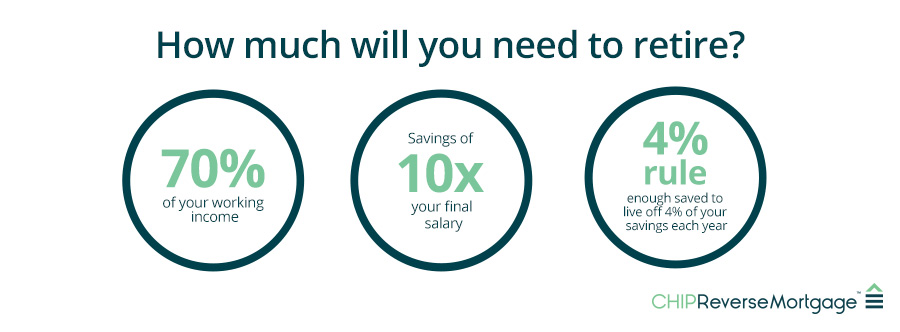
Most financial gurus, the folks who wear tweed jackets and have impressive beards, suggest a general rule of thumb: you’ll need about 25 times your annual living expenses saved up. Think of it this way: if you spend, say, $50,000 a year to live your awesome life (fancy coffee runs, spontaneous weekend getaways, and maybe a subscription box for artisanal cheese – we’re not judging!), then you’re looking at needing approximately $1,250,000. That sounds like a LOT, I know! It might even make you want to go back to your desk and start furiously refreshing your email. But hold on, grasshopper! Don’t let that number scare you into submission. We’re talking about annual living expenses. For many people aiming for an early retirement, those expenses look a little different than when they were climbing the corporate ladder.
Picture this: no more work clothes that make you feel like a tightly-wound spring. No more battling rush hour traffic that makes you want to invent a personal teleportation device. Your daily grind transforms into a gentle stroll through a farmers market, perhaps followed by a leisurely brunch. Your expenses might shrink faster than a wool sweater in a hot wash! Think about it: fewer lunches bought out, less pressure to keep up with the Joneses (who are probably still stuck in traffic, anyway), and a whole lot less impulse buying fueled by workplace stress. For some, their annual expenses might be closer to $30,000 or $40,000, which dramatically changes the target number. That $1,000,000 mark suddenly feels less like Mount Everest and more like a very tall, but climbable, hill.
Now, let’s add another layer of awesome. We’re not just talking about hoarding cash under your mattress, though a little emergency stash is always a good idea! We’re talking about making your money work for you, like tiny financial ninjas doing backflips in your investment accounts. When you retire early, especially at 50, you’re not just relying on your savings to last until you’re 90. You’ve got a good chunk of time to play with. This means you can be a little more strategic with your investments. We’re not suggesting you become a Wall Street wizard overnight, but understanding the basics of investing can make a huge difference. Think of it like planting seeds. You plant them, you water them, and with a little patience and the right conditions, they grow into beautiful, money-generating trees.
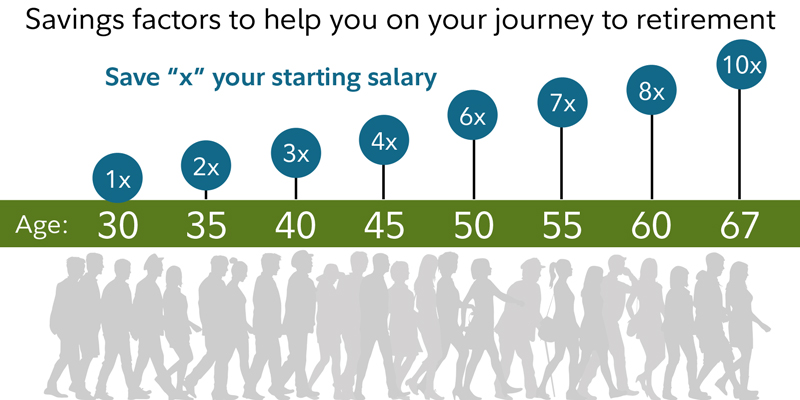
If You Have This Much Money At 50, You're Set Up For Retirement Success
Here’s where the fun really kicks in. Many people who retire early find that their investments can generate enough income to cover their living expenses, and then some! This is often referred to as the "4% Rule." It’s not a hard and fast law of physics, but a guideline that suggests you can withdraw about 4% of your investment portfolio each year, and it’s likely to last you for a very long time, possibly forever! So, if you have a cool $1,000,000 invested, that 4% withdrawal is a tidy $40,000 a year. See? That $50,000 lifestyle we mentioned earlier? Suddenly, it’s looking very, very achievable without touching the principal of your investments. It's like having a personal ATM that dispenses pure freedom and adventure!
Imagine this: you’ve built up your nest egg, it’s humming along nicely, churning out passive income, and you decide to finally learn to play the ukulele or hike the entire Appalachian Trail. No guilt, no stress, just pure, unadulterated enjoyment. That’s the dream, isn't it?
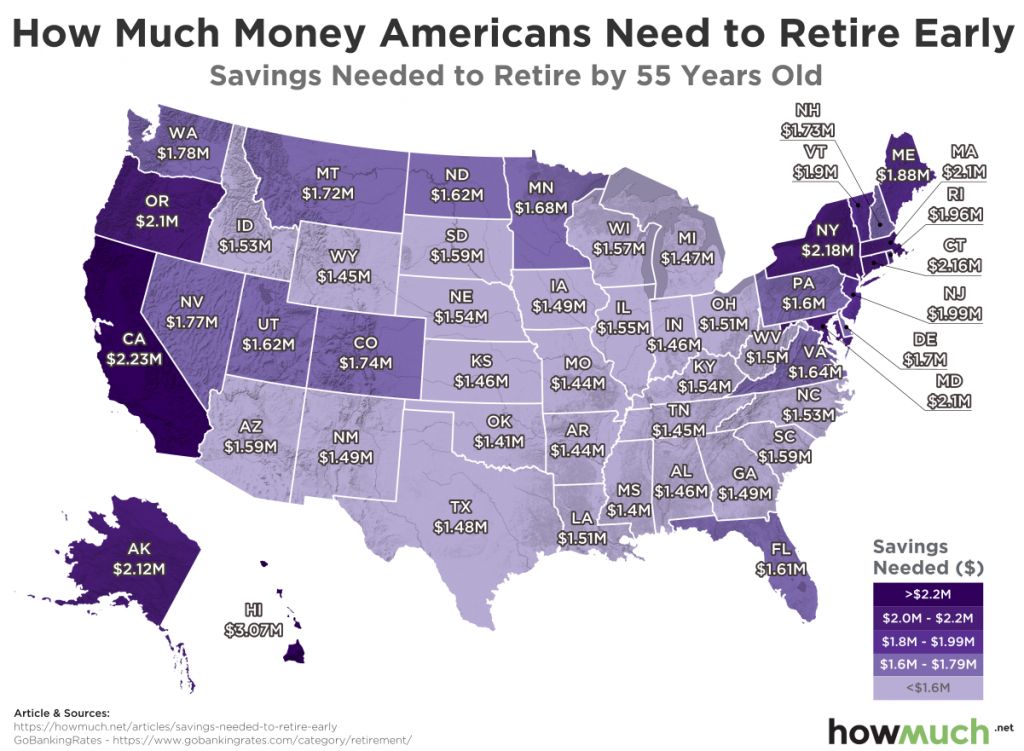
How Much Money You Need To Save To Retire Early In Every U.S. State
But here's the secret sauce, the ingredient that separates the dreamers from the doers: consistency and a little bit of sacrifice. Nobody stumbles into early retirement like a sleepwalker. It usually involves a period of diligent saving and smart investing. That means maybe saying "no" to a few extravagant purchases in your younger years, packing your lunch a few more times than you’d like, and making sure your money is doing more than just sitting there collecting dust. Think of those little sacrifices as down payments on your future freedom. Every dollar you save and invest now is a tiny step closer to that day when your biggest decision is whether to have coffee by the beach or by the mountains.
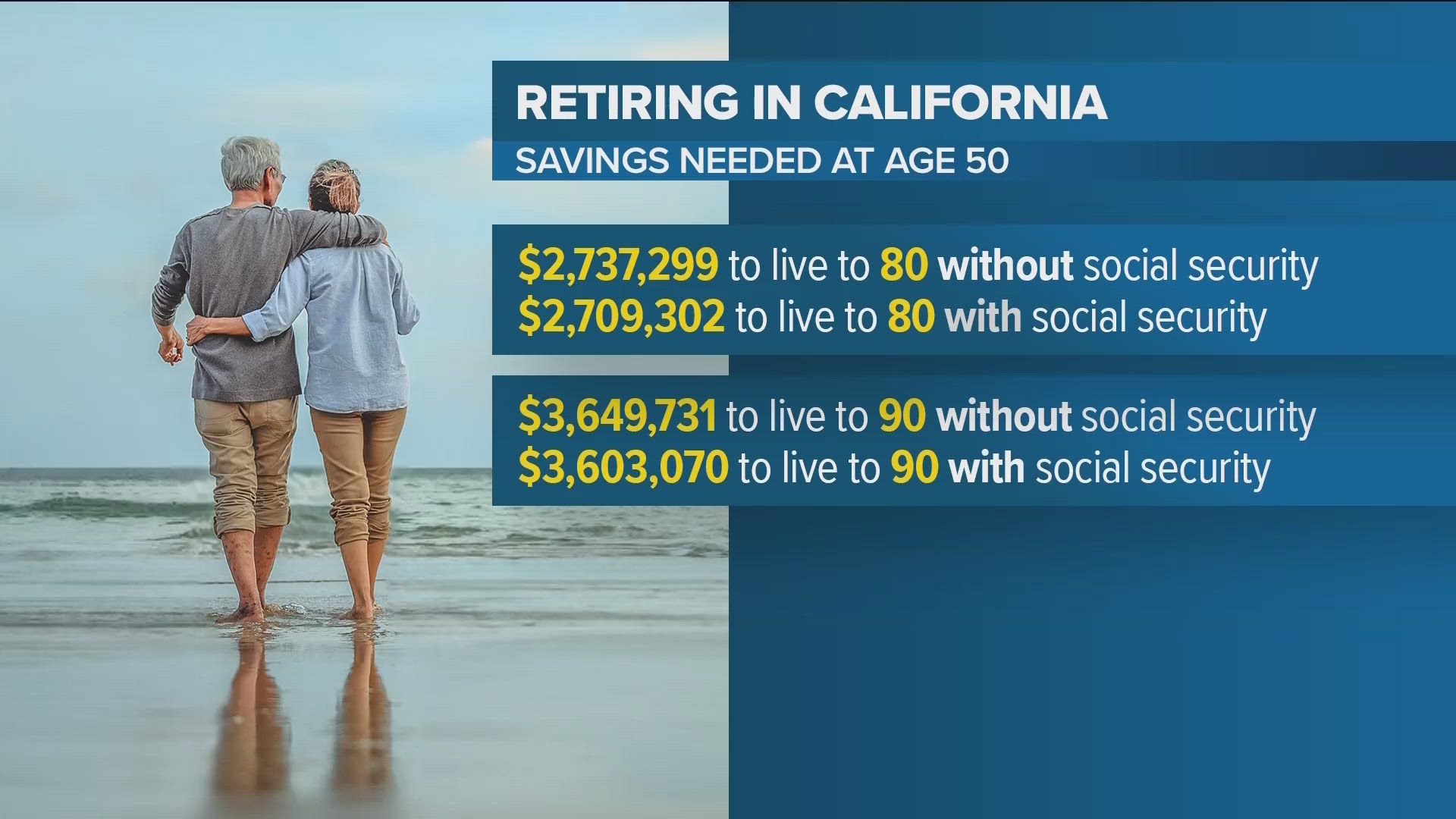
So, how much money do you need to retire at 50? The short answer is: enough to comfortably cover your projected living expenses for the rest of your life, with a healthy buffer. The long answer involves smart saving, savvy investing, and a willingness to trade a little bit of today’s instant gratification for a whole lot of tomorrow’s ultimate freedom. It’s not about a single, magical number, but about building a financial engine that can power your dreams. And trust me, those dreams are worth every penny.