How Do You End A Sympathy Card

Ah, the sympathy card. A beautiful, albeit somber, tradition. We’ve all been there. Staring at that blank space after pouring out our heartfelt condolences. The words “Sincerely” or “With deepest sympathy” feel a tad… well, predictable, don’t they? Like the beige of closing statements. And honestly, sometimes, the weight of grief feels too big for a simple sign-off. So, how do you really end a sympathy card? Let’s have a little fun with this, shall we? Because in the face of loss, a little lightness, a touch of genuine connection, can sometimes be more comforting than stiff formality.
First off, let's acknowledge the elephant in the room. Most of us default to the tried and true. And there’s nothing wrong with that! If you’re feeling the profound sadness, and “With sympathy” truly captures it, then absolutely, go with it. But what if you’re feeling something else? What if you’re remembering a hilarious anecdote about the departed? What if you’re feeling a quiet sense of hope for the grieving? Does “Yours truly” suddenly sound like you’re about to propose marriage? It can feel that way, can’t it?
Consider the relationship you had with the person who passed. If they were a close friend, someone you shared inside jokes with, perhaps a more personal closing is in order. Something that hints at that shared history. Imagine signing off with, “Thinking of you and all our ridiculous adventures.” See? It injects a little warmth, a reminder of brighter times. It’s like a little wink across the veil, a subtle acknowledgment of the joy they brought. It doesn't diminish the sadness; it just makes the memory of the person feel more complete. It’s a little bit of realness in a sea of polite phrases.
Must Read
Then there’s the scenario where you want to offer practical support. You want to say, “Seriously, I’m here for you. Like, really here.” So, instead of a generic “Best wishes,” you could try something like, “Let me know when I can bring over that casserole. No, seriously. I’m good at casseroles.” Or perhaps, “Don’t hesitate to call, even if it’s just to vent about the never-ending laundry.” These are little bridges, building blocks of connection that say, “I’m not just offering words; I’m offering action.” It’s about making your presence tangible, not just a penned sentiment.
And what about those times when you knew the departed for a shorter time, but still want to convey genuine sorrow? You might feel that “Love” is a bit too strong, but “Regards” feels too cold. This is where you get to be a little creative. How about a simple, heartfelt, “Holding you in my thoughts”? It’s gentle, it’s caring, and it doesn’t overstep. Or maybe, “Wishing you moments of peace”? It’s a beautiful sentiment that acknowledges the turmoil and offers a gentle hope.

Let’s talk about the absolute no-nos that sometimes creep in. We’ve all seen them. The overly cheerful closings that feel wildly out of place. “Stay positive!” – while well-intentioned, can sometimes land with a thud. Or the casual, almost dismissive, “Catch you later!” Nobody wants to be “caught later” after a profound loss. It’s like suggesting they’ll just pop back up for coffee next week. The key here is empathy. Imagine yourself receiving this. Would it feel supportive, or just a little bit… off?
Sometimes, the most powerful closing is the one that’s just… you. If you’re someone who expresses affection through shared humor, maybe a gentle, knowing nod to a shared memory is appropriate, followed by a simple, “Thinking of you.” For instance, if the departed had a signature silly phrase, and you know the recipient would appreciate the reminder, you could subtly weave it in. It’s a delicate dance, of course. You don’t want to make light of the situation, but you do want to offer a genuine connection, a reminder of the full spectrum of the person’s life.

It’s almost like a mini-signature for the grief itself. Are you signing off with a heavy heart? Or a heart that’s remembering a smile? Are you signing off as a practical helper, or a quiet observer of their pain?
And then there’s the option of keeping it wonderfully simple. Sometimes, the most profound message is conveyed by the fewest words. After your carefully crafted paragraphs of comfort, a simple, “With caring,” or “Warmly,” can be incredibly effective. It’s like a gentle hand on the shoulder. It doesn’t demand a response, it doesn’t offer platitudes, it just offers presence.
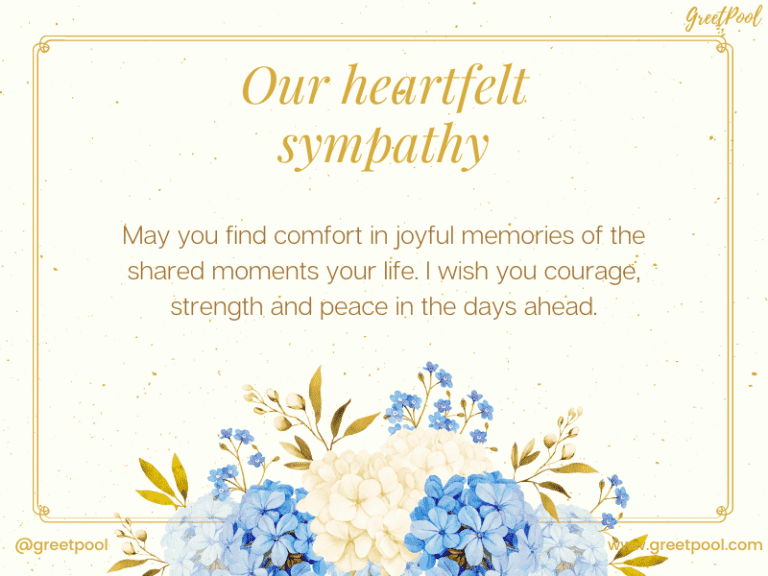
Think about the deceased’s personality. Were they formal and dignified? Then perhaps a more traditional closing is fitting. Were they a free spirit, always ready with a laugh? Then a warmer, more personal sign-off might resonate. It’s about aligning your closing with the memory of the person you’re honoring. It’s a small detail, but it can make a big difference in how the message is received. It’s like picking the perfect frame for a precious photograph.
Ultimately, the “right” way to end a sympathy card is the way that feels most honest and comforting to you, and most likely to offer solace to the recipient. It’s a moment for genuine human connection. So, go ahead, be a little brave. Try something beyond the usual. Because sometimes, the simplest and most heartfelt closings are the ones that linger the longest, like a warm embrace in a difficult time.