How To Write A Eulogy For Mom
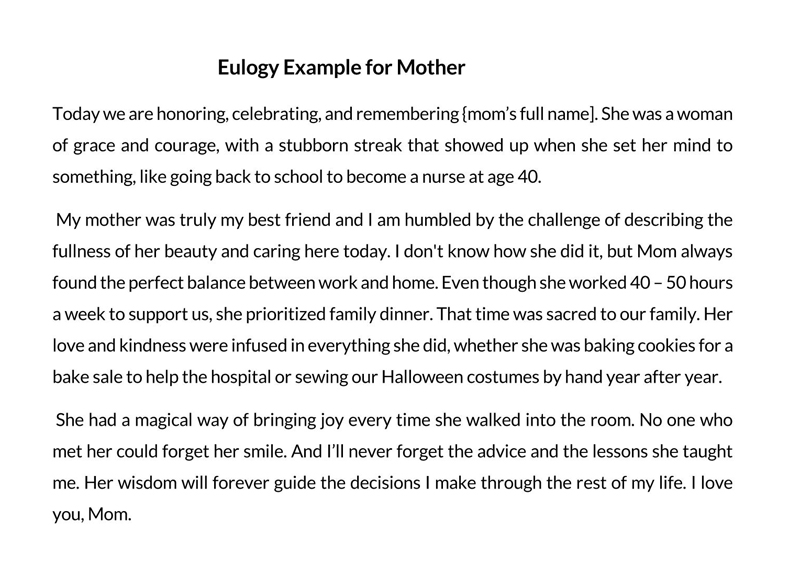
Losing your mom is, let's be real, a kick in the gut. It's a grief that settles deep, a silence where there used to be laughter, advice, or maybe even a gentle scolding about leaving the cap off the toothpaste. And then, someone, usually you, is tasked with the monumental, heart-wrenching job of writing her eulogy. It feels like trying to bottle lightning, doesn't it? How do you distill a lifetime of love, of shared moments, of her very essence into a few poignant minutes? Take a deep breath, friend. We're going to walk through this together, with a sprinkle of grace and a whole lot of love.
Think of a eulogy not as a formal speech, but as a heartfelt conversation with everyone gathered, sharing the story of the woman who meant the world to you. It's your chance to paint a picture, to remind people why she was so special, and to celebrate the life she lived.
The Blank Page Blues: Where to Even Begin?
Staring at a blank document can feel like staring into the abyss. It’s okay. Most people feel that way. The first step is to give yourself permission to feel. Grief is messy, and sometimes the most profound words come when we’re not forcing them.
Must Read
Instead of thinking "I have to write a eulogy," try reframing it as "I get to share memories of Mom." This small shift in perspective can make a world of difference. Remember those amazing stories she used to tell at family gatherings? Or the silly inside jokes that only you two understood? Those are your building blocks.
Pro-tip: Grab a notebook, a voice recorder, or open a simple text file. Don't worry about perfect grammar or flow just yet. Just start jotting down anything and everything that comes to mind when you think of your mom.
Unearthing the Gold: Brainstorming Memories
This is where the real treasure hunt begins. Think about different aspects of her life:
- Her personality: Was she a riotous comedian? A quiet observer? Fiercely independent? A gentle soul? What were her defining traits?
- Her passions and hobbies: Did she love gardening, baking, reading, traveling, art, music? What made her eyes light up?
- Key life events: Her wedding day, the birth of her children, a significant career achievement, a memorable vacation.
- Everyday moments: The way she made your favorite meal, her morning routine, her specific way of offering comfort, the sound of her laugh.
- Her impact on others: How did she influence you? Your siblings? Her friends? Colleagues?
Don't be afraid to get specific. Instead of saying "Mom was a good cook," say "Mom’s Sunday roasts were legendary; the gravy was so rich, you could practically swim in it." Specificity makes memories vivid and relatable.
Fun Fact: Did you know that the word "eulogy" comes from the Greek words "eu" (good) and "logos" (word)? So, you're essentially speaking good words about your mom. Simple, right?

Structuring Your Tribute: A Gentle Roadmap
Once you've gathered a good collection of memories, it's time to start weaving them into a narrative. A common, effective structure for a eulogy is:
1. Introduction: Setting the Scene and Your Connection
Start by identifying yourself and your relationship to your mom. A simple "Hello everyone, I'm [Your Name], and I'm [Mom's Name]'s [son/daughter/other]." Then, briefly state the purpose of the gathering – to honor and celebrate her life.
You might want to share a brief, overarching sentiment about her. Something like, "Today, we’re here to celebrate the incredible life of my mom, a woman who was truly one of a kind," or "It’s hard to imagine a world without Mom’s light, but today we’re going to share some of that light with each other."
2. The Body: Sharing Stories and Anecdotes
This is where you bring your brainstormed memories to life. Don't try to cover everything. Focus on a few key themes or stories that really capture who she was. Think about impact and essence. What are the stories that people will remember long after the service?
Consider organizing this section chronologically, thematically, or even by significant relationships. For example, you could dedicate a paragraph to her role as a mother, another to her career, and a third to her friendships.
Example: Instead of listing her achievements, tell the story of how she overcame a challenge, or a funny mishap during a significant event. For instance, if she was a dedicated gardener, you could talk about the time her prize-winning roses were attacked by aphids and how she waged war with organic sprays for weeks.

Cultural Nuance: In many cultures, families will share stories that highlight humility and kindness. You might find it fitting to share an anecdote about her quiet acts of generosity or her unwavering support for those in need. It’s about showing her character, not just listing accomplishments.
3. The Impact: Her Legacy and Influence
This section is crucial. How did your mom make a difference? What lessons did she teach you, both intentionally and unintentionally? How did she shape the lives of those around her?
This is where you can talk about her values. Did she believe in perseverance? Compassion? The importance of family? Share how these values were reflected in her actions and how they've stayed with you.
Consider a quote: Sometimes, a well-placed quote, whether from a poem, a song, or even something your mom herself used to say, can perfectly encapsulate her spirit. Think about her favorite sayings or mottos.
4. Conclusion: A Final Farewell and Blessing
This is your closing statement. You can reiterate your love and gratitude for her. You might offer a wish for her peace or a hopeful message for those left behind.
A common and touching way to end is to acknowledge the enduring nature of her love. "Mom, your love will forever be a guiding light in our lives," or "We will carry your spirit with us always."

You can also include a final blessing or a hopeful thought for the future, perhaps looking forward to seeing loved ones again or finding comfort in shared memories.
Words That Matter: Tone and Delivery
Authenticity is key. Don't try to be someone you're not. If you're naturally a funny person, inject humor where appropriate. If you're more reserved, a heartfelt and simple delivery will be more impactful. Your emotions are valid. It’s okay to pause, to take a breath, to show your love and your sadness.
Keep it concise. A eulogy typically runs between 3 to 5 minutes. This might sound short, but it’s long enough to convey powerful emotions and meaningful stories without overwhelming your audience. Practice reading it aloud to get a sense of timing.
Use clear, accessible language. Avoid jargon or overly complex sentences. You want everyone to understand and connect with what you're saying.
Practice, practice, practice. Read your eulogy aloud several times. This will help you find awkward phrasing, gauge the timing, and become more comfortable with the material. Practice in front of a mirror, record yourself, or read it to a trusted friend or family member. This isn't about memorizing it perfectly, but about feeling confident and connected to the words.
Fun Fact: Did you know that the famous, often-quoted poem "Do Not Stand At My Grave And Weep" by Mary Elizabeth Frye, written in 1932, is a beautiful example of a eulogy-like sentiment, offering comfort and continuity?
When Tears Fall: Navigating the Emotion
It is almost guaranteed that you will cry. And that's not just okay, it's expected. Let the tears come. They are a testament to your love. Most people in the room will be experiencing their own grief, and your vulnerability can be a shared human experience that connects everyone.
Have a backup plan: If you're worried about losing your voice or being overcome by emotion, consider having a family member or close friend with a copy of your eulogy who can step in to read if needed. You can also have a glass of water nearby.
Don't strive for perfection. The most important thing is that your words come from the heart. If you stumble over a word or need to pause, it’s a sign of your humanity and your love.
Beyond the Service: The Enduring Connection
Writing a eulogy isn't just a task for the funeral. It's an act of love that continues long after the service. The stories you share, the memories you evoke, they become a part of your mom's ongoing legacy. You’ve essentially created a living tribute.
The process of writing and delivering a eulogy can be a profound way to process your grief. It forces you to focus on the positive, to celebrate the good, and to remember the love that will always remain.
Small Reflection: Think about the simple things your mom did that brought you comfort. Maybe it was the way she always had a cup of tea ready, or the specific way she’d hum a tune while she worked. These little moments are the threads that weave the fabric of our lives. As we navigate our days, a quiet moment of gratitude for those everyday acts of love, those small, seemingly insignificant gestures, can be a powerful way to keep her spirit alive. Her influence isn't confined to a speech; it’s woven into the very rhythm of your days, in the lessons you carry, and the love you continue to give.