
How To Measure A Nut For Size
Ever found yourself staring at a bolt, a screw, or even a tiny little fastener and thinking, "Huh, how do I actually figure out what size this thing is?" It’s a surprisingly common little puzzle, isn't it? You’re trying to fix something, maybe a wobbly chair or a squeaky hinge, and you’ve got a whole bunch of nuts and bolts lying around, but none of them seem to be the right one. It’s like a miniature treasure hunt where the treasure is… well, a piece of metal that fits perfectly.
And let’s be honest, sometimes the packaging is long gone, or maybe you inherited a box of assorted hardware from someone who believed in “keeping everything, just in case.” So, how do we go from a mysterious metal ring to knowing its exact dimensions? It’s actually a lot less intimidating than it sounds, and once you get the hang of it, it’s kinda cool. Like unlocking a secret code for all things threaded!
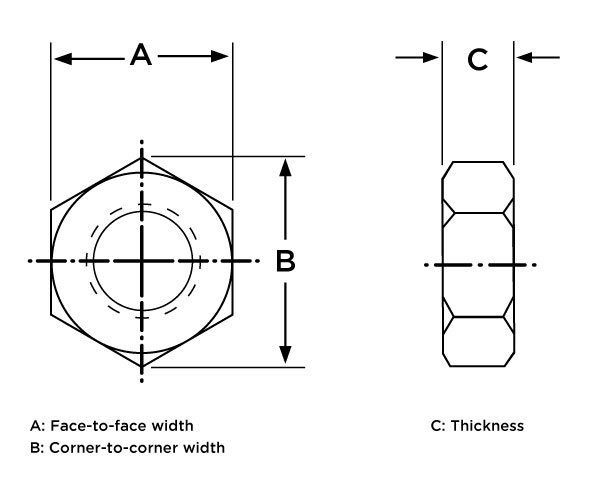
So, what are we even measuring when we talk about nut size? It’s not just one single number, right? Think of it like describing a person – you wouldn't just say "tall." You'd mention their height, maybe their build. Nuts are similar. We're usually interested in a couple of key things: the diameter of the hole (how wide it is inside) and the thread pitch (how far apart those little ridges are). These two things together determine what bolt that nut is going to happily embrace.
Must Read
Let's start with the easiest one: the diameter. For most common nuts, this is often referred to as the "nominal size." If you’ve seen nuts labeled "1/4 inch" or "M6," that's the nominal diameter. This is the size of the bolt the nut is designed to fit. Think of it as the nut’s job description. It’s meant to hold onto a bolt of this specific size. But here’s where it gets a little fuzzy sometimes. That "1/4 inch" isn't usually the exact measurement of the hole. It's more of a category, a general descriptor.
So, how do we get a more precise idea? Your best friend in this situation is a good old-fashioned ruler or, even better, a pair of calipers. If you have a ruler with fine markings (like 1/16th or 1/32nd of an inch), you can try to measure the inside diameter of the nut. Place the ruler inside the nut and see how many inches or millimeters it spans across the opening. Be as accurate as you can. It's a bit like trying to measure the width of a straw – you want to get it right in the middle.
Now, what if you don't have calipers or a super precise ruler? Don't sweat it! Often, you can get a good idea by just looking at the size of the bolt it fits. If you have a bolt that screws smoothly into the nut, that bolt's diameter (often measured from the outside edges of the threads) is a pretty good indicator of the nut’s nominal size. It’s like finding a glove that fits a hand – you know they’re a matching pair.
The Inch vs. Metric Mystery
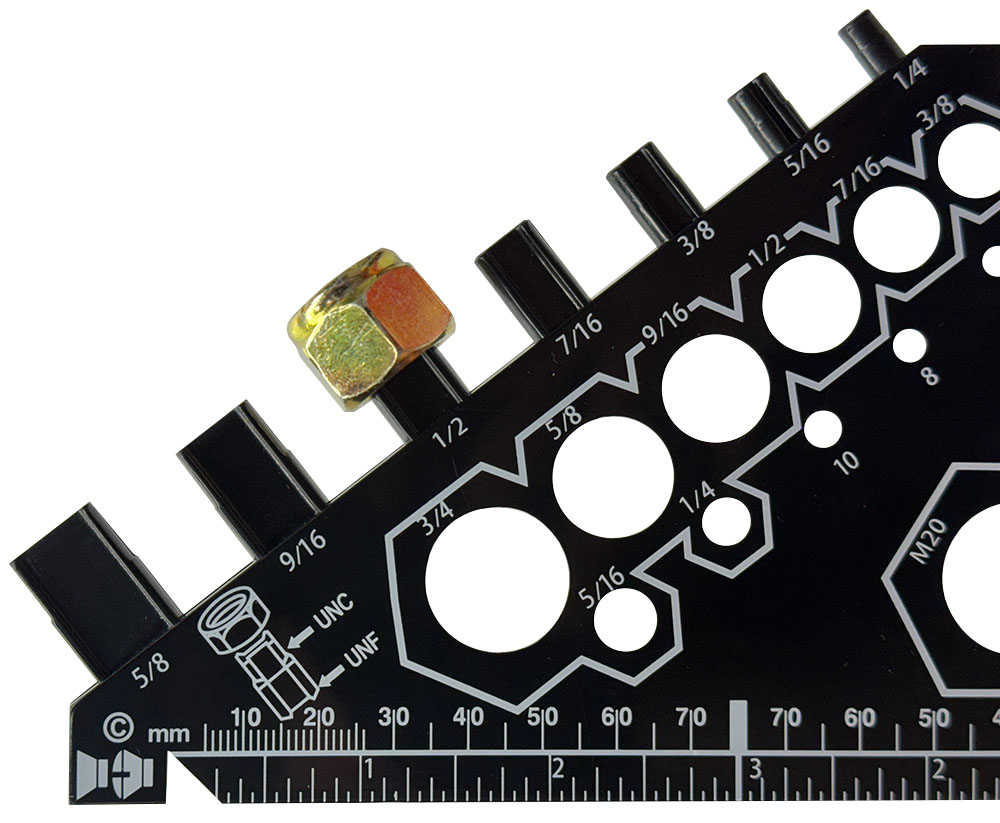
Here’s where things can get a little confusing: the whole inch versus metric thing. In some parts of the world, especially the US, measurements are often in inches. Think "1/2 inch nut." In other places, and for a lot of modern applications, it's all about millimeters. Think "M8 nut." So, when you're measuring, pay attention to whether your ruler is in inches or centimeters/millimeters. It’s like trying to read a map in two different languages – you need to know which one you're using!
If you measure your nut and get something like 12.7 mm across the inside, that's likely a 1/2 inch nut. If you measure it and get around 8 mm, it's probably an M8 nut. There are handy conversion charts online if you get stuck, but generally, if you're working with older items or in the US, think inches. If it’s newer stuff or you're in a metric-friendly zone, lean towards millimeters.
The Secret Language of Threads: Pitch
Now, let’s talk about the really cool part: the threads. These are those little ridges that make the nut and bolt grip each other. If you just measure the diameter, you might end up with a nut that fits diameter-wise but doesn't actually thread onto the bolt. That's where the thread pitch comes in. This tells you how many threads there are per inch (in the imperial system) or how far apart they are in millimeters (in the metric system).

For imperial threads (inches), you’re looking for "threads per inch" or TPI. This is where a specialized tool called a thread gauge is super handy. It looks like a little comb with different sets of teeth. You hold it up to the threads of your bolt or nut and see which set of teeth matches perfectly. The number on that set of teeth is your TPI. So, a "1/4-20" nut or bolt means it's 1/4 inch in diameter and has 20 threads per inch. That "20" is the pitch.
If you don't have a thread gauge, you can get a rough idea by using your ruler. Lay the ruler alongside the threads and count how many complete threads fit within one inch. It’s not perfectly accurate, but it can give you a ballpark figure. This is where things start to feel a bit like detective work, piecing together clues!
For metric threads, it's usually simpler. Instead of counting threads per inch, you measure the distance between the crests of two adjacent threads. This is usually expressed in millimeters. So, an "M8 x 1.25" nut or bolt means it's an M8 (8mm nominal diameter) with a thread pitch of 1.25mm. That "1.25" is the distance between the threads.

Again, a thread gauge is the best tool for this. You can also use a ruler, but it’s trickier to be precise. You'd be measuring the tiny gap between the ridges. It's a bit like trying to measure the width of a whisper – very delicate work!
The "Nut and Bolt" Matchmaking Service
So, why is all this important? Because the wrong size nut is like trying to wear shoes that are too big or too small – it just doesn't work! You need the right diameter and the right pitch for the nut and bolt to mate properly. It's a bit like a puzzle where you need both the picture on the box and the shape of the piece to fit.
Think about it: if you try to put a nut with too fine a thread on a bolt with coarse threads, it might seem like it’s starting to screw on, but it won't engage properly. It’ll feel loose or just won’t go in more than a turn or two. Conversely, a nut with a coarse thread on a fine-threaded bolt will probably just spin freely, making no connection at all. It's a total mismatch!
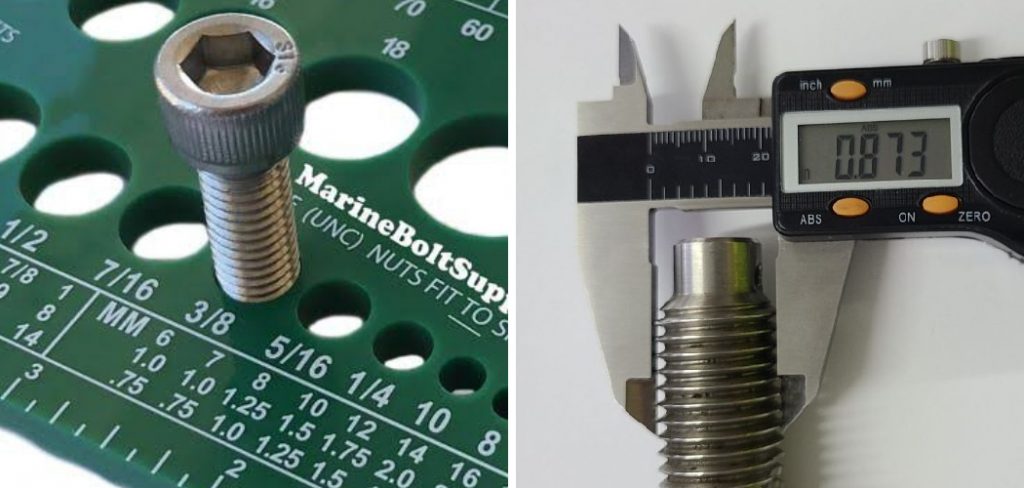
Sometimes, you’ll encounter "coarse" and "fine" threads within the same system. For example, in the imperial system, common bolts come in UNC (Unified National Coarse) and UNF (Unified National Fine) threads. So, you could have a 1/4-20 (coarse) and a 1/4-28 (fine). They both have a 1/4 inch diameter, but their thread pitches are totally different. This is why measuring the pitch is just as crucial as measuring the diameter.
It's not just about DIY projects, either. Understanding nut and bolt sizing is fundamental in so many fields. From automotive repairs to building a bookshelf, even assembling that flat-pack furniture, knowing your hardware is a superpower. It saves you frustration, trips to the hardware store, and those embarrassing moments where you realize you’ve brought the wrong fastener.
So, the next time you’re faced with a mysterious nut or bolt, don't be intimidated. Grab a ruler, maybe a caliper if you’re feeling fancy, and a bit of patience. You've got this! It's a small skill, but it’s one that will serve you well, turning those little metal circles from enigmas into easily identifiable components. Happy measuring, and may your projects always find their perfect fit!

