How Do I Work Out Square Metres

Ever found yourself staring at a paint can, wondering if you've got enough to cover that one wall, or trying to figure out if that new sofa will actually fit in your living room? We’ve all been there! It’s those little moments of spatial confusion that can turn a fun DIY project into a bit of a head-scratcher. But fear not, my friends, because today we’re going to demystify something super useful: square metres.
Now, the very words "square metres" might sound a little bit like something from a fancy engineering textbook, right? But honestly, it’s just a way of measuring space. Think of it like this: it’s the size of a room, a garden, or even a whole house, all neatly wrapped up in a single number. And why should you care? Because understanding square metres can save you time, money, and a whole lot of unnecessary stress. Plus, it’s actually pretty simple once you get the hang of it!
The Mighty Square Metre: What's the Big Deal?
Imagine you're planning a picnic. You wouldn't just grab a handful of sandwiches and hope for the best, would you? You'd probably think about how many people are coming and make sure you have enough food. Square metres are kind of like that, but for physical space. When you’re buying flooring, carpeting, or even deciding how much furniture you can cram into a space (without making it feel like a sardine can!), knowing the square metres is your secret weapon.
Must Read
Let’s say you’re eyeing up a gorgeous new rug. The description might say it's 2 metres by 3 metres. That’s 6 square metres of cozy goodness for your feet! Or maybe you're looking at a tiny studio apartment. The listing might mention it's 30 square metres. That’s the total living area all in one handy number. It helps you paint a picture in your mind before you even step foot inside.
Unlocking the Magic: How to Actually Work Them Out
Okay, so how do we get to these magical square metre numbers? It’s easier than you think. The most common shapes we deal with in our homes are rectangles and squares. And guess what? They’re the easiest to measure!
Here’s the golden rule, the one you’ll want to tattoo on the back of your hand (okay, maybe just write it down somewhere safe): For a rectangle or square, you multiply the length by the width. That’s it. Seriously!

Let’s get practical. Grab a tape measure – that trusty tool that’s probably hiding in your kitchen drawer. Imagine you want to measure your living room floor. Stand at one end and measure the length of the room. Let’s say it’s 5 metres. Then, walk to the side and measure the width. Maybe that’s 4 metres.
So, your calculation looks like this: Length x Width = Square Metres. In our living room example, that's 5 metres x 4 metres = 20 square metres. Ta-da! You’ve just calculated the area of your living room. That 20 square metres is the space you have to play with for furniture, rugs, and whatever else you fancy.
When Shapes Get a Bit Fiddly
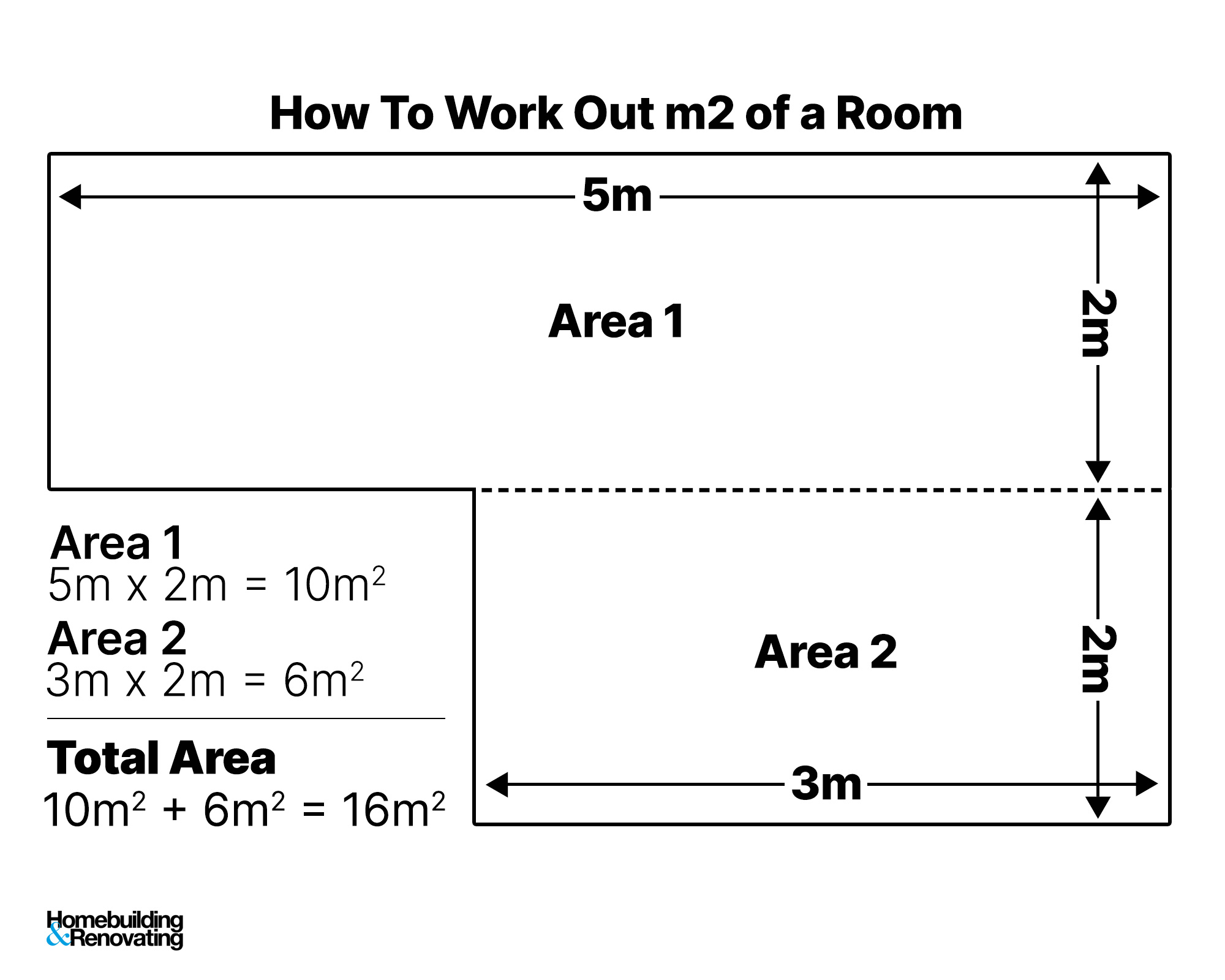
Life isn’t always perfectly rectangular, is it? Sometimes, rooms have nooks, crannies, or even awkward L-shapes. Don’t panic! You can still tackle these. The trick is to break down those complex shapes into simpler ones – think of it like building with LEGO bricks.

Let's say you have an L-shaped room. You can mentally (or with a pencil and paper!) divide that ‘L’ into two separate rectangles. Measure the length and width of each of those smaller rectangles, calculate the square metres for each one individually, and then add them together. Voilà! You’ve got the total area of your quirky L-shaped space.
Picture this: You’re trying to carpet a room that has a bay window. The main part of the room is a perfect rectangle, but that bay window area juts out. You'd measure the main rectangular part, get its square metres, then measure the area of the bay window (which might also be a rectangle or a series of smaller rectangles), get its square metres, and then add those two numbers up. Simple, right?
Real-Life Scenarios Where Square Metres Shine
Why is this so handy? Let’s look at some everyday situations.
1. Painting Projects: You’re ready to refresh your bedroom with a splash of colour. You know the dimensions of your walls (remember, you measure walls the same way – width x height). Calculate the area of each wall in square metres. Now, look at the paint can. It will tell you how many square metres it can cover. This way, you won’t buy a tiny can for a huge room and end up with a sad, half-painted wall, or worse, buy way too much and have paint festering in the cupboard for years.

2. Flooring and Carpeting: This is a big one! When you’re buying tiles for your kitchen or carpet for your lounge, you need to know the square metres. Most suppliers sell by the square metre. Buying too little means an incomplete job and extra trips to the store. Buying too much means wasted money and possibly having to store leftover materials.
Imagine you find the perfect tiles for your bathroom. The room is 3 metres by 2 metres, so that's 6 square metres. But you’ll probably want to buy a little bit extra (say, 10% more) to account for cuts and mistakes. So, you’d aim to buy around 6.6 square metres of tiles. Most places sell in full boxes, so you’d then figure out how many boxes that equates to.
3. Furniture Shopping: You’ve spotted that dream sofa online. It looks perfect! But will it actually fit? Before you click "add to cart," whip out your tape measure and sketch out your room. Mark where the sofa would go. Knowing the dimensions of the sofa and the available space in square metres (and also its specific length and width, of course!) helps you visualize the fit and avoid that awkward moment when the delivery team arrives and the sofa is just…too…big.

4. Garden Projects: Planning a new patio or a vegetable patch? Measuring your garden space in square metres helps you figure out how much paving you need, how much soil to buy, or even how many plants you can fit. It’s your garden blueprint!
A Little Story to Seal the Deal
My neighbour, Brenda, decided to surprise her husband with a new, bigger shed. She’d seen a fantastic one at the garden centre, but the dimensions were listed in metres. She’d never really bothered with square metres before and just thought, "It looks big enough!" She bought it, got it delivered, and then… disaster. When they tried to assemble it on the exact spot she had in mind, it was a centimetre too wide to fit between the fence and the existing patio. She’d completely forgotten to measure the available space properly. If she’d just taken a quick measurement of the width and depth of the spot and worked out the square metres, she would have seen it was too tight before she spent a penny. A simple calculation saved a lot of frustration (and a very heavy shed being moved around!).
Don’t Be Shy, Just Measure!
So, there you have it. Working out square metres is simply about multiplying length by width for basic shapes. For more complex shapes, break them down into smaller, manageable rectangles and add them up. It’s a skill that takes seconds to learn but can save you a world of trouble.
Next time you’re looking at a room, a piece of furniture, or a home improvement project, don’t just guess. Grab that tape measure. A few minutes of measuring can lead to much smarter decisions, more successful projects, and a home that feels just right. It’s a little bit of knowledge that makes a big difference!