When Does A Pond Become A Lake
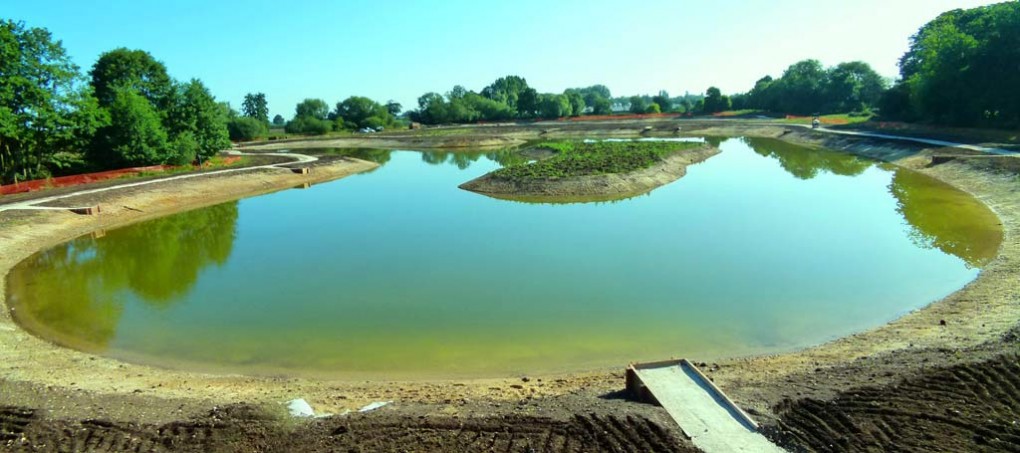
You know, I remember this one summer, probably about ten years ago now. My uncle, bless his green thumb, decided he was going to build a pond in his backyard. It was a grand vision – a little slice of aquatic serenity. He dug and he dug, lining it with this thick, black plastic that looked more like a giant swimming cap for a sea monster than a natural water feature. He filled it up, and it was… well, it was definitely a pond. Like, a proper pond. You could see the bottom, all the little pebbles, and a brave, slightly bewildered-looking goldfish he’d named Bartholomew.
Bartholomew, bless his little orange heart, seemed perfectly content. And so was my uncle, for a while. But then, the rains came. And they kept coming. And then the spring melt happened. And suddenly, Bartholomew’s little world wasn’t so little anymore. The plastic liner was stretched taut, the edges were starting to disappear, and it looked… different. Bigger. A lot bigger. My uncle started referring to it less as "the pond" and more as "that water feature." I think he even started eyeing up a couple of rather substantial lily pads that had spontaneously appeared. It got me thinking: when exactly does a pond say "peace out" to being a pond and decide to up its game and become a lake?
It’s a question that’s probably crossed your mind too, right? Maybe you’ve got a little water hole in your garden that’s gotten a tad out of hand, or perhaps you’ve been on a road trip and marvelled at a vast expanse of blue. We toss around these terms so casually – pond, lake, sometimes even reservoir if we’re feeling particularly technical. But is there a hard and fast rule? A secret handshake? A specific cubic meter of water required?
Must Read
Spoiler alert: it’s not as simple as you might think. There isn't one single, universally agreed-upon definition. It’s more of a… gradient. A blurry line drawn in the sand. Or rather, in the water.
Let's start with the generally accepted idea of a pond. Think small. Think cozy. Think something you could probably throw a decent-sized rock across. Ponds are typically shallow enough that sunlight can reach the bottom, allowing aquatic plants to grow pretty much everywhere. This means they’re often teeming with life from top to bottom. You can usually see all the way to the substrate, whatever that might be – mud, gravel, or even just your uncle's slightly wonky liner.
The key characteristic here is that a pond’s water is usually well-mixed. There’s not much stratification, which is fancy talk for different layers of water with different temperatures. In a pond, the sun warms it up relatively evenly. It's a bit like a bathtub – a very large, natural bathtub.
And the size? Well, that’s where things get fuzzy. Some definitions say a pond is less than 1 acre (about 4,000 square meters). Others go up to 2.5 acres. It’s like trying to nail jelly to a wall, isn't it? Your uncle’s "water feature" was definitely pushing those boundaries by the end of that summer. Bartholomew was probably starting to feel like he lived in a rather spacious, albeit contained, ocean.

Now, a lake. Ah, a lake. This is where we’re talking about something more substantial. Think grand. Think majestic. Think something you might actually need a boat to cross. Lakes are generally much larger and deeper than ponds.
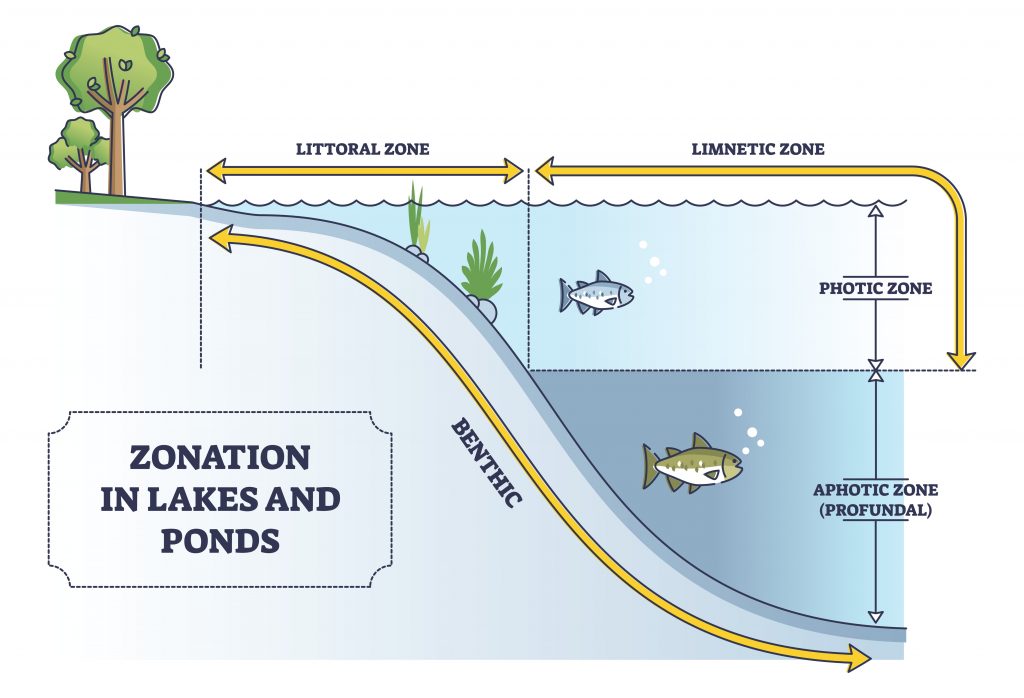
Because they’re deeper, sunlight often struggles to penetrate all the way to the bottom. This leads to stratification. You know, those different temperature layers I mentioned? In a lake, the top layer (the epilimnion) is warmer and receives sunlight. Below that is a transition zone (the thermocline), and then a colder, darker layer at the bottom (the hypolimnion). This stratification affects the types of organisms that can live at different depths.
So, if sunlight can't reach the bottom everywhere, you won't have plants growing across the entire lakebed. You'll see more open water, and plant life will be concentrated closer to the shores, in what’s called the littoral zone. It's a bit like comparing a shallow wading pool to the deep end of a public swimming pool.
The term "lake" also generally implies a significant volume of water. While there’s no official minimum volume, you’re talking about something that holds a lot more water than your average garden pond. Think of the Great Lakes, for instance. You’re not going to be seeing the bottom of those anytime soon, are you?

So, what’s the magic number? The point of no return for Bartholomew’s expanding universe? Well, as I said, it’s not crystal clear. But here are some common factors that hydrologists (those are the water scientists, for the record) and geographers consider:
Size: This is probably the most intuitive factor. If it’s bigger, it’s more likely to be a lake. But how much bigger? Some sources will point to acreage, with anything over 2.5 acres often being considered a lake. But again, it’s not a hard rule. A very long, narrow body of water might feel more like a river than a lake, even if it’s technically large in area.
Depth: This is a really important one. If the water is deep enough to prevent sunlight from reaching the bottom and to create those distinct temperature layers (stratification), it’s a strong indicator of a lake. A pond is generally considered to be uniformly mixed and sunlit.
Wave action: This might sound a bit quirky, but hear me out. Larger bodies of water, like lakes, are more susceptible to wind-driven waves. You’re not going to get significant wave action on a small, sheltered pond. Think of the gentle ripples on your uncle’s expanding pond versus the crashing waves you might see on Lake Michigan.

Origin: Sometimes, the way the water body was formed can also play a role. Glacial activity, tectonic shifts, or volcanic eruptions can create large depressions that fill with water, forming lakes. Ponds, on the other hand, can be more man-made, or formed by smaller natural processes like beaver dams or oxbow lakes (which are formed from a meander of a river). Though, to be fair, nature isn't always neat and tidy with its classifications. Some natural depressions can be quite small, and some man-made reservoirs can be enormous.
Vegetation: As we touched on, the extent of aquatic plant growth is a good clue. If plants are growing across the entire surface and down to the bottom, it's probably a pond. If there's a significant area of open water with vegetation only along the edges, it’s leaning towards lake territory.
It’s also worth noting that the distinction can be political or local. Sometimes, a body of water might be called a "lake" simply because it's the largest or most significant water feature in an area, regardless of whether it strictly meets all the scientific criteria. Imagine a small town with a particularly large pond; they might just call it "The Lake" out of convenience and local pride. "Hey, meet me down by the lake!" sounds a bit more impressive than "Meet me down by the pond, the one near the rusty swing set."
And what about the in-betweeners? The ones that are too big to be a pond but maybe not quite grand enough to be a full-blown lake? These are often referred to as reservoirs (if man-made for water storage), lagoons (often found near coastlines, sometimes brackish), or simply large ponds. It’s a whole spectrum of aquatic possibilities!

Think about it this way: a pond is like a goldfish bowl. A lake is like the ocean. And then there are all the aquariums, swimming pools, and even paddling pools in between. Your uncle's situation was a classic example of a pond evolving. He started with a clearly defined pond, but as it collected more water and potentially deepened naturally (or thanks to persistent rain), it started exhibiting lake-like characteristics. Bartholomew, the brave goldfish, likely found himself with a much more expansive kingdom than he'd initially signed up for.
It's also interesting to consider the dynamic nature of these water bodies. Ponds can fill in over time with sediment and vegetation, eventually becoming marshes or even dry land. Lakes can shrink due to drought or evaporation, or grow larger with increased rainfall. So, a body of water’s classification isn't always a permanent state.
So, the next time you’re pondering a body of water, take a closer look. Can you see the bottom? Is it a uniform temperature? Does it have waves? Is it big enough to warrant a boat rental? These questions will help you place it on the pond-to-lake continuum.
Ultimately, while scientists and geographers might have their preferred metrics, the everyday person's definition can be a bit more subjective. It’s about the feeling the water body evokes. Does it feel like a contained, intimate space, or a vast, impressive expanse? My uncle, I suspect, eventually accepted that his backyard had, through the sheer, undeniable power of water, become something a little more… lake-ish. Bartholomew, I’m sure, was thrilled about the extra swimming space.
It’s a fun little thought experiment, isn’t it? This idea that a simple puddle could, with enough time and the right conditions, graduate to a more impressive title. It’s a reminder of the constant, fascinating changes happening all around us, even in the most seemingly static elements of nature. So go forth, and classify those water bodies with newfound (and slightly fuzzy) authority!