Use The Power Property To Rewrite Log3x9.
Ever stared at a mathematical expression and felt a twinge of curiosity, a whisper of "there must be a simpler way"? Well, get ready to unlock a neat little trick that can make working with logarithms feel a whole lot less daunting. Today, we're going to dip our toes into the fascinating world of the Power Property of Logarithms, specifically when we encounter something like log₃(x⁹). It might sound a bit technical, but trust me, it's a concept that's both elegant and surprisingly useful.
So, why bother with this? Think of logarithms as the inverse of exponents. They help us figure out what power we need to raise a certain base to in order to get a specific number. The Power Property is like a secret handshake that lets us rearrange logarithmic expressions, making them easier to simplify or solve. Its main purpose is to bring down exponents from inside a logarithm and turn them into multipliers. This is incredibly beneficial because multiplication is generally much easier to handle than exponents tucked away inside a log. It’s like having a tool that neatly untangles a knot in your mathematical shoelace.
Where might you see this in action? In education, it's a fundamental building block for understanding more complex logarithmic equations and functions. Students learning algebra often encounter this property as they move beyond basic equations. Outside the classroom, while you might not be explicitly writing log₃(x⁹) in your grocery list, the underlying principle is at play in many areas that use logarithms. Think about fields like science (measuring earthquake magnitudes with the Richter scale, for example), finance (calculating compound interest), and even in the way computers process information. While the specific examples might be more intricate, the simplification power of properties like this is what makes these calculations manageable.
Must Read
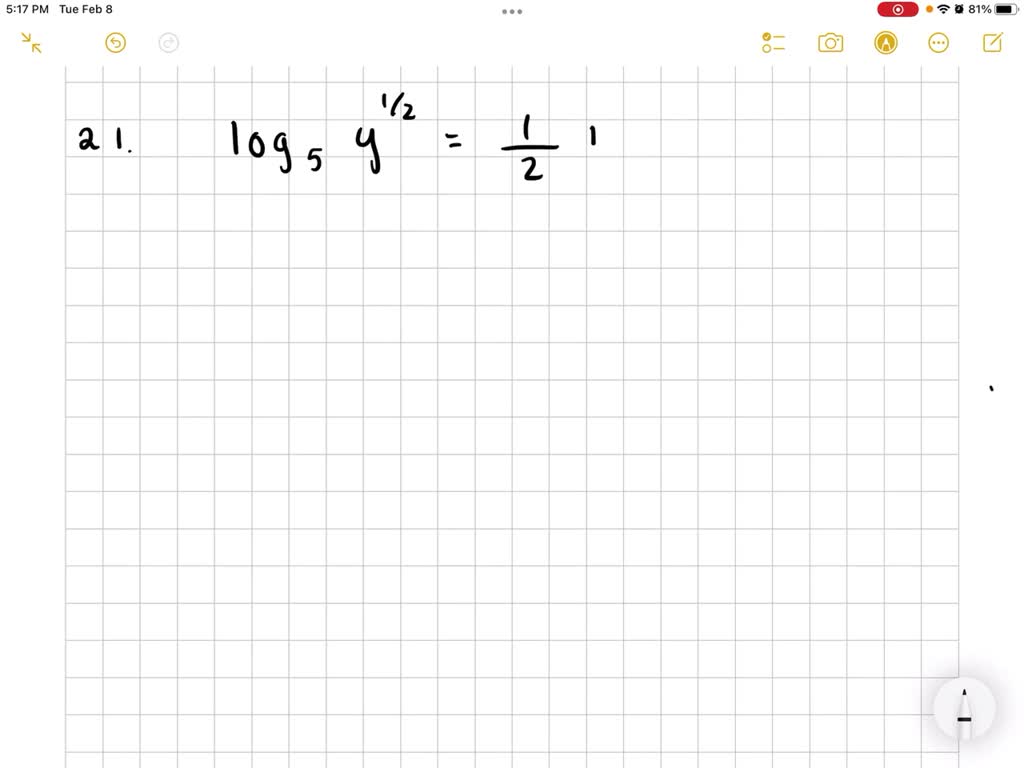
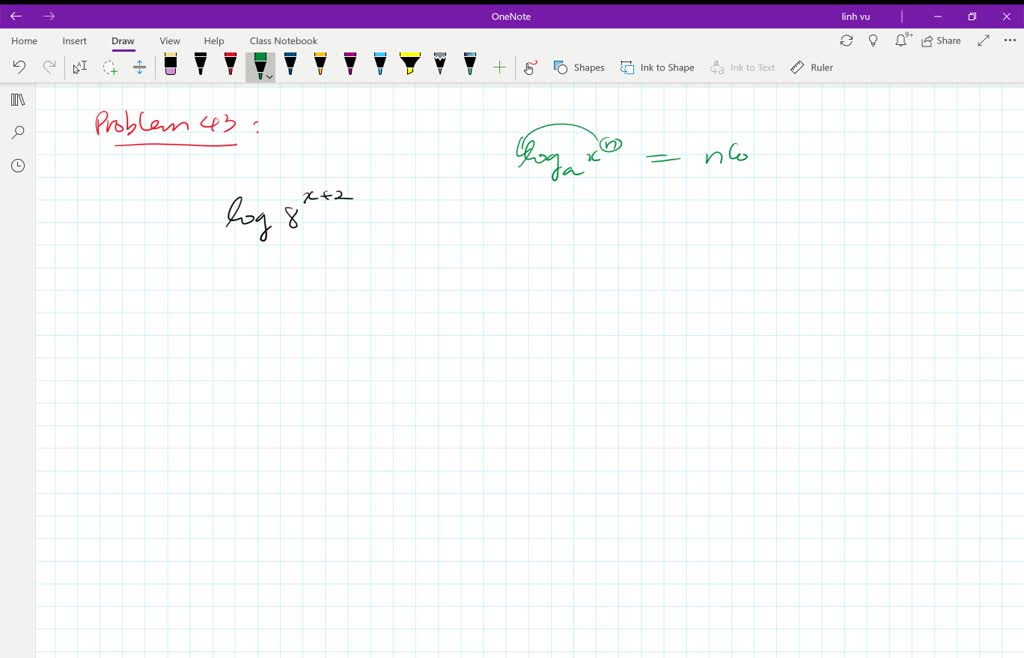
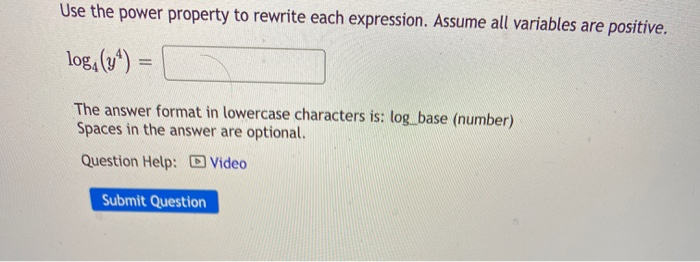
Let’s look at our example: log₃(x⁹). Using the Power Property, which states that logb(mp) = p * logb(m), we can rewrite this as 9 * log₃(x). See how much simpler that looks? The exponent 9 has been 'pulled down' to become a multiplier. This makes it easier to isolate variables or combine with other logarithmic terms. Imagine trying to solve for x in log₃(x⁹) = 18 versus solving 9 * log₃(x) = 18. The second one is clearly more approachable!
Ready to play around with it yourself? It's easier than you think! Start with simple numbers. Try rewriting log₂(8²). Using the property, it becomes 2 * log₂(8). Since 2 to the power of 3 is 8, log₂(8) is 3. So, you end up with 2 * 3 = 6. You can then check your answer: 8 squared is 64, and 2 to the power of 6 is also 64. It works! Another tip is to practice with different bases and exponents. Grab a notebook, jot down a few expressions like log₅(y³) or log₁₀(10x), and see if you can apply the Power Property to simplify them. You’ll quickly get a feel for how powerful and handy this little rule really is!
![[ANSWERED] Use the power property to rewrite each expression Assume all](https://media.kunduz.com/media/sug-question-candidate/20230502034116479789-5333730.jpg?h=512)


![[ANSWERED] Use the given property of multiplication to rewrite each](https://media.kunduz.com/media/sug-question-candidate/20230413223621359503-3694319.jpg?h=512)