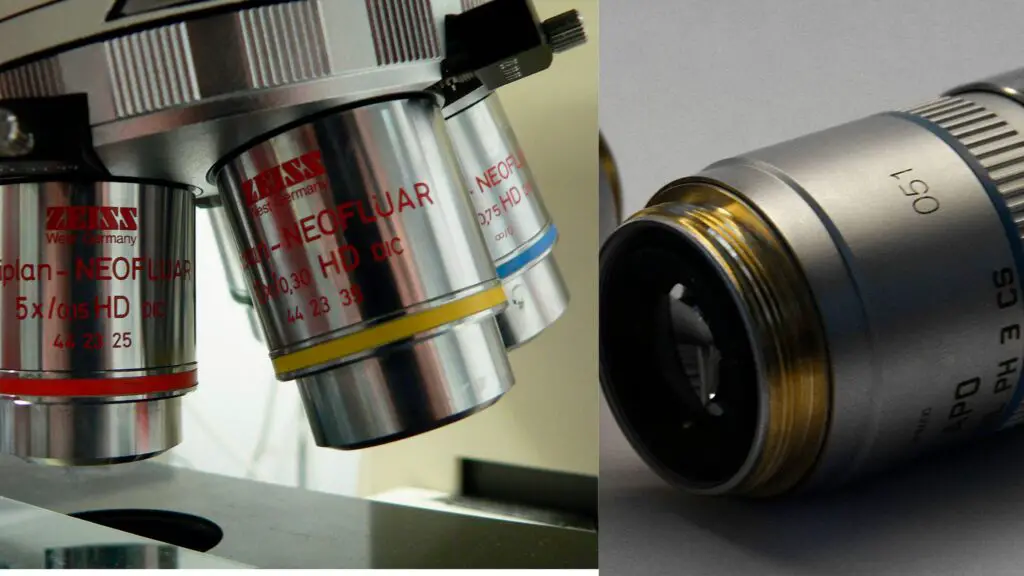
Objective Lenses Names

Ever looked through a microscope and been absolutely blown away by the tiny world it reveals? That magic happens thanks to a few key players, and today, we're going to chat about some of the unsung heroes: the objective lenses. They're like the eyes of the microscope, and their names are surprisingly fun and full of personality!
Think of them as tiny, powerful wizards. Each one has a special job, and their names give you a little peek into what they do. It's not just random letters and numbers; it's a secret code for adventure!
The Humble Beginnings: Achromats and Apochromats
Let's start with the workhorses, the ones you'll see most often. You've got your Achromats. They sound a bit fancy, don't they? But really, they're the reliable friends of the microscope world.
Must Read
Achromats are excellent at correcting for two primary colors of light. This means they do a great job of showing you a clear, crisp image without those annoying rainbow edges. They're the everyday heroes, getting the job done with a smile.
Then, things get even more exciting with Apochromats. If an Achromat is good, an Apochromat is like its super-powered, deluxe sibling. They go the extra mile!
These brilliant lenses correct for not just two, but three colors of light. This correction is way more advanced, resulting in images that are incredibly sharp and have virtually no color fringing. They're the ones that really make colors pop and details sing.
Imagine looking at a butterfly wing under an Apochromat. You'd see every iridescent scale, every delicate vein, with colors so true, it would feel like you could reach out and touch it. That's the magic of an Apochromat.
The Special Powers: Plan Achromats and Plan Apochromats
Now, let's talk about flat images. Sometimes, even with great lenses, the edges of your view can be a little blurry. That's where the Plan lenses come to the rescue!

A Plan Achromat takes that reliable Achromat and gives it an upgrade for flatness. It means the entire field of view, from the very center to the furthest edge, is in sharp focus. No more focusing on the middle and then realizing the sides are all fuzzy!
It’s like having a perfectly flat canvas. Everything you see is clear and detailed, no matter where it is in your picture. This is a huge deal when you're trying to capture an entire cell or a whole section of tissue.
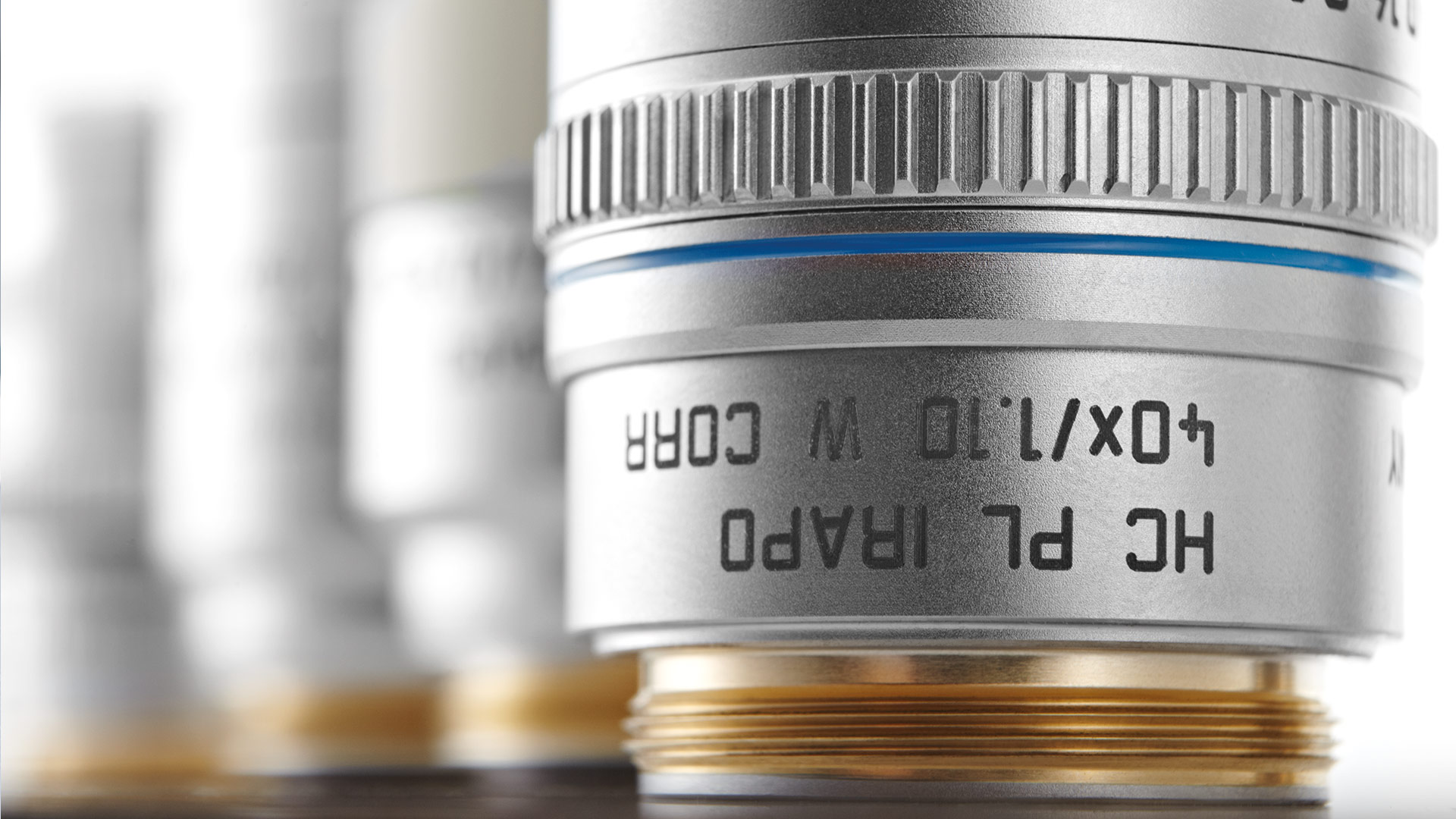
And for the ultimate in flatness and color correction, we have the legendary Plan Apochromat. This is the pinnacle of objective lens performance for many applications. It combines the superior color correction of an Apochromat with the edge-to-edge sharpness of a Plan lens.
Looking through a Plan Apochromat is a truly breathtaking experience. The image is not only incredibly sharp and vibrant, but it’s also perfectly flat. It’s like looking through a window into another world where everything is in perfect focus.
These lenses are the MVPs for anyone who needs the absolute best. They bring out details you never thought possible, making your observations truly spectacular.
Beyond the Basics: Fluors, DIC, and More!
But the fun doesn't stop there! The world of objective lenses is a playground of specialized tools. Have you ever heard of a Fluorite lens?

Fluorite lenses are similar to Apochromats, but they use a special type of glass called fluorite. This special ingredient helps to further reduce chromatic aberration, giving you even better color accuracy and image clarity. They're like the rare, sparkling gems of the microscope world.
Then there are lenses designed for specific imaging techniques. For example, you might encounter a DIC objective. DIC stands for Differential Interference Contrast.
These lenses are fantastic for observing unstained, transparent specimens. They create a sort of 3D effect, making subtle details pop out in a way that's almost sculptural. It's like your sample suddenly has contours and shadows you never noticed before.
Imagine looking at living cells with DIC. You can see their internal structures and movements with incredible clarity, without having to stain them and kill them. It’s a window into the living, breathing world of biology.
There are also specialized objectives for fluorescence microscopy, like Nikon's Super Fluor or Olympus's Super Plan Fluor. These names hint at their extra capabilities. They are designed to capture faint fluorescent signals beautifully.
These lenses are engineered to be incredibly efficient at transmitting light, especially in the wavelengths used for fluorescence. This means you can see those glowing little molecules with amazing brightness and detail. They are essential for anyone doing advanced biological research.
The Magnification Mystery: 4x, 10x, 40x, 100x
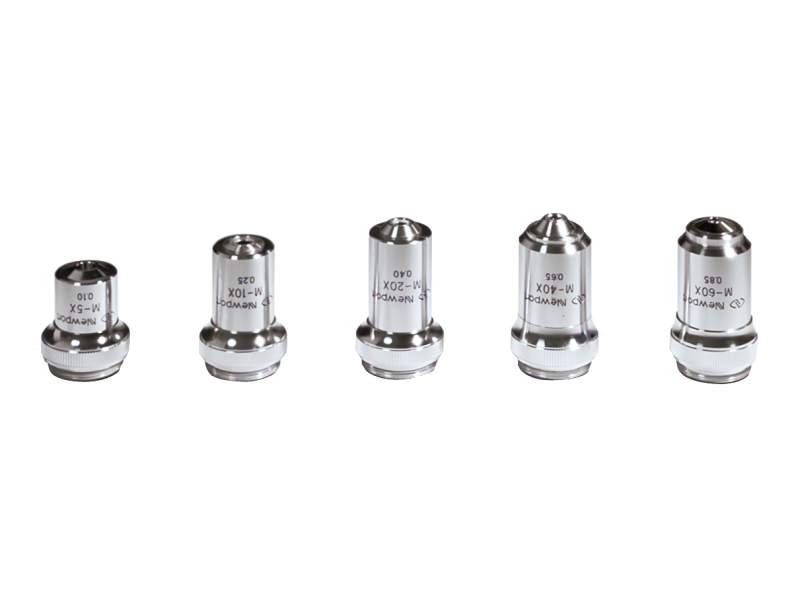
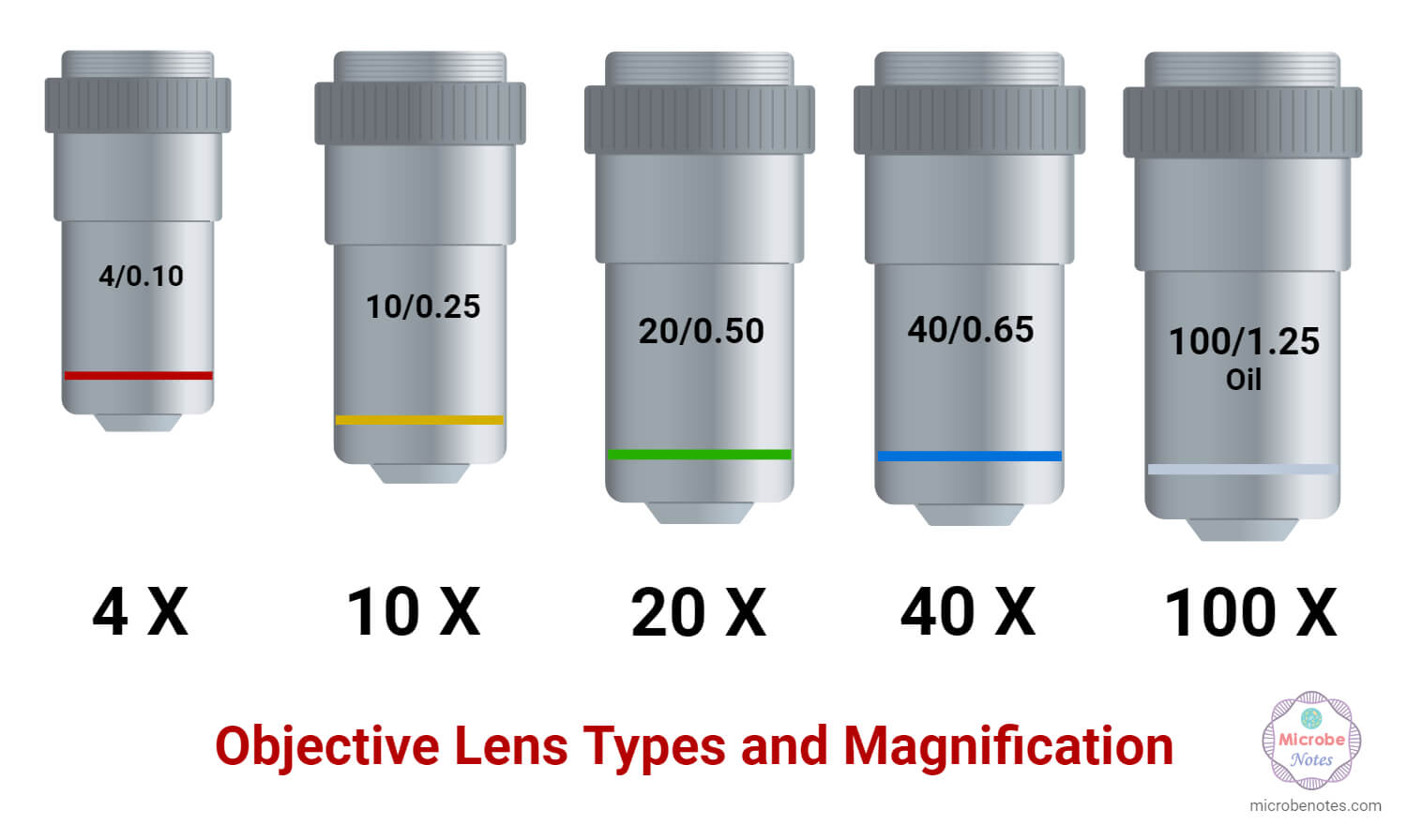
Of course, no chat about objective lenses would be complete without mentioning their magnification power. You'll see numbers like 4x, 10x, 40x, and a whopping 100x.
The 4x objective is your "scanning" lens. It gives you a wide overview, like looking at a map of a new territory. It's great for finding what you're interested in.
The 10x is your "low power" objective. It offers a good balance between field of view and detail, perfect for exploring larger structures. It’s the explorer’s best friend.
Then comes the 40x, your "high power" objective. This is where things get really interesting! You start to see much finer details, like individual cells or parts of cells.
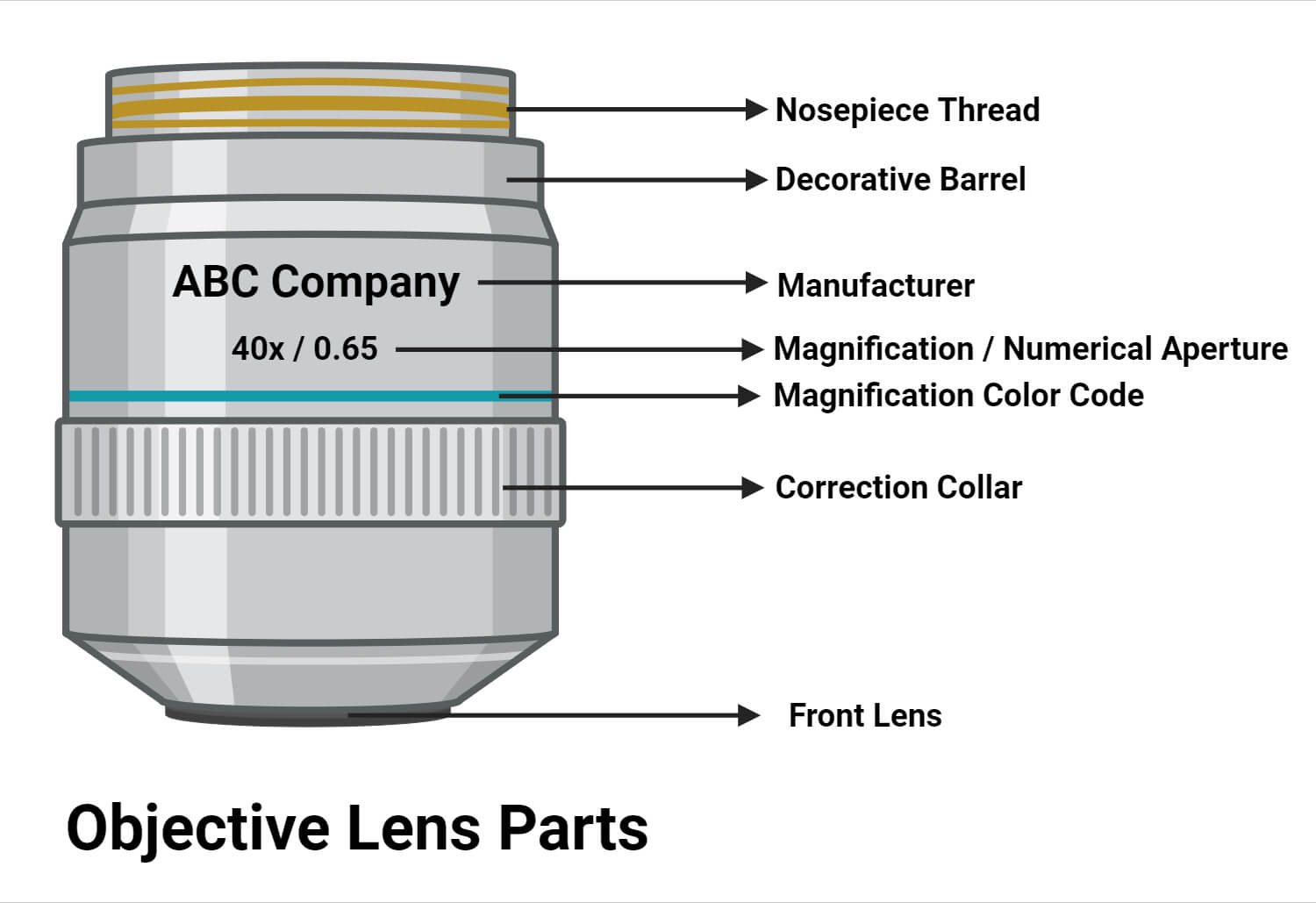
And the grand finale: the 100x objective! This is usually a 100x oil immersion lens. You need a drop of special oil to make it work.
The oil fills the gap between the lens and the slide, allowing much more light to enter the lens. This is how you achieve incredible magnification and see the tiniest of structures with astounding clarity. It’s like unlocking a secret level of detail.
Using a 100x oil immersion objective is an experience in itself. It demands a steady hand and careful technique, but the rewards are immense. You're peering into a universe of microscopic wonders.
The Names are the Clues!
So, next time you look at a microscope, don't just see a tube with lenses. See a collection of specialized tools, each with a name that tells a story. An Achromat is a solid performer. A Plan Apochromat is the rockstar.
The names are your clues to the incredible capabilities within. They are the gatekeepers to a world of astonishing detail and breathtaking beauty. It's a language of precision and wonder.
Understanding these names can make your microscopy journey even more exciting. It’s like having a decoder ring for the microscopic universe. You can appreciate the ingenuity and the effort that goes into making these amazing tools.
So, if you ever get the chance to peek through a microscope, take a moment to notice the objective lenses. Their names are more than just labels; they are invitations to explore and discover. Happy observing, and may your images be ever sharp and your colors ever true!