In A Station Of The Metro Poem

So, picture this. You’re crammed into a metro carriage. It’s rush hour, naturally. The air is thick with the scent of… well, let’s not dwell on that. Your shoulder is practically glued to a stranger’s armpit, and you’re pretty sure you just made eye contact with someone’s earlobe. It’s the kind of moment that makes you question all your life choices, right? Like, “Did I really need that extra biscuit this morning? Because now I’m stuck here, a human sardine, contemplating the existential dread of public transportation.”
And then, just when you’re about to descend into a vortex of commuter misery, BAM! Something catches your eye. Something… beautiful. Something that makes the whole ordeal, just for a fleeting second, feel less like a punishment and more like a bizarre, accidental art installation. That, my friends, is the magic that Ezra Pound, a poet who probably had his own interesting experiences on public transit (or maybe just saw a really cool leaf), bottled up in his famously minuscule poem, "In a Station of the Metro."
This poem is shorter than a commercial break. It’s practically a haiku that took a wrong turn at Albuquerque. It goes like this:
Must Read
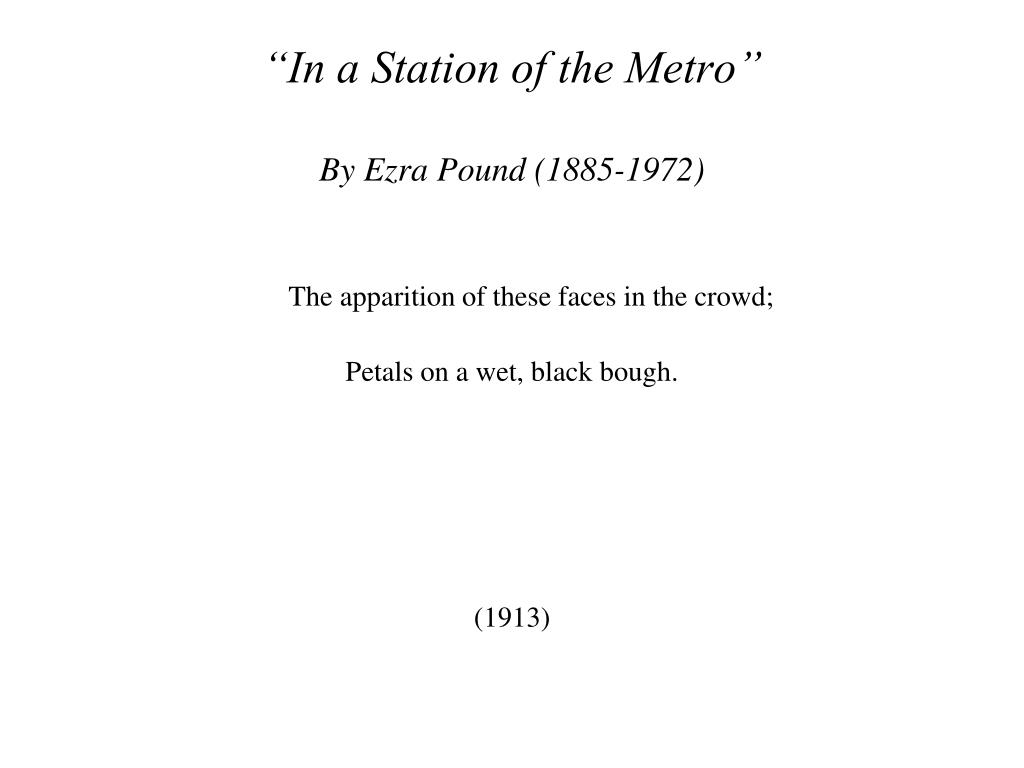
The apparition of these faces in the crowd;
Petals on a wet, black bough.
That’s it. That’s the whole darn thing. My grandma once wrote me a postcard with more words. Seriously, if you blink, you’ll miss it. It's so short, it’s like the poet said, "Okay, time's up, gotta catch my train. Here's the gist."
But oh, the gist! Ezra Pound, this literary heavyweight (he was quite the character, apparently a bit of a drama queen and a big fan of Mussolini, which, let's just say, is a whole other can of worms for another time). Anyway, this guy, he’s staring at a bunch of people in a metro station, probably looking as thrilled as a damp dishrag. And instead of moaning about the general unpleasantness, he has a moment of pure, unadulterated poetic epiphany. He sees the faces. The sea of faces, all looking a bit washed out, a bit weary, perhaps a bit… well, like they’ve seen too many Tuesdays. And suddenly, he doesn’t see just people. He sees something else entirely.

He sees "Petals on a wet, black bough."
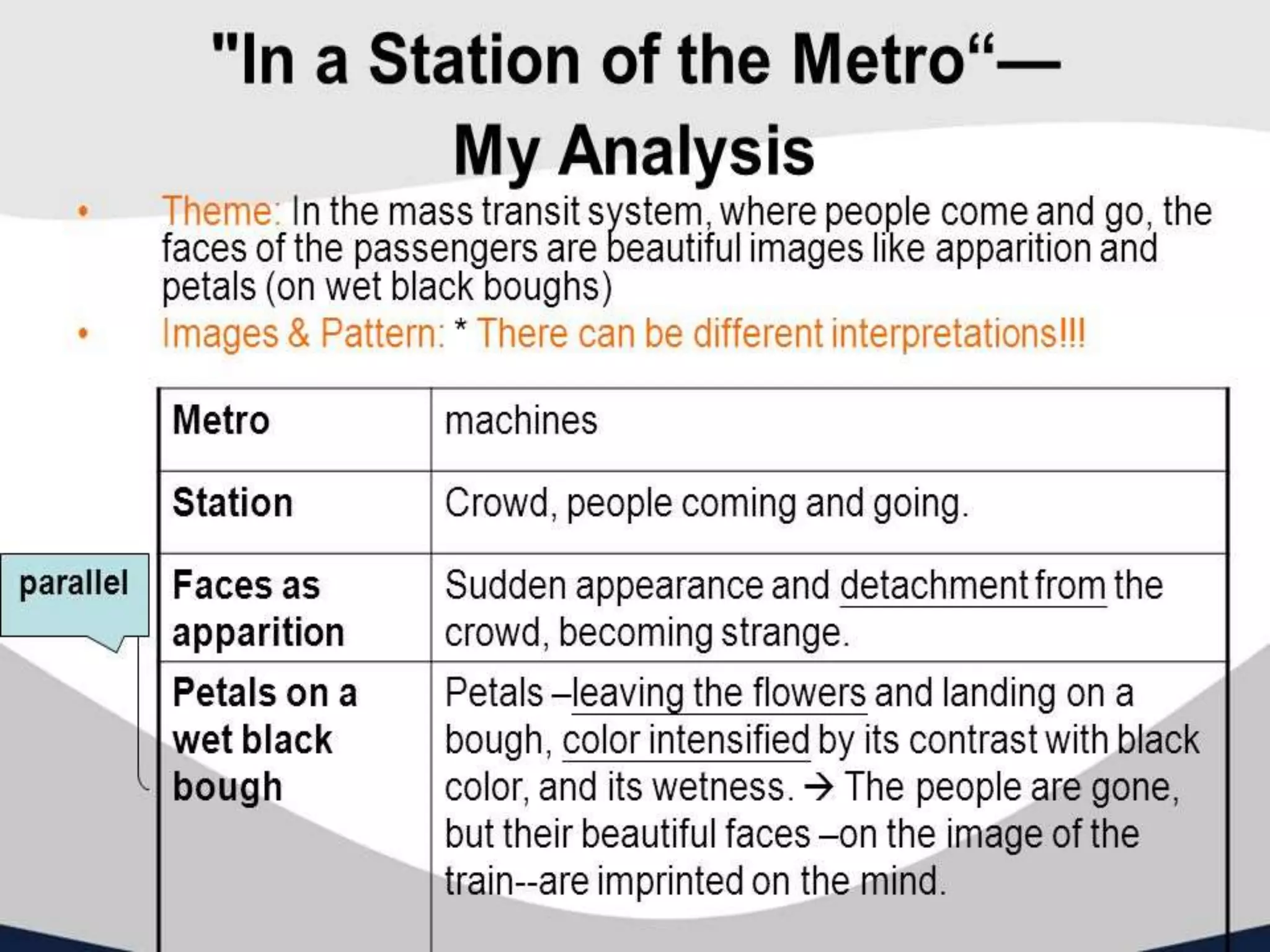
Now, let’s unpack this. Because this isn’t just some random observation. This is where Pound, with the precision of a brain surgeon and the flair of a stage magician, transforms the mundane. He’s taking the gritty, grimy reality of a subway station and finding the delicate, fleeting beauty within it.
Think about it. What are "petals"? They’re soft, they’re often brightly colored (though maybe not in a gloomy metro station, we’ll get to that), they’re delicate, and they usually appear in nature, a place we associate with peace and loveliness. What are they on? A "wet, black bough." A bough is a branch. "Black" sounds dark, maybe even a little foreboding. And "wet"? That could mean rain, or dew, or… let’s just say, the general dampness of a subway tunnel. So, he’s comparing these ephemeral human faces to delicate flower petals clinging to a dark, possibly dripping branch.

It’s a brilliant juxtaposition, isn’t it? He’s taking the organic, the natural, the beautiful (petals) and placing it against something that sounds a little more… industrial and a touch depressing (wet, black bough). But instead of making the petals look sad, it makes the bough seem almost softened by their presence. It’s like a tiny, unexpected act of defiance against the drabness.
And that word, "apparition". Ooh, fancy! It doesn't just mean "appearance." It suggests something ghostly, something that materializes suddenly, almost miraculously. Like you’re not expecting to see these faces, and then suddenly, there they are, shimmering into existence amidst the throng. They’re not just people; they're ethereal beings, momentarily illuminated by some unseen force. Maybe it’s the flickering fluorescent lights, or maybe it’s just the sheer, overwhelming number of them that makes them seem otherworldly.
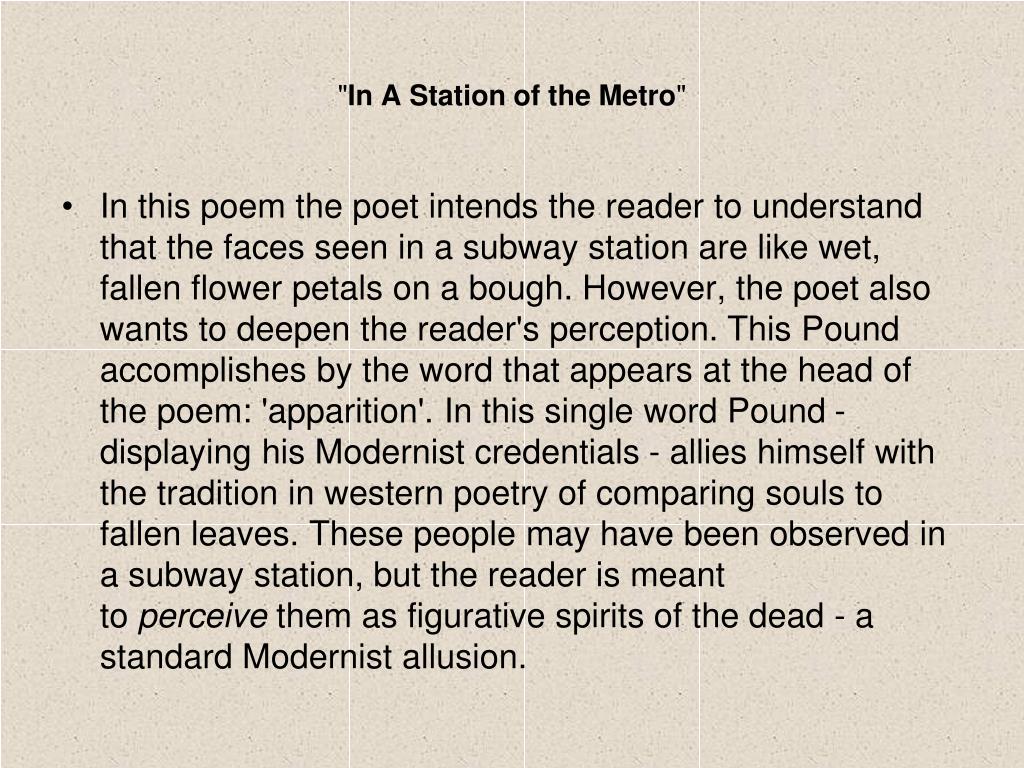
So, what’s the takeaway from this minuscule masterpiece? Well, it’s a reminder that beauty can be found anywhere, even in the most unlikely of places. It’s about heightened perception. It’s about training your brain to look beyond the obvious. That guy with the questionable tie? He might have the spectral grace of a fallen petal. That woman engrossed in her phone? Her concentration might be as delicate as a blossom. It’s all about how you choose to see it.
Pound, bless his short-poem-loving heart, was a big proponent of Imagism, a poetic movement that believed in using precise, clear language and presenting the image directly. No flowery nonsense, just the pure, unadulterated visual. And this poem is the poster child for that. It’s a snapshot. A mental photograph taken in a fraction of a second.
It’s also incredibly efficient. Think about how many words it would take to describe a crowded metro station in detail. Pages and pages! You’d get bogged down in the descriptions of uncomfortable shoes, the faint smell of stale coffee, the muffled announcements that sound like they’re coming from the bottom of a well. But Pound cuts through all that with just two lines. It’s like he’s got a poetic laser beam.
And here’s a fun fact: Pound apparently wrote this poem after seeing an exhibition of Japanese prints. The Japanese are masters of capturing essence and emotion in a few strokes. So, he was probably inspired by their ability to convey so much with so little. He essentially said, "Okay, how can I do that with words in my own Western context?" And voila! Petals on a wet, black bough.
It’s a poem that invites you to participate. It’s not telling you what to feel; it’s giving you an image and letting your mind do the heavy lifting. You’re the one who connects the dots between the faces and the petals. You’re the one who imagines the dampness, the darkness, and the unexpected burst of delicate beauty. It’s like a literary Rorschach test, but way more civilized and less likely to end with a therapist asking you about your mother.
So, the next time you’re crammed into a metro, feeling like you’re slowly being assimilated by the collective commuter consciousness, take a moment. Look around. You might not see direct petals on a bough (unless, of course, someone’s carrying a rather unusual floral arrangement, which, let’s be honest, wouldn’t surprise me in the slightest). But you might see something else. A fleeting expression, a moment of quiet contemplation, a shared glance that speaks volumes. And in that moment, you, too, can be Ezra Pound, discovering the unexpected poetry in the everyday grind. Just try not to poke anyone in the eye while you’re doing it. That’s probably not very poetic.