How To Use A Gif On Powerpoint
So, you're sitting there, staring at your PowerPoint presentation. It's looking a little…dry, right? Like a plain cracker when you really want a loaded nachos situation. Well, guess what? We’re about to sprinkle some serious cheesy goodness onto that cracker. Yep, we're talking about Gifs. Those little animated wonders that add personality, humor, and a whole lot of "OMG, did they just do that?!" to your slides. Honestly, who can resist a well-placed cat doing a little dance? Nobody, that's who.
Think of your presentation. Is it screaming for a bit of life? Is it begging for that extra spark of oomph? If you answered yes, or even a hesitant "maybe," then this little chat is for you. We're diving headfirst into the magical world of using Gifs in PowerPoint. It’s easier than you think, I promise. Like, seriously easier than trying to assemble IKEA furniture without the instructions. (Don't even get me started on that ordeal.)
First things first, what even is a Gif? If you're already nodding along, great! If you're like, "Huh? Is that a type of coffee?", then bless your heart, we'll get you up to speed. A Gif, short for Graphics Interchange Format, is basically a bunch of still images strung together to create a short, looping animation. It's like a tiny, silent movie that plays on repeat. Think of your favorite reaction Gifs online – the ones that perfectly capture that feeling of "I can't even!" or "Nailed it!". Those are Gifs, and they're about to become your new best presentation friends.
Must Read
Now, why would you even want to put a Gif in your PowerPoint? Besides the sheer joy and amusement they bring, Gifs can be incredibly effective. They can:
- Grab attention: Let's be real, a moving image is way more likely to catch someone's eye than a static slide.
- Explain complex ideas: Sometimes, a quick animation can illustrate a process or a concept better than words or even a diagram. Think about showing a workflow or a quick change.
- Inject humor: This is the big one, right? A funny Gif can break the ice, lighten the mood, and make your audience actually want to pay attention. Who doesn't love a good laugh?
- Evoke emotion: A well-chosen Gif can elicit a specific feeling – excitement, surprise, even a touch of nostalgia.
- Make it memorable: People remember things that are engaging. A funny Gif can stick with them long after your presentation is over.
So, the burning question: how do we actually do this? It’s not like you can just drag and drop them like a regular picture. Well, yes and no. The process has gotten a lot simpler over the years, which is fantastic news for us! We don't have to be tech wizards to make our slides sing. PowerPoints of yesteryear were a bit more…stubborn. But today? They're practically begging for some animated flair.
Finding Your Perfect Gif: The Treasure Hunt Begins!
Before you can sprinkle your Gifs, you need to find them. And where do we find these magical moving pictures? The internet, of course! There are a ton of resources out there, so let's explore a few of the most popular and easiest ones.
Giphy: This is probably the king of Gif-ville. Giphy.com is a massive library of Gifs, and it’s ridiculously easy to search. Just pop in what you're looking for – "happy dance," "mind blown," "confused cat," "success kid" – and prepare to be overwhelmed with awesome choices. It's like a digital candy store for your presentation.
Tenor: Another fantastic option, Tenor is also super popular and integrated into a lot of apps. Similar to Giphy, you can search for keywords and find exactly what you need. They have a great selection of trending Gifs too, which can be super relevant if you're talking about current events or pop culture.
Directly within PowerPoint (newer versions): Get this! Newer versions of PowerPoint (we’re talking Office 365 and some later standalone versions) have a built-in Gif library. Yes, you read that right. This is a game-changer. You can search and insert Gifs without even leaving PowerPoint. It’s so convenient, it feels like cheating. I mean, who doesn't love a little bit of delightful convenience?
Important Note: When you're searching, make sure you're looking for Gifs that are appropriate for your audience and the context of your presentation. A super edgy or inappropriate Gif might get a chuckle from your friends, but it could be a total disaster in a professional setting. So, use your best judgment, okay? We're going for impactful, not infuriating.
How to Insert a Gif into PowerPoint: Step-by-Step (It's Not Scary!)
Alright, you’ve found your perfect Gif. You’ve envisioned exactly where it’s going to go, and you can practically hear the collective "aha!" from your audience. Now, let’s get it onto that slide. We'll cover the most common methods.
Method 1: Using the Built-in PowerPoint Feature (The Magic Wand Method)
If you have a recent version of PowerPoint, this is your go-to. It’s so smooth, you’ll wonder why you ever did it any other way.
- Go to the slide where you want your Gif to live.
- Click on the Insert tab at the top.
- Look for the Illustrations group. You’ll see an option for Pictures, but we want something a little more animated.
- Click on Pictures, and then select Online Pictures. (Sometimes it's just a single "Online Pictures" button).
- In the search bar that pops up, you can type in your Gif keyword, OR…
- Look for a dropdown or an option that says "Gifs" or "Animated Gifs." (This might vary slightly depending on your exact version, but it’s usually pretty obvious once you see it.)
- Now you can search directly for Gifs within PowerPoint! Type in your search term and hit Enter.
- Browse through the results. When you find the one that makes your heart sing, select it and click Insert.
Voila! Your Gif should now be on your slide, doing its thing. Isn't that just the easiest thing ever? It feels like PowerPoint is trying to be helpful for once. It’s a beautiful thing, really.

Method 2: Inserting a Downloaded Gif (The Old School, But Still Works Method)
Sometimes, the built-in library might not have exactly what you're looking for, or you might be using an older version of PowerPoint. No worries! Downloading and inserting works just fine.
- Find your Gif: Go to Giphy, Tenor, or wherever you found your perfect animated masterpiece.
- Download it: Most Gif sites will have a download button. Right-click on the Gif and select "Save image as..." or look for a download icon. Save it to a folder you can easily find, like your Desktop or a dedicated "Presentation Gifs" folder.
- Go to your PowerPoint slide: The one that’s practically begging for animation.
- Click on the Insert tab.
- In the Illustrations group, click on Pictures.
- Select "This Device..." (or "From File..." in older versions).
- Navigate to the folder where you saved your Gif, select it, and click Insert.
And there you have it! Your downloaded Gif is now gracing your slide. It’s still that simple, even if it involves a few more clicks.
Method 3: Copy and Paste (The "I'm in a Hurry" Method)
This is the quickest and dirtiest method, and it often works, but it can be a little less reliable. If you're in a rush and just need a quick Gif on there, give this a whirl.
- Find your Gif: Go to Giphy, Tenor, etc.
- Copy the Gif: This is the tricky part. Sometimes, right-clicking on the Gif will give you a "Copy Image" option. If it does, use that. If not, try right-clicking and selecting "Copy Image Address" (though this is more for linking, so it might not work for embedding). The most reliable way is usually to find a "Copy Gif" button or option on the Gif site itself.
- Paste into PowerPoint: Go to your slide, right-click, and select Paste.
If it works, you’ll be rewarded with your animated beauty! If it doesn’t, stick to Method 1 or 2. This method is a bit of a gamble, but when it pays off, oh boy, does it save time!
Working With Your Gif: Size, Position, and Playback
Okay, so your Gif is on the slide. High five! But are we done? Not quite. We need to make sure it looks good and behaves the way we want it to.
Resizing and Positioning: Make it Fit!
Just like any other image or object on your slide, you can resize and move your Gif around.
- To resize: Click on the Gif to select it. You’ll see little circles or squares around the edges. Click and drag these to make the Gif bigger or smaller. Hold down the Shift key while you drag to maintain its proportions, so it doesn't look squashed or stretched. Nobody likes a squashed cat, trust me.
- To move: Click and drag the entire Gif to wherever you want it on the slide.
Experiment with different sizes and positions. Does it look better as a small accent, or a full-slide spectacle? Your audience will thank you for making it visually appealing.
Playback Options: Does it loop forever? Can I control it?
This is where things get a little more advanced, but still totally manageable. Sometimes, Gifs just loop automatically. Other times, you might want more control.
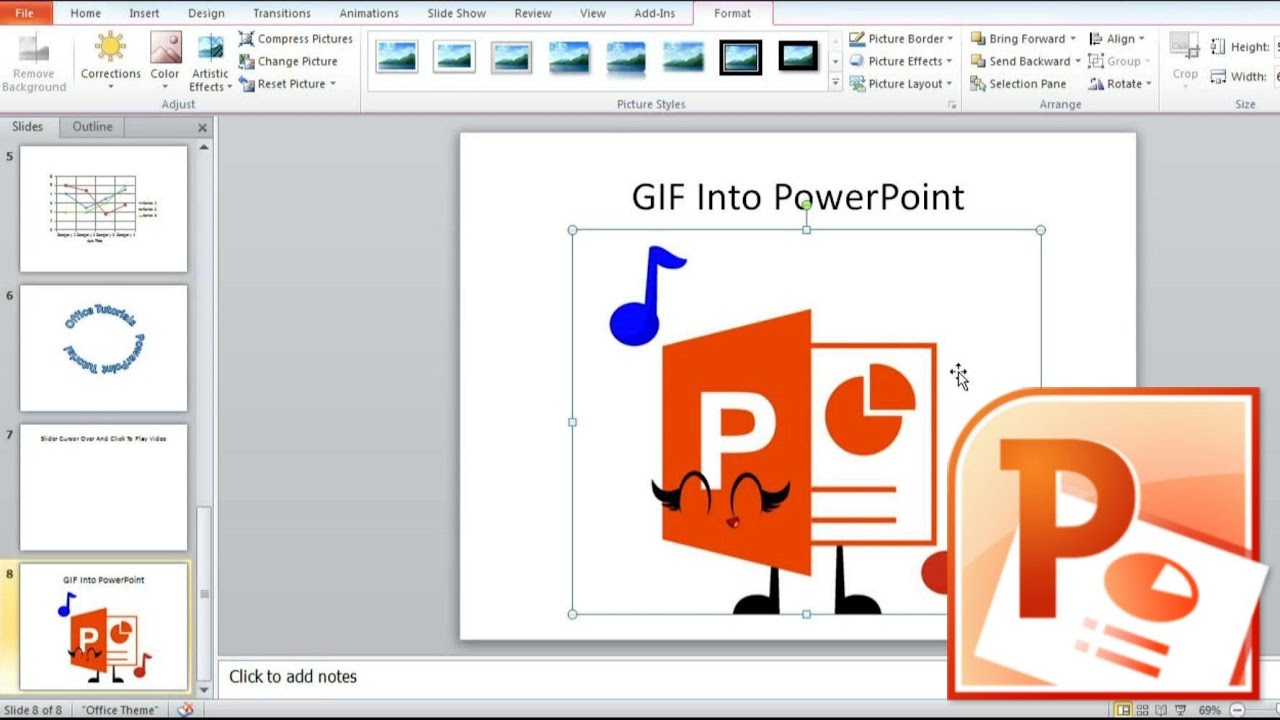
When you select your Gif, you'll notice a new tab appears at the top of PowerPoint: Picture Format (or sometimes Format). Click on that!
Within the Picture Format tab, look for the Adjust group. You might see options like "Artistic Effects" or "Compress Pictures." What we're really looking for is related to animation settings.

Here's the key: Gifs are technically inserted as a type of picture. Their animation is inherent to the file. So, you don't usually have a ton of "playback" controls like you would for a video. They're designed to loop. If you need more control over when a Gif starts or stops, or if you want it to play only once, you might need to consider converting your Gif to a video file first and then inserting it as a video. But for most presentation purposes, the automatic looping is exactly what you want!
A Word on Looping: Most Gifs will loop automatically. This is usually a good thing! It keeps the animation going and adds continuous visual interest. If you're worried about it being distracting, consider placing it strategically or making it smaller. Or, as mentioned, if you need to control it, a video conversion is your friend. But for general awesomeness, the loop is key!
Tips for Using Gifs Like a Pro (Without Being a Guru)
Okay, so you know how to find and insert them. But how do you use them effectively? Here are some golden nuggets of wisdom to elevate your Gif game.
- Relevance is King (or Queen): This is non-negotiable. Your Gif must be relevant to the point you're making. A random dancing banana isn't going to help your financial report. Unless, of course, your financial report is about the banana industry, then by all means, go wild.
- Know Your Audience: I touched on this before, but it's so important. What’s hilarious to your best buds might be offensive to your boss. Always err on the side of caution in professional settings. When in doubt, go for a more general, positive Gif.
- Don't Overdo It: A sprinkle is good. A whole buffet of Gifs? Not so much. Too many moving images can be overwhelming and distracting. Your audience will start to feel like they’re in a digital disco. Pick your moments wisely.
- Consider the Tone: Is your presentation serious? Informative? Humorous? Your Gifs should complement, not contradict, the overall tone. A very serious topic might benefit from a subtle, clever Gif, while a more lighthearted presentation can handle something more overtly funny.
- Size Matters (Sometimes): A massive, flashing Gif can be jarring. A small, subtle one can be a delightful little wink. Think about the visual hierarchy of your slide and how the Gif fits in.
- Test it Out!: Always, always, ALWAYS do a slide show rehearsal*. See how the Gifs look and play when your presentation is actually running. Sometimes things behave differently in the live show compared to the edit screen. You don't want any unexpected GIF-related surprises!
- Keep File Size in Mind: While Gifs are generally smaller than videos, a very complex or long Gif can still add to your presentation's file size. If you're sharing your presentation online or have strict file size limits, this is something to be aware of. For most cases, though, it's not a major issue.
Using Gifs in PowerPoint isn't just about adding a bit of flair; it’s about making your presentations more engaging, memorable, and frankly, a lot more fun to create and to watch. It’s like giving your slides a personality upgrade.
So, go forth and Gif! Experiment, have fun, and don't be afraid to inject a little animated joy into your next presentation. Your audience will thank you for it. And who knows, you might just become the office's go-to Gif guru. Now, if you'll excuse me, I think I saw a Gif of a sloth slowly clapping that I absolutely *need for my next point about project timelines…