How To Say Shut Up In Chinese

Ever found yourself in a situation where words fail you, but your internal monologue is screaming, "Oh, for goodness sake, just be quiet already!"? We've all been there! Whether it's a friend oversharing, a commercial that's on repeat in your head, or just a particularly persistent fly buzzing around your perfectly brewed cup of tea, sometimes the universe just needs a little... pause. And while English has its delightful arsenal of polite (and not-so-polite) ways to ask for silence, what about when you're exploring the vibrant world of Chinese?
Let's dive into the wonderful, and sometimes hilarious, world of telling someone to "shut up" in Mandarin Chinese. Now, before you imagine yourself yelling at your elderly aunt during a family dinner (please, for the love of all things delicious, don't do that!), rest assured, we're going to explore a range of options, from the mildly dismissive to the downright emphatic. Think of this as your linguistic toolkit for when politeness has officially left the building.
The "Are You Kidding Me?" Options
Sometimes, you need a way to express disbelief or annoyance that is just a little bit stronger than a raised eyebrow. For those moments, we have some gems. Let's start with a phrase that's like a gentle nudge, but can pack a punch if delivered with the right tone: 别说了 (bié shuō le).
Must Read
Literally, this means "don't say anymore." It's like saying "enough already" or "cut it out." Imagine your friend is telling you a story for the tenth time, complete with all the dramatic pauses and sound effects. A softly delivered 别说了 can be your signal that you've heard it all before and are ready for a new topic. It’s polite enough for most casual situations, but the underlying sentiment is clear: the talking needs to stop.
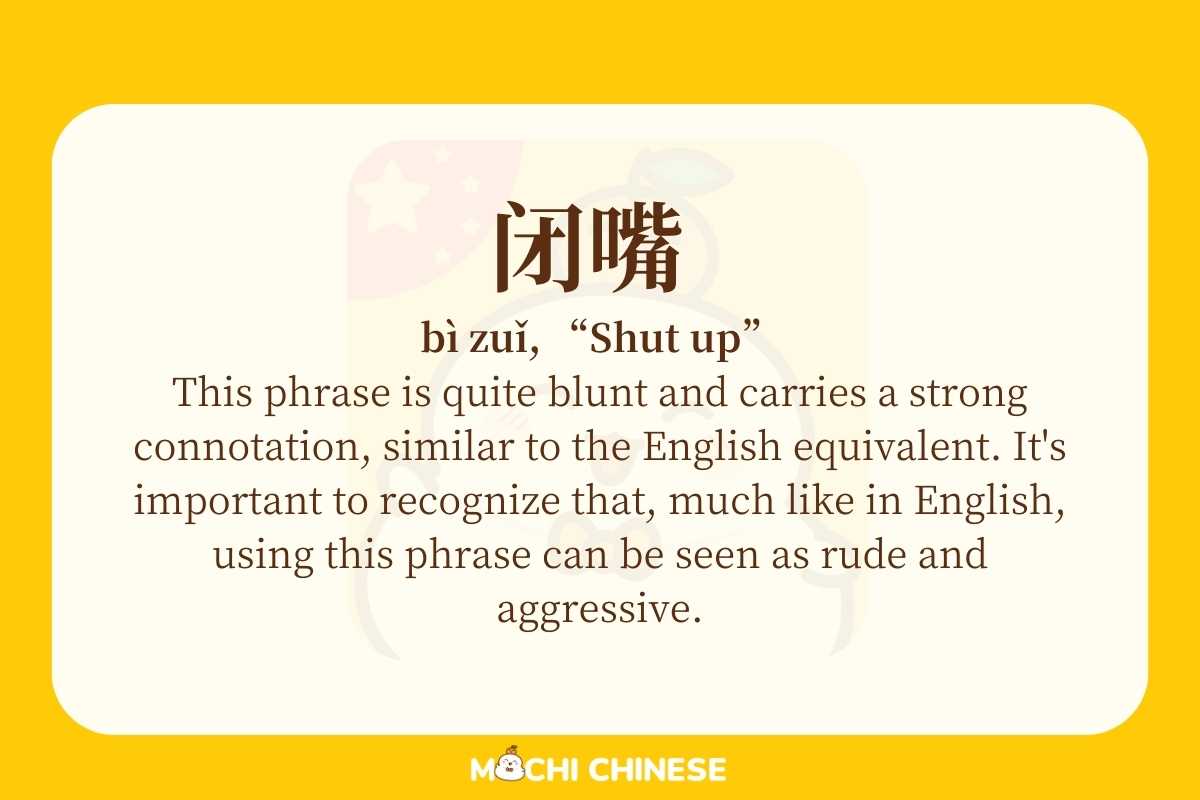
Then there's 闭嘴 (bì zuǐ). Now, this one is a bit more direct. It literally translates to "close mouth." Think of it as the Chinese equivalent of a firm "zip it." You wouldn't use this with your boss, unless you're aiming for a very exciting, albeit short-lived, career change. However, among close friends who understand your playful (or exasperated) nature, it can be used humorously.
Picture this: you're at a karaoke night, and your buddy is attempting to sing a ballad but sounds more like a strangled cat. In a fit of good-natured teasing, you might playfully point at them and exclaim, "闭嘴!" They’ll likely laugh it off, understanding it’s all in good fun. But remember, tone is everything! A harsh 闭嘴 can definitely sound rude.

When You Mean Business (Sort Of)
Okay, sometimes you need to convey that you're genuinely tired of hearing something. It’s not necessarily anger, but a strong desire for peace and quiet. For these occasions, let's explore some phrases that lean a bit more towards the "I'm done" side of things. One such phrase is 行了 (xíng le), which when used to stop someone talking, carries a similar weight to "that's enough" or "okay, I get it."
Imagine you're in a group conversation, and one person is dominating with a lengthy, convoluted explanation that's losing everyone. You can subtly interject with a polite but firm 行了. It’s a way to signal that the point has been made, understood, and it’s time to move on. It’s less about silencing them and more about redirecting the energy.
Another option, still in the realm of mild exasperation, is 停 (tíng). This simply means "stop." While it can be used for anything that needs to halt, when directed at speech, it's a very concise way to say "stop talking." Think of a child excitedly telling you about a cartoon for the hundredth time without taking a breath. A gentle "停" can be the parental equivalent of a much-needed breather. It’s direct without being overly aggressive.

The "Seriously, I Can't Even" Zone
Now, we venture into the territory of phrases that are undeniably more forceful. These are for those moments when your patience has worn thinner than a cheap paper towel. Use these with caution, and preferably only with people who know your sense of humor is as dramatic as a telenovela. First up, the infamous 滚 (gǔn).
滚 literally means "to roll" or "to get lost." When you tell someone to 滚, you're not just asking them to be quiet; you're essentially telling them to leave and take their noise with them. This is the Chinese equivalent of "piss off" or "get out of here." It’s a strong dismissal, and not to be used lightly. Imagine someone is being incredibly obnoxious and overstaying their welcome with a never-ending tirade. 滚 would be your nuclear option.
Then we have 安静 (ān jìng). While on its own, 安静 means "quiet" or "peaceful," adding a forceful tone can make it a demand. You can say 安静点 (ān jìng diǎn), which means "be quieter." However, if you bellow 安静! with a stern face, it's definitely a command for silence. It’s less aggressive than 滚 but still conveys a clear message that the noise needs to cease.
Consider a situation where you're trying to concentrate on a very important task, and your roommates are having a loud argument in the next room. A forceful 安静! from behind your closed door might just do the trick. It’s a plea for sanity, a desperate cry for the sweet sound of silence.
A Note on Nuance and Respect
It’s incredibly important to remember that language is more than just words; it’s about context, tone, and the relationship you have with the person you’re speaking to. What might be a playful jab between friends could be a grave insult to a stranger or an elder.
In Chinese culture, respect for elders and maintaining harmony is highly valued. So, while learning these phrases can be fun and informative, always consider the potential consequences of your words. Think of these as secret codes you can understand, not necessarily loud pronouncements you should make.

For most everyday situations where you simply want someone to talk less, sticking to gentler phrases like 别说了 or 行了 is usually the best bet. They get the point across without causing unnecessary offense.
So, there you have it! A little peek into the fascinating ways you can ask for silence in Chinese. Whether you’re dealing with an overenthusiastic tour guide or a chatty aunt, you now have a few more tools in your linguistic belt. Remember to use them wisely, with a smile (or at least a well-timed smirk!), and enjoy your newfound ability to navigate the soundscape of Mandarin!