How To Read Maps With A Compass
Ever feel like you're staring at a treasure map but have no clue where to dig? That's how a lot of us feel when we first encounter a real, honest-to-goodness map. They're full of squiggly lines and weird symbols. But what if I told you that with just a little know-how, that map can transform from a confusing puzzle into your personal adventure guide? And the secret weapon? A trusty compass!
Learning to read a map with a compass isn't just a handy skill for hikers or campers. It's like unlocking a hidden superpower that lets you connect with the world around you in a whole new way. Think about it: instead of being glued to a screen, you're using something tangible, something that points you in the right direction, literally. It’s a charming dance between the paper in your hand and the Earth beneath your feet.
Let's dive into why this old-school combo is surprisingly fun. First off, maps are like miniature versions of reality. They show you mountains, rivers, roads, and even buildings. But a map alone can be a bit like a photo album – pretty, but you don't know how to get to those places. That's where the compass struts in, like the confident sidekick. It’s the magic wand that brings the map to life.
Must Read
Imagine you're planning a little day trip to a local park you've never been to. You find a map of the park online. It shows a beautiful lake, a winding trail, and a picnic area. Looks nice, right? But which way is north? Which way do you need to go to reach that picnic spot? Staring at the map is like looking at a delicious menu but not knowing which dish to order. You need a direction, a purpose!
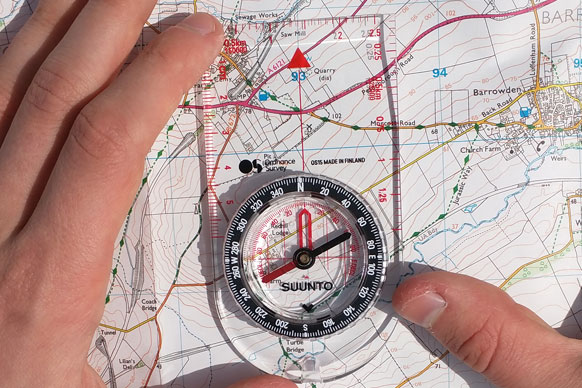
This is where the adventure truly begins. You get your map, and you get your compass. It’s a small, usually round device with a needle that always, always wants to point towards North. It's like a tiny, loyal dog that never gets lost. The first step is learning to align your map with the real world. This is called orienting the map. Sounds fancy, but it's super simple.

You place your map on a flat surface. Then, you put your compass on top of the map. You gently rotate both the map and the compass together until the magnetic north arrow on your compass lines up with the north direction on your map. How do you know where north is on your map? Most maps have a special symbol that shows you, often a little arrow pointing upwards. So, you make the compass needle point to that arrow. Voila! Your map is now a faithful reflection of what's actually around you.
Suddenly, that path on the map isn't just a line; it's a real path you can follow. That hill isn't just a shaded area; it's a real hill you can climb. It feels like you've cracked a secret code. You can look at the map, see a lake is to your east, and with your compass, you can confidently walk east and find that sparkling water. It’s incredibly satisfying. It’s like solving a puzzle where the prize is the actual experience!
Think about the feeling of accomplishment. You're not just following instructions; you're understanding the landscape. You're making decisions. You can say, "Okay, according to the map and my compass, the viewpoint is this way," and then you set off. There's a wonderful sense of self-reliance that comes with it. You're not just a tourist; you're an explorer.

And the compass itself? It's a marvel of simple engineering. It’s been used for centuries to guide ships across vast oceans and explorers through unknown lands. Holding one in your hand connects you to all that history. It’s a direct link to a time when adventure was about more than just Wi-Fi signals. It’s about the thrill of the unknown and the confidence of knowing where you stand.
The best part? It's not difficult to learn. You don't need a degree in geography. You just need a map and a compass, and a little bit of curiosity. Start with a local park, a nature trail, or even just exploring a new neighborhood. Get a map of the area and a basic compass. Spend some time practicing orienting the map. Then, pick a point on the map, like a park bench or a specific tree, and use your compass to find it.

You’ll be amazed at how quickly you start to see the world differently. Distances become more understandable. Directions become clearer. You might even start to notice details on the map you never saw before – a small stream, a hidden clearing, a historical marker. These are the little treasures waiting to be discovered.
It's a playful way to engage with your surroundings. Instead of passively looking at a map, you're actively using it. You’re engaging in a silent conversation with the landscape. The map tells you what is there, and the compass tells you which way to go. Together, they create an infinite number of adventures, big and small.
So, the next time you feel the urge for a little exploration, consider ditching the GPS for a bit. Grab a map, get a compass, and give it a try. You might just discover that the world is an even more exciting place when you learn to read its secrets, one direction at a time. It’s a skill that opens up doors, both literally and figuratively, and it’s a journey well worth taking.