How To Convert Pounds To Kilograms In Python

Ah, the wonderful world of converting units! It might not sound like the most thrilling hobby at first glance, but trust me, there's a certain satisfaction in making those numbers dance to a new tune. Whether you're a globetrotter packing for an adventure and suddenly faced with luggage weight limits in a different system, or you're trying to follow a recipe from across the pond, understanding how to switch between pounds and kilograms is a surprisingly useful skill. And when you can do it with a bit of digital magic, thanks to Python, it becomes downright fun!
So, why bother with this seemingly small task? Well, the benefits are as practical as they are widespread. Imagine trying to buy something online from an international seller who lists prices in one unit and shipping costs in another. Being able to do a quick conversion means you're not getting any nasty surprises at checkout. It's also invaluable for anyone working with scientific data, international trade, or even just comparing nutritional information on food labels. In our increasingly connected world, units are like languages – sometimes you just need a translator!
Think about it: a baker in the US might be following a European recipe that calls for flour in kilograms, but their trusty kitchen scale only measures in pounds. Or perhaps you're an athlete tracking your progress and want to compare your weight loss goals with a friend who uses a different system. Even something as simple as understanding how much that "giant" bag of chips weighs when you're used to metric might spark a moment of clarity. Python, with its straightforward syntax, turns these everyday scenarios into simple coding exercises.
Must Read
Now, how can you make this conversion process even more enjoyable? The key is to embrace the simplicity of Python. The formula itself is quite straightforward: 1 pound is approximately equal to 0.453592 kilograms. In Python, this translates to a basic multiplication. You can create a simple function, give it a clear name like pounds_to_kilograms, and let it do the heavy lifting. For example, you could write:

def pounds_to_kilograms(pounds):
  kilograms = pounds * 0.453592
  return kilograms
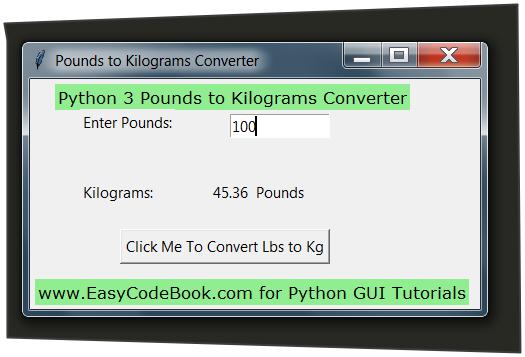
Then, to test it out, you can simply call your function with a number of pounds, like print(pounds_to_kilograms(150)). Seeing that output appear instantly is incredibly satisfying! To take it a step further and truly enjoy this skill, try building a small interactive script. You could prompt the user to enter a weight in pounds, perform the conversion, and then display the result in kilograms. This makes it a practical tool you can use anytime, anywhere, right from your own computer.
Don't be afraid to experiment! You could even add functionality to convert kilograms back to pounds, or create a program that asks the user which conversion they want to perform. The more you play with it, the more you'll realize how powerful even a simple script can be. So, next time you encounter a weight in pounds, don't reach for a calculator; let Python be your trusty, and surprisingly entertaining, unit-converting sidekick!