
How Many Teeth Does A Human Has

Ever found yourself idly counting things in your mouth? Or perhaps a curious child pointed at your smile and asked a simple, yet profound question: "How many teeth do humans have?" It might seem like a small thing, but understanding our pearly whites is actually pretty fun and surprisingly useful! It's a topic that pops up in classrooms, at the dentist's office, and even in casual conversation. Knowing this little fact can spark further curiosity about our bodies and how they work.
For beginners, this is a fantastic starting point for learning about human anatomy. It’s a tangible number, easy to grasp, and the first step towards understanding oral health. For families, it's a great way to engage kids in learning. You can turn it into a game, exploring the different types of teeth and their jobs. Imagine playing "dentist" at home, identifying your incisors, canines, premolars, and molars! For anyone interested in a bit of biological hobbyism, it opens doors to understanding evolutionary changes in dentition and the fascinating diversity of teeth across different species.
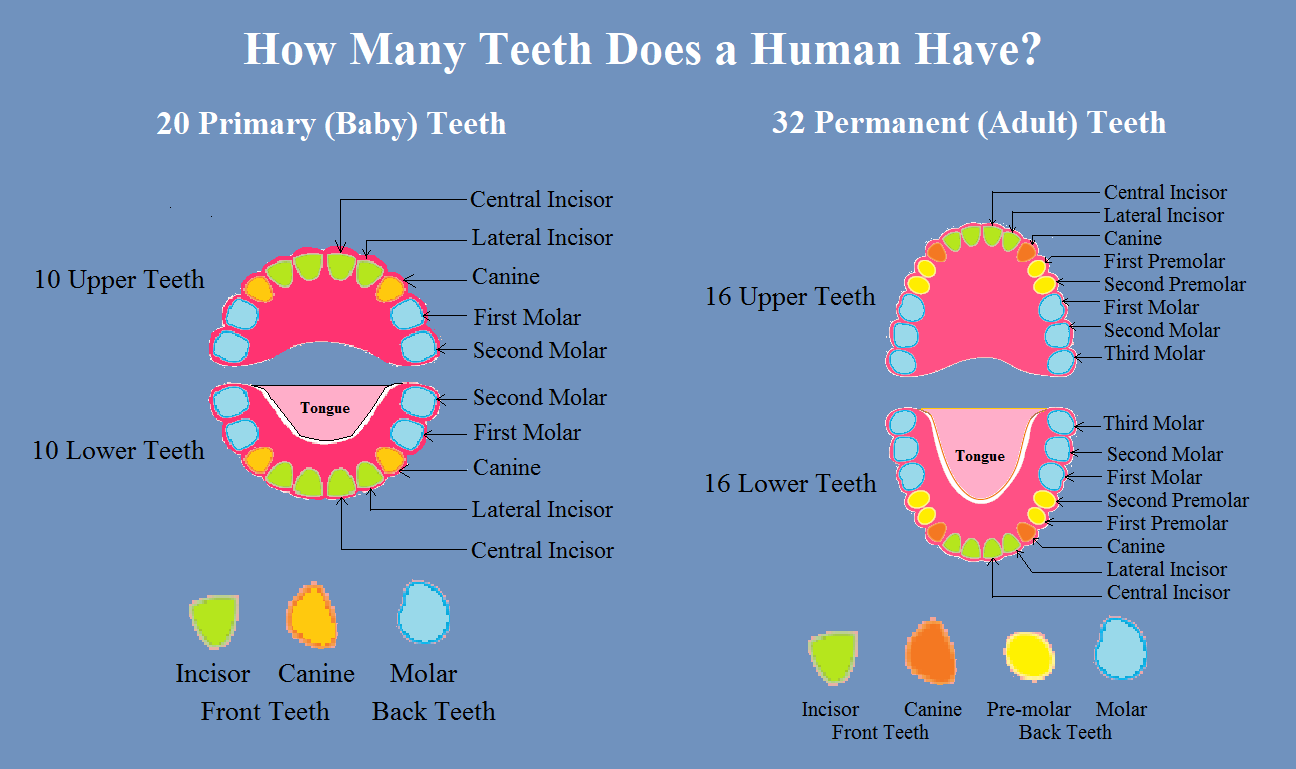
Now, the number of teeth isn't always a fixed figure. Most adults end up with a total of 32 teeth. This includes 8 incisors (those flat ones at the front for biting), 4 canines (the pointy ones), 8 premolars (for grinding and tearing), and 12 molars (the big chewing machines at the back). And yes, those 12 molars include the famous wisdom teeth! These often cause a bit of drama, and not everyone develops all four, or they might need to be removed. So, while 32 is the typical adult count, some folks might have fewer if their wisdom teeth never come in or are extracted.
Must Read
It's also important to remember that we start with a different set: our baby teeth, or primary teeth. Babies typically have 20 of these. These are smaller and are eventually replaced by our adult teeth. This transition happens gradually, usually between the ages of 6 and 12, a period filled with wobbly teeth and trips to the Tooth Fairy!
Getting started with this topic is incredibly simple. Next time you're in front of a mirror, or helping a child brush their teeth, take a moment to explore. You can try to gently count them (don't poke around too much!). Look up pictures of different tooth types online. You'll find diagrams that clearly label each kind. For kids, tooth-themed books or apps can make learning interactive and fun. You can even create a simple chart of the teeth and their functions.
So, there you have it! The journey into the world of human teeth, starting with a simple count, can be surprisingly insightful and enjoyable. It's a fundamental part of our well-being, and understanding it brings a little more appreciation for the complex marvel that is our own body. Happy counting!
:max_bytes(150000):strip_icc()/HowManyTeethDoAdultsHave-final-0c3dd9a52cdf4801b386595a3a601911.png)


