How Far Is Germany From The Uk

Ever found yourself gazing across the English Channel, a mug of tea warming your hands, and a little voice whispering, "You know, Germany isn't that far away"? It’s a thought that often crosses the minds of us Brits, isn't it? That tantalizing proximity of a country brimming with fairy-tale castles, steins of beer, and a seriously impressive knack for engineering. But just how far is Germany from the UK, really? Let's dive in, with a generous dollop of wanderlust and a sprinkle of practicalities.
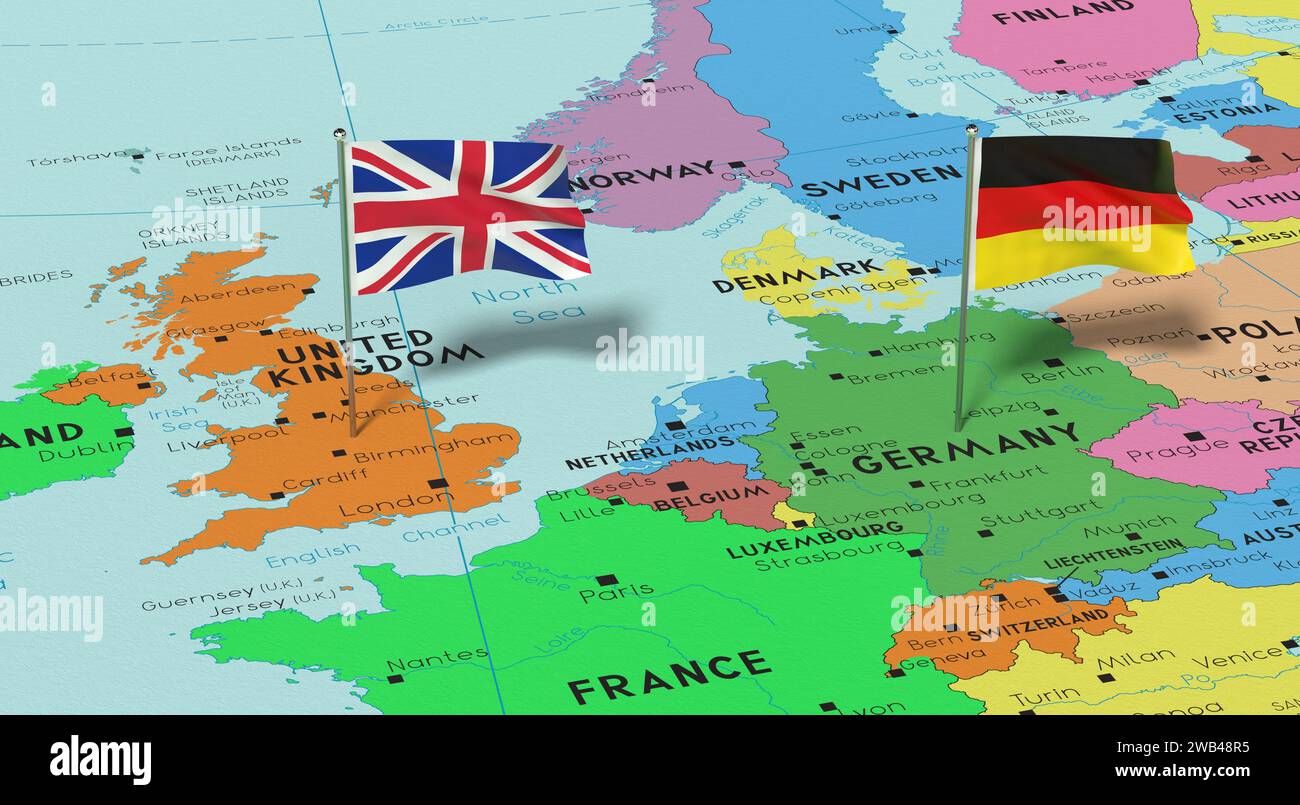
The answer, in a nutshell, is: not very far at all. When we talk about distance, it's always helpful to define our terms. Are we talking a straight line across the map, or the actual journey you'll undertake? For the curious cartographers out there, the shortest distance between the UK and Germany, point-to-point, is roughly 500 kilometers (about 310 miles). That’s the kind of distance you can cover in a good day's drive, especially if you’re not stopping every five minutes for a scone and a cuppa.
But of course, most of us aren't strapping on our hiking boots and trekking across the continent. We're talking about getting there in comfort and style, which usually means one of two things: a ferry or a plane. And this is where the actual travel time becomes more interesting.
Must Read
The Channel Crossing: Your Gateway to Europe
Ah, the ferry. It's a quintessentially British experience, isn't it? The bracing sea air, the chance to stretch your legs, maybe even spot a dolphin or two. When it comes to reaching Germany, the most popular ferry routes involve crossing the English Channel to France, and then driving into Germany.
The classic Dover to Calais route is a speedy affair. We're talking about a ferry crossing that takes as little as 90 minutes. Yes, you read that right. Less time than a feature-length film! Once you're on French soil, Germany is a relatively short drive away. Depending on your chosen German destination, the drive from Calais can be anywhere from 3 to 7 hours.
For example, if your sights are set on Cologne (Köln), a city famed for its magnificent cathedral and lively carnival, you're looking at approximately a 5-hour drive from Calais. That's perfectly manageable for a weekend getaway, especially if you break it up with a charming French roadside café stop. Imagine this: breakfast in Britain, lunch in France, and dinner in Germany. It’s practically a continental tour before you’ve even unpacked.
Other popular ferry ports exist too, like Harwich to Hook of Holland (for access to western Germany) or Newcastle to Amsterdam (for a more northern German entry). These might take a little longer for the crossing itself – think overnight journeys – but they can be a more relaxed way to travel, allowing you to sleep on board and wake up ready to explore.

Ferry Fun Facts:
- Did you know that some ferries have onboard cinemas, shops, and even swimming pools? It's less of a gruelling journey and more of a mini-cruise!
- The sheer scale of these ferries is mind-boggling. They are essentially floating towns, carrying thousands of passengers and hundreds of cars.
- Spotting seabirds can be a surprisingly addictive pastime. Keep an eye out for gulls, terns, and maybe even the majestic albatross if you’re lucky!
Soaring to Success: The Aeroplane Option
For those who value speed above all else, or perhaps have a slightly longer distance to cover within Germany, flying is often the go-to. And when it comes to covering distance quickly, airplanes are, well, planes above the rest.
Direct flights from major UK airports (like London Heathrow, Gatwick, Stansted, or Manchester) to German cities are incredibly frequent and varied. Flights to hubs like Berlin, Frankfurt, Munich, or Hamburg typically range from 1.5 to 2 hours. That's shorter than your average commute for some people!
Consider this: you can leave your London flat at 7 am, be sipping a German beer in a Munich beer garden by lunchtime, and be back home in time for a late supper. It’s a testament to how interconnected our world has become, and how easily accessible Germany is from the UK.
The "distance" then, in terms of travel time, is incredibly manageable. It’s the briefest of hops across the North Sea. You're essentially popping over for a visit, rather than embarking on an epic expedition. This ease of access is what makes Germany such a popular destination for weekend breaks, business trips, and even spontaneous day trips.

Aviation Adventures:
- The fastest commercial flights between the UK and Germany can be under 1.5 hours. That’s a blink-and-you’ll-miss-it kind of journey.
- Many budget airlines fly to Germany, making it an incredibly affordable option for a quick European escape. Keep an eye out for those flash sales!
- Think about the sheer engineering marvel of it all. We’re hurtling through the sky at hundreds of miles per hour, covering vast distances with relative ease. It's pretty spectacular when you stop to think about it.
Beyond the Obvious: Other Ways to Cross
While ferries and planes are the headliners, let's not forget the other, perhaps more adventurous, ways to get to Germany. For the truly dedicated road tripper, driving the entire way is an option. This involves taking a ferry across the Channel (as mentioned) and then navigating the European road network.
This is where the fun really begins! You're not just travelling from A to B; you're experiencing Europe. You could take a scenic route through the Belgian Ardennes, stop for waffles in Bruges, or explore the charming towns of northern France. The "distance" becomes a journey of discovery, not just a number on a map.
And then there's the Eurostar. While it doesn't go directly to Germany, it's a fantastic way to get yourself to continental Europe. You can hop on the Eurostar from London to Brussels or Paris, and then connect to German trains. This is a wonderfully relaxing way to travel, allowing you to sit back, enjoy the scenery, and arrive in Germany feeling refreshed.
The high-speed rail network in Germany is exceptional, and connecting from Brussels or Paris via train is a seamless experience. Imagine travelling from London to, say, Berlin, all by train. It’s a greener option and offers a unique perspective on the landscapes between the UK and Germany.

Rail & Road Ramblings:
- Driving in Germany is generally a pleasure. The Autobahn is famous, of course, but many smaller roads are equally well-maintained and offer picturesque journeys.
- Remember to pack your international driving permit if required, and brush up on any specific German road rules – like understanding the nuances of the Autobahn.
- The train journey from Brussels to Cologne, for example, is remarkably quick, taking just under 2 hours. It’s a testament to the efficiency of European rail travel.
Cultural Whispers and Practicalities
So, Germany is close. But what does that mean for us? It means spontaneous weekend trips are not just possible, they're positively encouraged! Fancy trying authentic German bratwurst and a crisp German lager? You can. Fancy exploring the historic streets of Heidelberg or marveling at the futuristic architecture of Hamburg? Absolutely.
Culturally, the UK and Germany share a lot of common ground, yet possess distinct differences that make them fascinating neighbours. We're both keen on our traditions, have a love for a good pub (or Biergarten!), and appreciate a well-organized system. Yet, the German appreciation for punctuality, their love of hearty food, and their rich artistic heritage offer a delightful contrast.
Practical tip: When planning your trip, always factor in the time it takes to get from your starting point to the ferry port or airport, and then from the arrival port/airport to your final German destination. While the flight might be short, getting to Heathrow can take time. Similarly, driving from Calais to your hotel will add to your travel day.
Another handy hint: The currency is the Euro (€) in Germany, so make sure you've got some Euros on hand or a reliable card for payments. While many places accept cards, having some cash is always wise.

Cultural Curiosities:
- The concept of 'Feierabend' in Germany – the time after work for relaxation and personal pursuits – is something many of us could embrace!
- German efficiency extends to their public transport, which is generally excellent, making it easy to navigate cities and explore the countryside once you're there.
- Be prepared for a different approach to dining. German meals are often hearty and substantial, with a focus on quality ingredients.
So, How Far Is Germany, Really?
When we boil it down, the physical distance between the UK and Germany is not the main story. The real story is the accessibility. It's the ease with which we can bridge that gap. Germany isn't a faraway land of myth and legend; it's a neighbour.
It's close enough for a spontaneous jaunt to a Christmas market, close enough for a weekend filled with history and culture, close enough for a taste of a different, yet familiar, way of life.
Think about it in your daily life. We often fret about traffic jams, long commutes, or the sheer effort of travelling for a few hours. The journey to Germany, whether by sea or air, is often less taxing than a regular Monday morning commute for many. It’s a reminder that the world, and our neighbours within it, are often closer than we think.
The next time you're contemplating a break, or even just wondering about that intriguing country across the water, remember: Germany is not a world away. It's just a short hop, skip, and a jump, brimming with experiences waiting to be discovered, and it's surprisingly within easy reach of your doorstep.