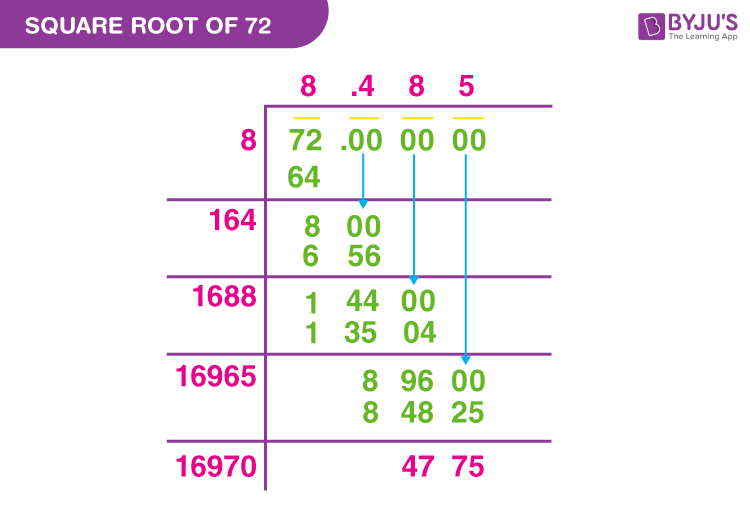
How Do You Simplify The Square Root Of 72

Hey there, math adventurer! Ever stare at a square root like √72 and think, "What in the world do I do with this guy?" Don't worry, you're not alone! It's like looking at a jumbled puzzle, and we're about to find the neat and tidy solution. Think of me as your friendly guide through the sometimes-bumpy, but ultimately rewarding, terrain of simplifying square roots. We're not going to be crunching numbers until our brains hurt, oh no. We're going to have a little fun with it, like finding hidden treasures. So, grab a comfy seat, maybe a sneaky snack, and let's dive into the wonderful world of making √72 a whole lot happier!
First things first, what even is a square root? It's basically asking, "What number, when multiplied by itself, gives you this number inside the root?" So, √9 is 3 because 3 * 3 = 9. Simple, right? Now, when we look at √72, we're asking the same question, but 72 isn't a perfect square. You know, like 4, 9, 16, 25, 36, 49, 64... see a pattern? Those are numbers that come from squaring whole numbers. 72 is a bit of a rebel, not playing by those perfect square rules.
But here's the secret sauce, the magic trick, the key to simplifying this beast: we're looking for any perfect squares that are hiding as factors inside of 72. Think of 72 as a little house, and we're going to see if any of the rooms are special, like a fancy ballroom (a perfect square!). If we can find a perfect square living inside, we can pull it out and make our square root much, much simpler.
Must Read
So, how do we find these hidden perfect squares? We break down 72 into its factors. Remember factors? They're just numbers that multiply together to make another number. It's like taking apart a LEGO set to see all the individual bricks. Let's brainstorm some pairs of numbers that multiply to 72. We've got 1 x 72 (boring, 1 is always a factor and not helpful here), 2 x 36, 3 x 24, 4 x 18, 6 x 12, and 8 x 9. See any perfect squares in that list? Blink, blink... Yes! We've got 4, 9, and 36!
Now, here's the cool part: any of these perfect squares that we found can help us simplify √72. But, we want to simplify it the most. It's like wanting the biggest piece of cake, not just a crumb. To get the biggest simplification, we need to find the largest perfect square factor. Out of 4, 9, and 36, which one is the biggest? You guessed it: 36!
So, we can rewrite 72 as 36 multiplied by something else. What is that something else? Well, 72 divided by 36 is... drumroll please... 2! So, we can write √72 as √(36 * 2).

Now, the magic of square roots comes into play. When you have a square root of two numbers multiplied together, like √(a * b), you can split it up into the square root of each number separately: √a * √b. It's like giving each factor its own little tent in the square root campground! So, √(36 * 2) becomes √36 * √2.
And what is √36? We already talked about this! It's that perfectly nice number that, when multiplied by itself, gives you 36. That number is 6! So, √36 is just 6.
Now we can put it all back together. We have 6 from √36, and we still have √2 hanging out. So, the simplified form of √72 is 6√2! Ta-da! We’ve tamed the beast!

Let's quickly recap the steps, just to make sure it's all clear.
Step 1: Find the largest perfect square that divides evenly into the number under the square root.
For 72, we found that 36 is the biggest perfect square that fits this bill. Remember, perfect squares are 1, 4, 9, 16, 25, 36, 49, 64, and so on. Keep that list handy!
Step 2: Rewrite the number under the square root as a product of that perfect square and another number.
We did this by saying 72 = 36 * 2. Easy peasy.
Step 3: Use the property of square roots that says √(a * b) = √a * √b.
This lets us separate the perfect square part. So, √(36 * 2) became √36 * √2.

Step 4: Take the square root of the perfect square.
√36 turned into a nice, clean 6.
Step 5: Put it all together, with the number from step 4 multiplied by the remaining square root.
So, we ended up with 6√2. The 2 inside the square root is just chilling there because it doesn't have any perfect square factors (other than 1, which doesn't help us simplify). It's like the remaining piece of the puzzle that's already in its final shape!
What if we hadn't found the largest perfect square right away? Let's say we used 9 instead of 36. We'd rewrite 72 as 9 * 8. So, √72 becomes √(9 * 8) which is √9 * √8. We know √9 is 3. So we'd have 3√8. But wait! Is √8 simplified? Nope! 8 has a perfect square factor of 4 (since 8 = 4 * 2). So, we'd have to simplify √8 further: √8 = √(4 * 2) = √4 * √2 = 2√2. Now, we put that back into our expression: 3 * (2√2) = 3 * 2 * √2 = 6√2. See? We still get to 6√2, but it took an extra little step. That's why finding the largest perfect square factor upfront is our shortcut to getting there faster and with less fuss. It's like using the express lane on the highway!

Let's try another quick example, just for fun. How about √50? What's the biggest perfect square that goes into 50? Hmm, 4? No. 9? Nope. 16? Still no. 25? YES! 25 is a perfect square (55) and 50 = 25 * 2. So, √50 = √(25 * 2) = √25 * √2 = 5√2. See? Once you get the hang of it, it's like a puzzle you can solve with your eyes closed! (Okay, maybe not *that easily, but you get the idea).
The cool thing about this skill is that it pops up in lots of places, especially in geometry and algebra. Being able to simplify square roots makes those equations and calculations look a whole lot cleaner and easier to manage. It’s like tidying up your room – everything looks better and works better when it’s organized!
So, the next time you see a square root that looks a bit intimidating, like √72, just remember the friendly advice we shared. Break it down, look for those hidden perfect squares, pull them out, and voilà! You've got a simplified, happier square root. It’s a little bit of mathematical magic, and guess what? You’re the magician!
Don't ever let a number, or a square root, tell you it's too complicated. You've got the power to break it down, understand it, and make it simpler. Every time you tackle a problem like this, you're not just solving a math problem; you're building confidence and proving to yourself just how capable you are. So go forth, simplify those square roots, and remember that with a little bit of know-how and a dash of courage, you can handle anything. Keep exploring, keep learning, and keep that smile on your face as you conquer the world of numbers, one simplified square root at a time! You’ve got this!