
How Do You Mix Two Stroke Fuel

Ever stare at that little can of two-stroke oil and the equally unassuming gas jug, wondering if there's some secret handshake or ancient incantation involved in mixing them? Don't worry, you're not alone! For a lot of us, getting our trusty chainsaw, weed whacker, or that cool vintage moped humming again involves a little bit of fuel alchemy. And guess what? It's not nearly as intimidating as it sounds. Think of it less like a chemistry experiment and more like making your favorite smoothie – a few simple ingredients, the right ratio, and voilà!
Why should you even care about this whole mixing thing? Well, imagine your lawnmower sputtering to a halt halfway through mowing that Everest of grass in your backyard. Or your chainsaw dying on you just as you're about to tackle that fallen branch that’s been an eyesore for weeks. It’s frustrating, right? Getting the two-stroke fuel mix just right is like giving your engine a perfectly balanced diet. Too little oil, and it’s like running on pure adrenaline – it'll burn hot, wear out fast, and might even seize up like a grumpy teenager on a Monday morning. Too much oil, and it's like feeding your engine a greasy burger every meal – it'll run sluggish, smoke like a chimney, and potentially clog up its insides, making it perform like a sloth trying to win a marathon.
So, let’s break down this magic potion. The star players are gasoline and two-stroke oil. That's it! No fancy additives, no secret spices. But the magic is in the ratio. You'll see numbers like 40:1, 50:1, or even 32:1 printed on your oil bottle or the equipment itself. These numbers tell you how many parts gasoline to one part oil you need. It’s like a recipe from your grandma, but for engines!
Must Read
Decoding the Ratio: It's Not Rocket Science!
Let's take a common ratio, say 50:1. This means for every 50 parts of gasoline, you need 1 part of two-stroke oil. So, if you're using a 1-gallon gas can (that's about 128 ounces), you'd need a tiny amount of oil. How tiny? Well, if 1 gallon is 128 ounces, and we’re working with a 50:1 ratio, we divide 128 by 50. That comes out to roughly 2.56 ounces of oil. See? Not a whole lot!
Think about it like this: Imagine you’re making a pitcher of lemonade. If you want it just right, not too tart and not too sweet, you add a specific amount of lemon juice to the water. The ratio of lemon juice to water determines the taste. For your two-stroke engine, the ratio of oil to gas determines its health and performance. Too much lemon juice, and it’s puckeringly bad. Too little, and it’s bland and uninspiring.
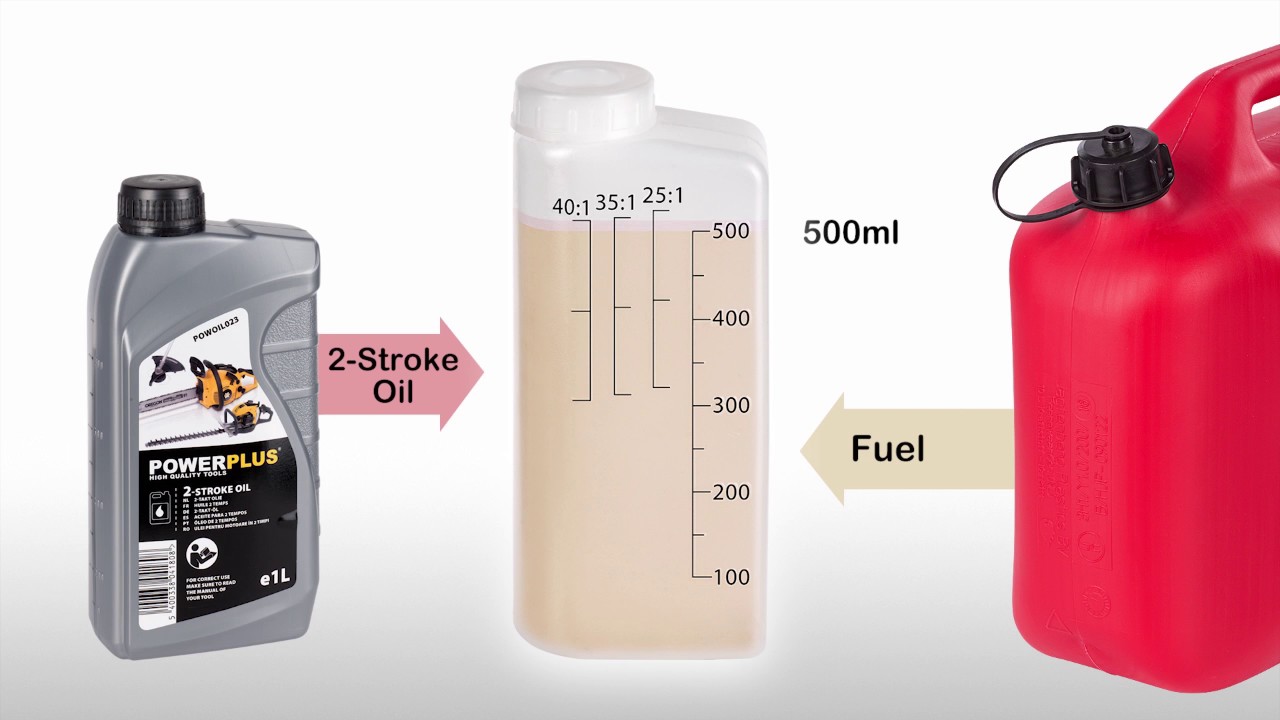
Another way to visualize it is with measurements. Most two-stroke oil bottles come with a handy measuring guide. If you’re using a 1-gallon gas can, the bottle might say something like, "Add X ounces for 1 gallon at 50:1." It’s usually a pretty small amount, often just a few capfuls. If you’re using a smaller gas can, like a quart (32 ounces), the math is even simpler. For a 50:1 mix, 32 ounces of gas divided by 50 is a little less than 0.7 ounces of oil. That’s roughly one and a half tablespoons! You can even use measuring cups you’d use for cooking – just make sure you don't accidentally pour your precious two-stroke oil into your pancake batter!
Where to Find Your Engine's "Secret Recipe"
So, where do you find out what ratio your specific engine needs? This is crucial! The best place to look is your owner's manual. It's like the instruction booklet for your car – it tells you everything you need to know. If you’ve lost it (and who hasn't misplaced a manual at some point?), don't fret. Look on the equipment itself. Many chainsaws and other two-stroke machines have a label near the fuel cap or on the engine housing that will clearly state the recommended fuel ratio. Sometimes, the two-stroke oil bottle will also list the ratios it's suitable for, and you'll need to match that to your equipment.
It’s really important to stick to the recommended ratio. Don't go freestyling! Your engine was designed to run on a specific blend. Deviating from that can cause all sorts of grief. If the manual says 40:1, and your neighbor says, "Oh, I always use 25:1, it makes my chainsaw run stronger!" – nod politely and then go back to your manual. Your engine will thank you for it in the long run. Think of it as listening to your doctor's advice for your health; you wouldn't take advice on medication from a stranger at the gym, would you?

The Mixing Process: A Step-by-Step Adventure
Alright, ready to get your hands dirty (just a little)? Here’s the simple process:
1. Get the Right Stuff: Make sure you have fresh, clean gasoline. Old gas can be like stale bread – not good for anything. And, of course, your high-quality two-stroke oil. Don't skimp on the oil; a good oil is an investment in your engine's life.
2. Choose Your Container: You'll need a clean, approved fuel container, also known as a gas can. These are usually made of plastic and have a secure cap. Some people even use a special mixing container that has measurement markings for different ratios. It's like having a dedicated pitcher for your lemonade, but for gas.

3. Measure Your Gas: Pour the correct amount of gasoline into your container. If you’re using a 1-gallon can, fill it up to the 1-gallon mark (or slightly less if you want to leave room for the oil). If you're using a smaller can, measure accordingly.
4. Add the Oil: Now for the star of the show! Using the measuring guide on your oil bottle or a separate measuring tool, add the precise amount of two-stroke oil for the amount of gasoline you’ve poured. Remember that 50:1 example? For 1 gallon of gas, it was about 2.56 ounces. For half a gallon (64 ounces), it would be about 1.28 ounces.
5. Seal and Shake! Securely fasten the cap on your fuel container. Now, give it a good, thorough shake. You want to make sure that oil and gas are married together perfectly. Imagine giving a baby a good rattle (but gently, of course!). You want everything to be well-mixed.

6. Prime and Go! Once it's well mixed, you're ready to fuel up your equipment. Most gas-powered tools have a priming bulb – a little clear bubble you press a few times to draw fuel into the engine. Then, you pull the starter cord, and with a bit of luck and a healthy fuel mix, your engine will roar to life!
A Little Cautionary Tale (and a Happy Ending)
I remember my first time trying to mix fuel. I was a bit nervous, to be honest. I grabbed my dad’s old chainsaw, which hadn't run in years. I grabbed a can of gas, poured in what I thought was the right amount of oil (probably way too much, thinking more is better!), and yanked on the cord. It coughed, sputtered, and then died. Not a good start! I was about to give up when I remembered my dad always had a little notebook. I found it, and there it was: "Chainsaw Fuel Mix – 40:1." I'd been using something closer to 20:1. A quick trip to the store for some actual measuring tools and the correct oil, and this time, following the ratio precisely, the chainsaw sputtered, coughed, and then… roared to life! That feeling of accomplishment was amazing. It was like finally solving a tricky puzzle.
So, don't be intimidated. It's a simple skill that will save you money, frustration, and the sad sight of your beloved tools sitting idle. By taking a few moments to understand and correctly mix your two-stroke fuel, you're not just preparing your engine; you're ensuring it has the energy, the stamina, and the longevity to tackle whatever tasks you throw its way. Happy mixing, and happy tinkering!

