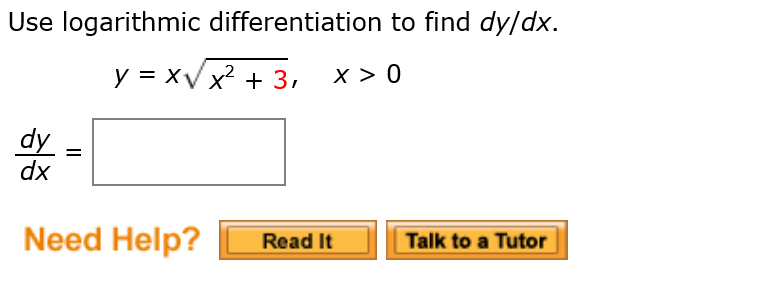
Find Dy Dx Using Logarithmic Differentiation
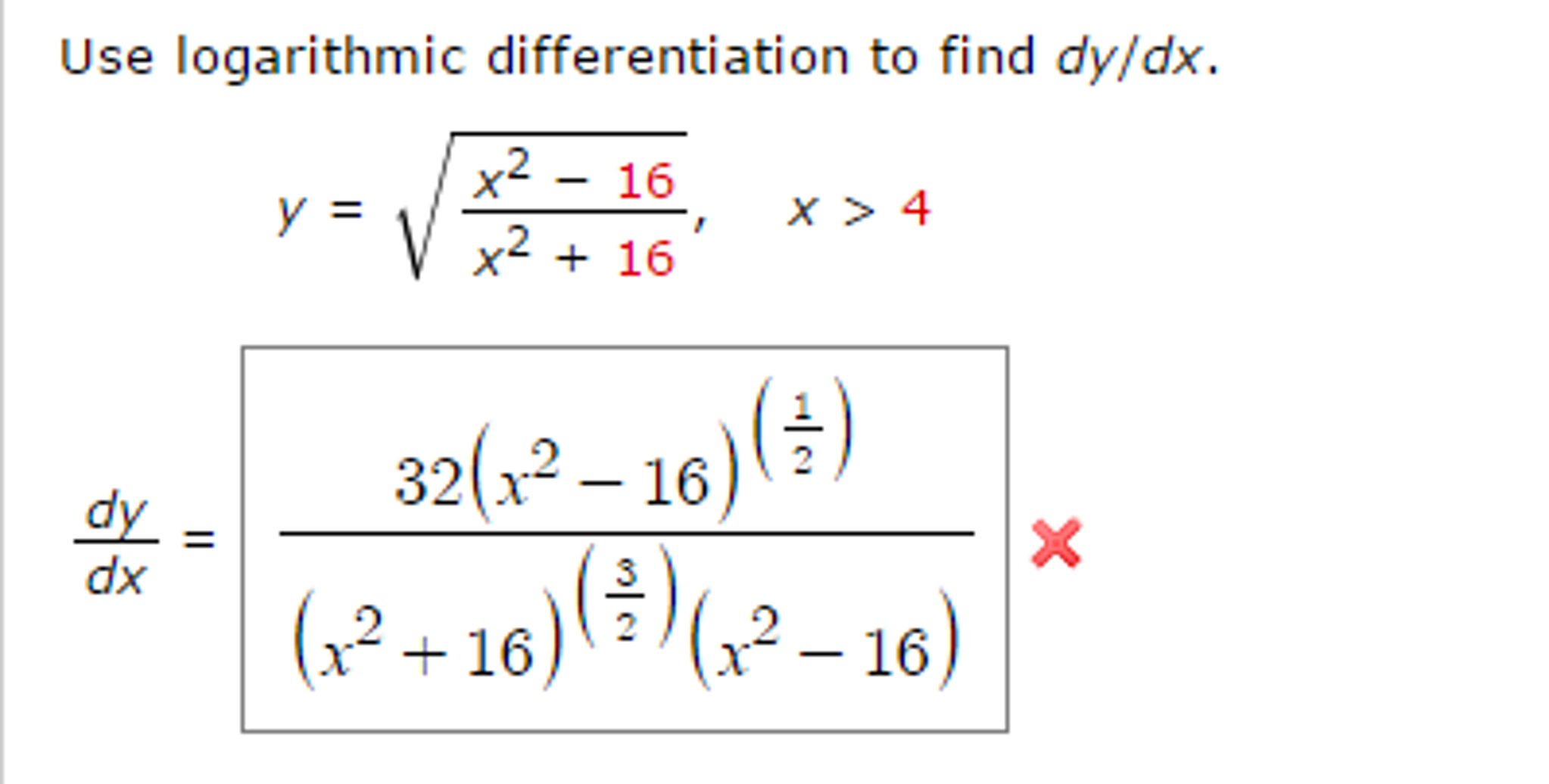
Hey there, math adventurer! Ever stare at a super complex function and think, "Is there a secret handshake to find its derivative?" Well, my friend, today we're unlocking one of those cool tricks:
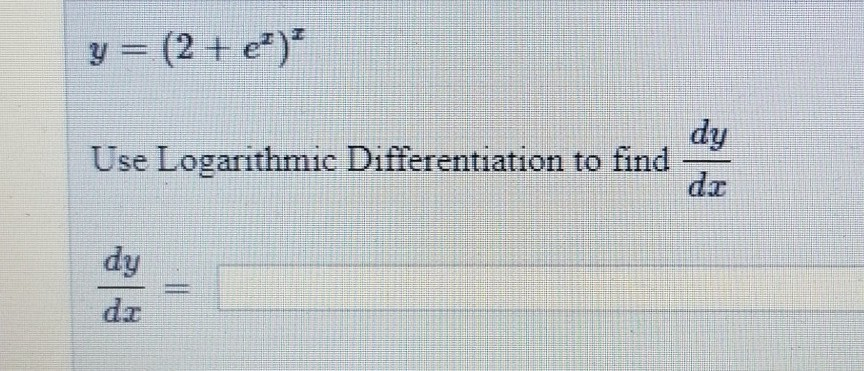
So, what’s the big deal? Normally, we’re slinging around the power rule, the product rule, the quotient rule – bless their cotton socks. They’re great, don't get me wrong. But imagine you’ve got something like $y = x^x$, or maybe $(x^2+1)^{sin(x)}$. Uh oh. Try taking the derivative of that beast directly. You might end up needing a nap and a strong cup of coffee. That's where our hero, logarithmic differentiation, swoops in to save the day!
Why Bother with Logs? They're Just Weird Numbers, Right?
Hold up, before you start picturing logarithm tables from your grandpa's attic, let's remember what logs are really good for. They're like little magicians that can
Must Read
In calculus, we often want to get variables out of the exponent position. Why? Because our differentiation rules are much more familiar and friendly when variables are hanging out on the base, not on the ceiling. Logarithms are the perfect ladder to get them down.
When is Logarithmic Differentiation Your New Best Friend?
Here are the situations where you should probably give logarithmic differentiation a little nod and say, "Okay, let's do this!"
- When you have a variable in the base AND the exponent. Like our buddy $y = x^x$. This is the classic scenario. You can't use the power rule ($d/dx(x^n) = nx^{n-1}$) because 'n' isn't a constant. You also can't use the exponential rule ($d/dx(a^x) = a^x ln(a)$) because 'a' isn't a constant. It's a bit of a "choose your own adventure" gone wrong.
- When you have a complicated product or quotient of functions where powers are involved. For example, if $y = (x^2+3)^5 \cdot (sin(x))^{tan(x)}$. Trying to use the product rule and then the chain rule and quotient rule on this would be… let's just say, a marathon. Logarithms can simplify that whole mess considerably.
- When functions are raised to other functions, especially if there are multiple terms multiplied or divided. This is where it really shines.
The Grand Plan: A Step-by-Step Adventure
Alright, ready to dive in? Let's break down the process. It's a bit like following a recipe, but way more exciting than baking cookies (unless your cookies involve implicit differentiation, which, let's be honest, is rare).
Step 1: Take the Natural Log of Both Sides (The "Log-In")
This is where the magic begins. If your equation is $y = f(x)$, you're going to rewrite it as $ln(y) = ln(f(x))$. Why the natural log (ln)? Because its derivative is super simple: $d/dx(ln(x)) = 1/x$. It plays nicely with our calculus game.
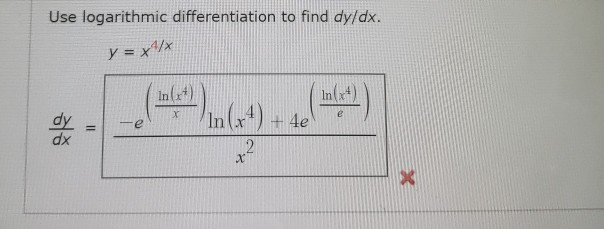
Let's use our classic example: $y = x^x$.
So, we do:
$ln(y) = ln(x^x)$
See? We've just applied the logarithm to both sides. No biggie, right?
Step 2: Use Logarithm Properties to Simplify (The "Exponent Annihilation")
This is the crucial part where we get those pesky exponents to behave. Remember our friend, the rule $ln(a^b) = b \cdot ln(a)$? We're going to deploy it like a superhero uses their cape.
Applying this to our example: $ln(y) = x \cdot ln(x)$
Whoa. Look at that. The 'x' that was stuck in the exponent is now just a regular 'x' multiplied by something else. This is so much easier to differentiate!
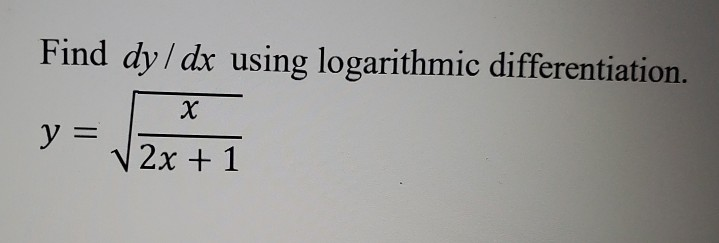
If you had a more complex expression, say $y = \frac{(x^2+1)^3}{\sqrt{x-2}}$, after taking the log you might have something like:
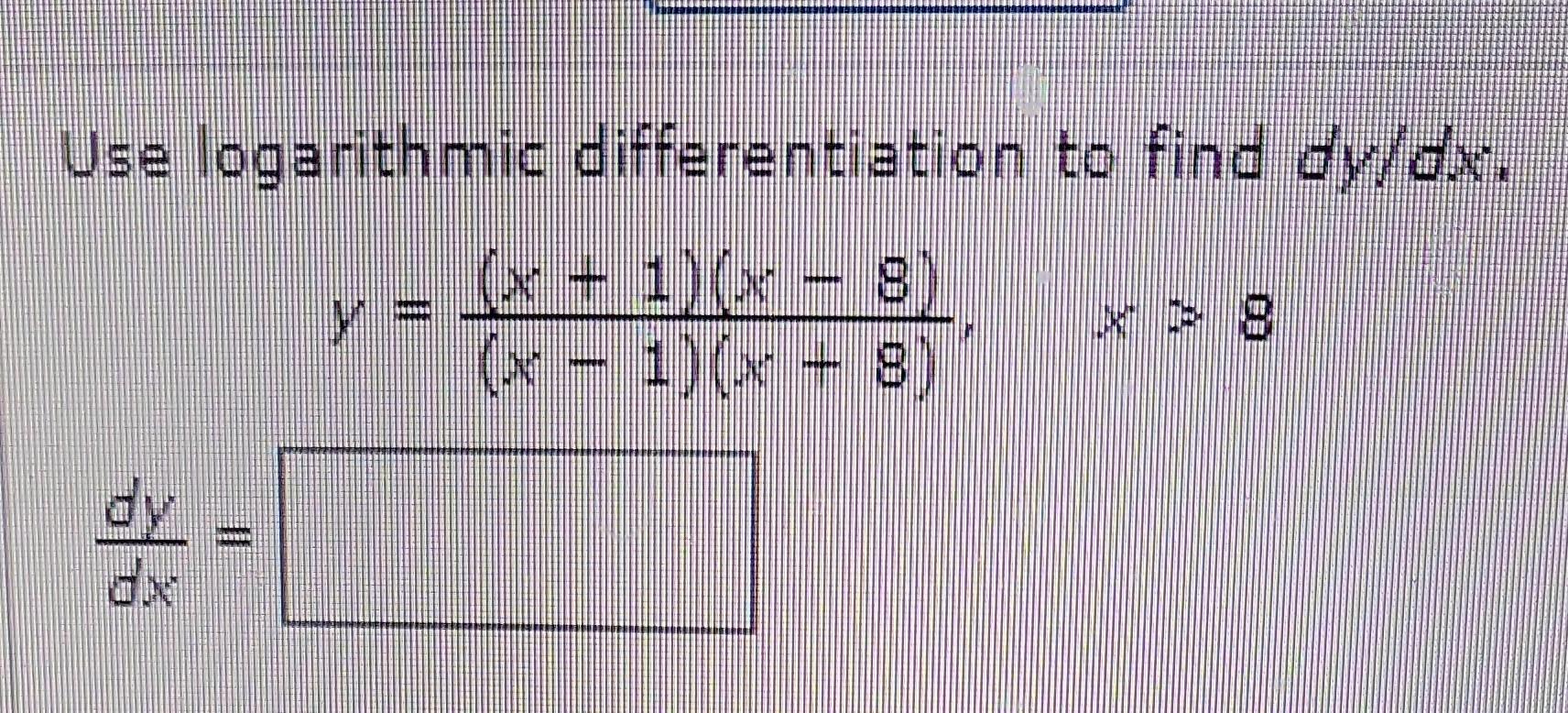
$ln(y) = ln\left(\frac{(x^2+1)^3}{\sqrt{x-2}}\right)$
Then, using the rules $ln(a/b) = ln(a) - ln(b)$ and $ln(a^n) = n \cdot ln(a)$:
$ln(y) = ln((x^2+1)^3) - ln(\sqrt{x-2})$
$ln(y) = 3 \cdot ln(x^2+1) - ln((x-2)^{1/2})$
$ln(y) = 3 \cdot ln(x^2+1) - \frac{1}{2} \cdot ln(x-2)$
See how the original complex fraction has been transformed into a simpler difference of logs? Much more manageable!
Step 3: Differentiate Both Sides with Respect to x (The "Calculus Power-Up")
Now we bring in our trusty calculus skills. We're going to differentiate both sides of our simplified equation with respect to 'x'. Remember, when we differentiate $ln(y)$ with respect to 'x', we need to use the
Let's go back to our $ln(y) = x \cdot ln(x)$ example.
Differentiating the left side: $d/dx(ln(y)) = \frac{1}{y} \frac{dy}{dx}$
Differentiating the right side requires the
Here, $u = x$ and $v = ln(x)$.
So, $u' = d/dx(x) = 1$.
And $v' = d/dx(ln(x)) = 1/x$.
Putting it together for the right side: $d/dx(x \cdot ln(x)) = (1) \cdot ln(x) + x \cdot (1/x) = ln(x) + 1$
Now, we equate the derivatives of both sides:
$\frac{1}{y} \frac{dy}{dx} = ln(x) + 1$
Looking good! We're almost there.
Step 4: Solve for dy/dx (The "Isolation Mission")
Our final mission, should we choose to accept it, is to get $dy/dx$ all by its lonesome. Right now, it's being multiplied by $1/y$. To get rid of that, we just multiply both sides of the equation by 'y'.
From our example: $\frac{1}{y} \frac{dy}{dx} = ln(x) + 1$
Multiply both sides by 'y':
$\frac{dy}{dx} = y \cdot (ln(x) + 1)$
We're so close to glory! But wait, there's a 'y' in our answer, and typically we want our derivative to be expressed purely in terms of 'x' (the original independent variable). Remember what 'y' was in the very beginning? It was $y = x^x$!
So, we substitute that back in:
$\frac{dy}{dx} = x^x (ln(x) + 1)$
And there you have it! The derivative of $y = x^x$ is $dy/dx = x^x (ln(x) + 1)$. Isn't that neat? It’s like finding a hidden treasure chest.
Let's Try a Slightly More Gnarly One (For Fun!)
Imagine we have $y = (\sin(x))^{x^2}$. This is definitely in "logarithmic differentiation territory."
Step 1: Log-In
$ln(y) = ln((\sin(x))^{x^2})$
Step 2: Exponent Annihilation
Using $ln(a^b) = b \cdot ln(a)$:
$ln(y) = x^2 \cdot ln(\sin(x))$
Much better! We've got the variable $x^2$ out of the exponent.
Step 3: Calculus Power-Up
Differentiate both sides with respect to x:
Left side: $\frac{1}{y} \frac{dy}{dx}$
Right side: This is another product rule! Let $u = x^2$ and $v = ln(\sin(x))$.
$u' = 2x$
$v' = d/dx(ln(\sin(x)))$. Here we need the chain rule again. The derivative of $ln(stuff)$ is $1/(stuff)$. So, $1/(\sin(x))$. Then we multiply by the derivative of the "stuff," which is $\sin(x)$. The derivative of $\sin(x)$ is $\cos(x)$. So, $v' = \frac{\cos(x)}{\sin(x)} = \cot(x)$.
Applying the product rule $u'v + uv'$:
$d/dx(x^2 \cdot ln(\sin(x))) = (2x) \cdot ln(\sin(x)) + x^2 \cdot \cot(x)$
Equating the derivatives:
$\frac{1}{y} \frac{dy}{dx} = 2x \cdot ln(\sin(x)) + x^2 \cdot \cot(x)$
Step 4: Isolation Mission
Multiply both sides by 'y':
$\frac{dy}{dx} = y \cdot (2x \cdot ln(\sin(x)) + x^2 \cdot \cot(x))$
Substitute $y = (\sin(x))^{x^2}$ back in:
$\frac{dy}{dx} = (\sin(x))^{x^2} \left( 2x \cdot ln(\sin(x)) + x^2 \cdot \cot(x) \right)$
Ta-da! Another complex derivative conquered with the power of logs. It might seem like a lot of steps, but with a little practice, it becomes quite intuitive.
A Little Reminder About Our Log Rules
Just to keep everything fresh in your mind, here are the key logarithm properties we're leaning on:
- $ln(a \cdot b) = ln(a) + ln(b)$ (Product Rule for logs)
- $ln(a / b) = ln(a) - ln(b)$ (Quotient Rule for logs)
- $ln(a^n) = n \cdot ln(a)$ (Power Rule for logs)
These are your secret weapons. Use them wisely!
The Takeaway: You've Got This!
So, there you have it! Logarithmic differentiation might sound intimidating at first, but it’s really just a clever way to simplify problems that would otherwise be a tangled mess. By taking the natural log, using log properties to untangle exponents, and then applying our trusty differentiation rules (especially the chain rule and product/quotient rules), we can find derivatives that seem impossible at first glance.
Think of it as a tool in your calculus toolbox. Sometimes you need a hammer, sometimes you need a screwdriver, and sometimes you need the sophisticated elegance of logarithmic differentiation. Don't be afraid to pull it out when the situation calls for it. Every time you use it, you're not just finding a derivative; you're proving to yourself that you can tackle complex challenges with a calm and strategic approach.
Keep practicing, keep exploring, and remember that every challenging problem you solve makes you a little bit stronger and a whole lot smarter. You’ve got the power, you’ve got the tools, and you’ve definitely got this! Go forth and differentiate, you magnificent math wizard!