Equation Of A Circle Centered At The Origin
Alright, gather 'round, my mathematically curious compadres! Pull up a chair, grab your latte (or your questionable energy drink, no judgment here), because we're about to dive into something that sounds way more intimidating than it actually is. We're talking about the Equation of a Circle Centered at the Origin. Yeah, I know, sounds like the math equivalent of a tax audit, right? But trust me, by the time we're done, you'll be drawing circles with your mind and impressing your cat (or your significant other, if you're feeling ambitious).
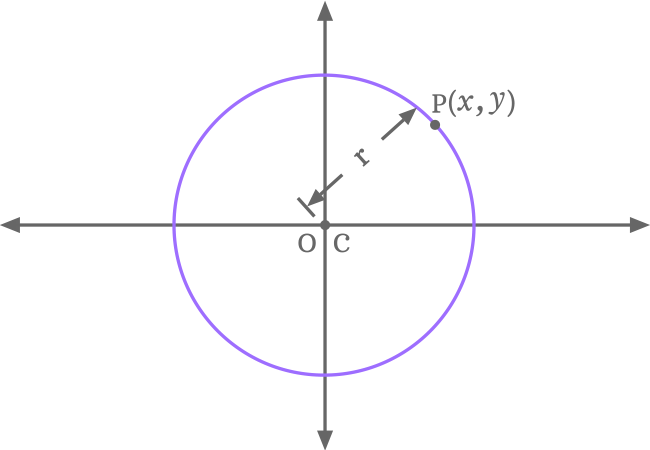
So, what exactly is this mysterious equation? Imagine you're at a carnival. You've just won a giant, suspiciously bright pink stuffed unicorn. Now, you want to draw a perfect circle on the dusty ground to show off your amazing aiming skills (or just to prove you didn't cheat that badly). The simplest, most elegant way to do this is to put a stake right in the middle – that's our origin, the VIP section of our coordinate plane, the spot where the x and y axes throw a party and high-five each other. From that stake, you tie a string of a certain length, let's call it 'r' for 'radius' (because ‘string length’ is just too many syllables, even for mathematicians).
Now, as you spin around, keeping that string taut, you're essentially tracing out a perfect circle. Every single point on that wobbly pink unicorn's perimeter is the exact same distance from the center stake. It’s like they’re all desperately trying to get a selfie with the origin, but are politely held back by the string of destiny. And that, my friends, is the fundamental concept behind our equation.
Must Read
So, how do we translate this into math-speak? We need a way to describe any point on that circle. We use our trusty coordinate system, remember those x and y things from your school days? Think of them as the directions your finger points on a giant map. If you want to get to a spot on the circle, you go 'x' units horizontally and 'y' units vertically from our origin. Simple, right? Like navigating your way to the pizza place.
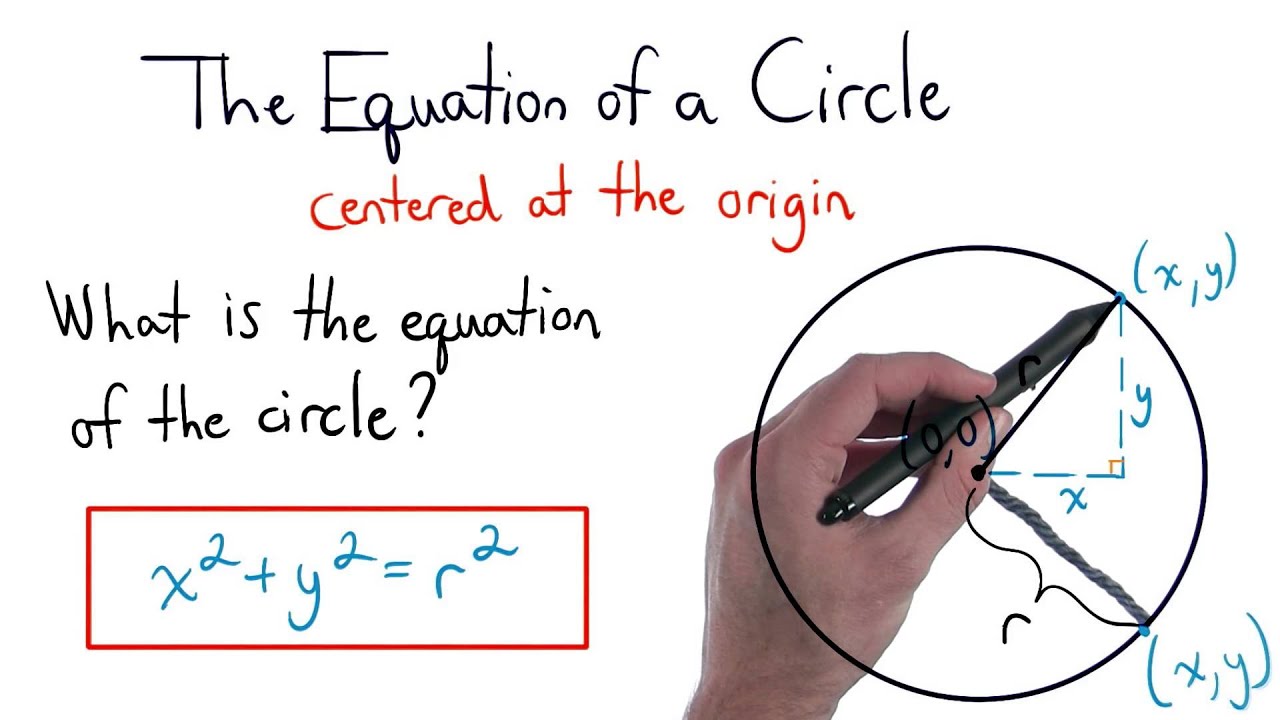
Now, here's where the magic happens. We know that the distance from the origin (which is at coordinates (0, 0)) to any point (x, y) on our circle is always, always, always going to be our radius, 'r'. And how do we calculate distance in this magical land of coordinates? We whip out the Pythagorean theorem! Remember that guy? The one who probably had really good knees for drawing right triangles? He told us that in a right triangle, the square of the hypotenuse (that's the longest side, the one that looks like it’s trying to escape) is equal to the sum of the squares of the other two sides.

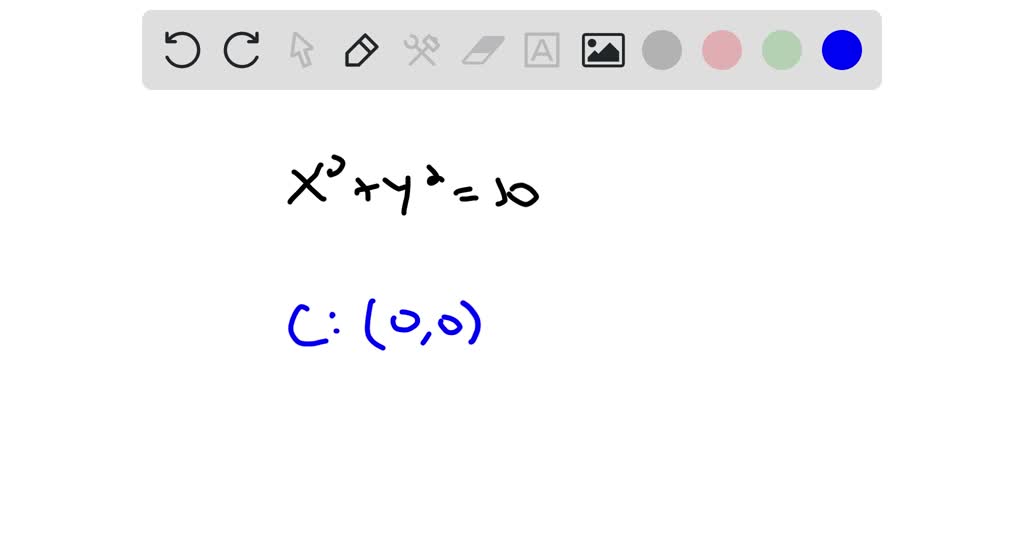
In our circle scenario, our 'x' and 'y' coordinates form the two shorter sides of a right triangle, and our radius 'r' is the hypotenuse! So, we can write it as: x² + y² = r².
BOOM! There it is! The grand unveiling! The equation of a circle centered at the origin. It’s less of a scary monster and more of a… well, a really polite and efficient way of saying "everything this far away from the center is on the circle." It’s like the circle’s personal bodyguard, making sure no point gets too close or too far.
Let’s break this down like a cheap biscuit. The 'x²' and 'y²' are just saying, "take the horizontal distance, square it, then take the vertical distance, square it." Why square them? Because distance is always positive, and squaring makes negative numbers happy and positive. It’s like putting all the numbers in a tanning bed – they all come out tanned and positive. And then we add them up, and that sum has to equal the square of our radius. If it doesn't, you're not on the circle, my friend. You're probably lost in the land of triangles that aren't right-angled, or worse, trying to plot a point in three dimensions with only two dimensions. Chaos!
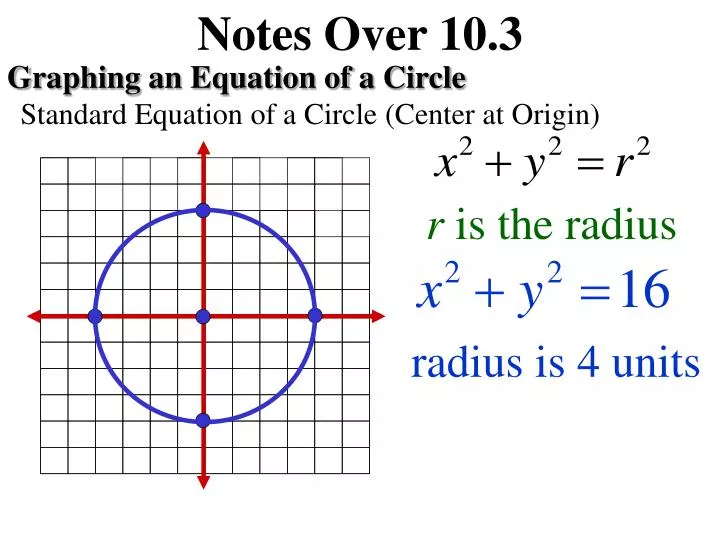
Think of it this way: If your radius is 5 (so your string is 5 feet long, or 5 miles long, or 5 light-years long – it doesn't matter the unit, math is unit-agnostic!), then r² is 25. So, any point (x, y) on that circle will satisfy x² + y² = 25. For example, if you go 3 units to the right (x=3) and 4 units up (y=4), then 3² + 4² = 9 + 16 = 25. See? You’re on the circle! You're practically a mathematician now. You could probably solve the mystery of why socks disappear in the laundry.

What if you went 5 units to the right (x=5) and 0 units up or down (y=0)? Well, 5² + 0² = 25 + 0 = 25. Still on the circle! That's the point where the circle just kisses the x-axis. Same goes for (-5, 0), (0, 5), and (0, -5). These are the cardinal points, the North, South, East, and West of your circular adventure.
And here’s a little mind-blower for you: This equation is so fundamental, it's like the mathematical equivalent of saying "water is wet." It pops up everywhere! From designing the perfect Ferris wheel (which is basically a giant, happy circle in the sky) to calculating the trajectory of a thrown baseball (which is sort of a parabola, but the principles are related!) to figuring out how to make a perfectly round pizza that doesn't have a weird bald spot in the middle. It’s the unsung hero of circularity!
So, the next time you see a circle, don't just think "ooh, round thing." Think x² + y² = r². Think about the origin being the boss, the radius being the leash, and every point on the circle being a loyal follower, perfectly equidistant from the center of attention. It’s a beautiful, simple, and surprisingly powerful piece of math. Now go forth and draw some circles! Or at least understand them better. Your latte-fueled brain will thank you.