Can I Start A Sentence With And
Okay, so, let's talk about something that might seem super, super minor, but it's actually kind of a big deal in the grand scheme of things, right? We're talking about sentences. Specifically, the humble beginnings of sentences. And today's hot topic, drumroll please... can you, or can you not, start a sentence with the word "and"?
I know, I know. It sounds like something you'd argue about with your English teacher back in third grade, doesn't it? Like, the absolute horror of it! The sheer, unadulterated grammatical sin! But honestly, is it really that bad? Or are we all just a little too caught up in the rules sometimes?
Think about it. How many times have you been writing, maybe a quick email, or even just a text message to your bestie, and you've got this perfect thought, this brilliant addition to what you just said, and it just feels right to start it with "And"? Like, you've just finished explaining your amazing weekend, and then you remember the one super important detail. And, of course, you want to tack it on!
Must Read
And then... the little voice of doubt creeps in. "Wait a minute," it whispers, all smug and pedantic, "you can't start a sentence with 'and'!" Where did that voice even come from? Probably from some dusty old grammar book that hasn't been updated since, I don't know, the invention of the printing press. Okay, maybe not that old, but you get the drift.
The truth is, for the longest time, this was a pretty firm rule. Like, etched in stone, don't-you-dare-disobey kind of rule. Teachers would mark it down. Professors would sigh dramatically. And you'd be left feeling like you'd committed some sort of linguistic felony. It was all about creating that perfect, formal, proper sentence structure, you see. And, in that context, starting with "and" was a no-no.
But here's the thing, and this is where things get interesting, my friends. Language is a living, breathing thing. It evolves. It changes. And what was once considered a cardinal sin can, over time, become perfectly acceptable, even encouraged, depending on the situation. It's like fashion, you know? What was once totally out is now totally in. Think of those bell-bottom jeans.
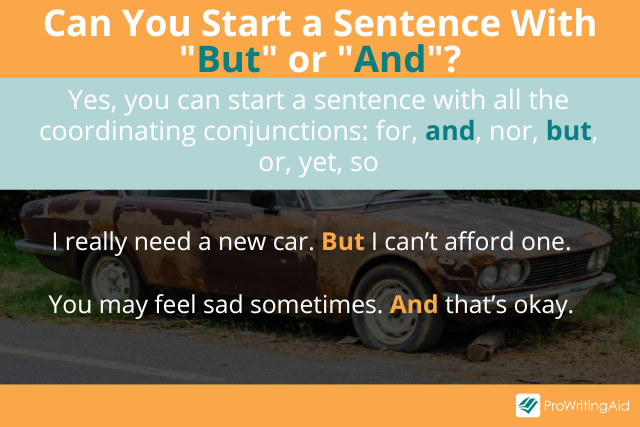
So, can you start a sentence with "and"? The answer, in modern English, is a resounding... yes! Shocking, I know. But it's true. And it's actually a really useful little trick to have up your sleeve. It helps you create a more conversational tone. It makes your writing flow more naturally. It's like adding a little conversational wink to your words.
Think about how we actually speak. Do we always meticulously craft perfectly structured sentences that never, ever begin with a conjunction? Of course not! We string ideas together. We add thoughts as they come to us. "I went to the store, and I got some milk, and then I saw Mrs. Henderson, and she told me about her new dog." See? It happens. Naturally.
And that's exactly what starting a sentence with "and" can achieve in your writing. It can create a sense of immediacy. It can make your reader feel like they're right there with you, hearing your thoughts as they unfold. It's like you're pausing for a breath, adding a bit more information, and then carrying on. It builds momentum.
When Did This All Change, Anyway?
Honestly, the "don't start a sentence with 'and'" rule is a bit of a holdover from older grammatical traditions. It was a way to enforce a certain level of formality and structure. Back in the day, formal writing was very formal. Think of old Victorian novels. Everything was perfectly, almost rigidly, constructed.
But as communication became more informal – emails, blogs, social media, you name it – the rules started to loosen up. We realized that sometimes, the rules were getting in the way of clear and effective communication. And that’s a pretty big problem, wouldn't you agree?
Linguists and grammarians, the brave souls who spend their lives studying how we use language, started to notice this shift. They saw that writers were naturally using "and" at the beginning of sentences, and it wasn't causing any confusion. In fact, it was often making things clearer. So, they decided to update the guidance. It was a revolution, of sorts, in the world of punctuation!
Now, most style guides, the bibles of good writing (or at least, good current writing), will tell you that it's perfectly fine. They'll say, "Go ahead! Use 'and' if it makes your writing better!" And that, my friends, is incredibly freeing. It's like getting permission to be a little bit more human in your writing.
So, How Do I Use This Power Responsibly?
Now, just because you can start a sentence with "and" doesn't mean you should do it every single time. That would be a bit much, wouldn't it? Imagine a whole paragraph where every single sentence started with "And." It would get pretty monotonous, pretty fast. Like eating the same flavor of ice cream for a week straight. Fun at first, then... ugh.
The key, as with most things in life, is balance. And purpose. You want to use this technique when it serves your writing. You want to use it to:
- Add an afterthought: You forgot something important? And, you need to add it in!
- Create a sense of continuation: You want to link two closely related ideas without breaking the flow too much.
- Emphasize a connection: You want to show how the new idea directly follows from the previous one.
- Achieve a conversational tone: You're aiming for a friendly, informal feel.
Let's try a little example, shall we? Say you're writing about your amazing vacation. You've just described the beautiful beaches.
Original: The beaches were stunning. The water was crystal clear. The sunsets were breathtaking.
With "and": The beaches were stunning. And the water was crystal clear. And the sunsets were breathtaking.
See how that "and" adds a little something? It feels like you're excitedly adding more wonderful details. It's like you're not quite ready to stop gushing about your trip.
Or, consider this: You're writing a recipe. You've just finished adding the flour.
Original: Add the flour. Then, mix until just combined.
With "and": Add the flour. And then, mix until just combined.
That "and" makes the transition smoother, more like you're talking someone through the steps. It's less abrupt.
When to Maybe Think Twice
Now, I'm not saying you should never worry about it. There are still situations where starting a sentence with "and" might not be your best bet. For instance, in very formal academic papers or legal documents, you might want to stick to the more traditional sentence structures. It’s all about knowing your audience and the purpose of your writing.
If you're writing a deeply philosophical treatise on the nature of existence, perhaps starting every other sentence with "And" might detract from the gravitas. Unless, of course, you're trying to make a very specific point about the interconnectedness of all things. Then, go for it! Be bold!

Also, be mindful of overuse. If you find yourself starting too many sentences with "and," it can make your writing sound a bit lazy or, dare I say it, a little childish. It's like adding too much glitter to a craft project. Sometimes, less is more. We don't want to sound like we're just stringing words together with tape, right?
Think of it this way: "And" is a powerful tool, but like any tool, it's best used with skill and precision. You wouldn't use a sledgehammer to crack a nut, would you? And you probably shouldn't use "and" to start every single sentence in your Pulitzer Prize-winning novel. Unless, of course, you're going for a very specific stylistic effect. Then, all bets are off!
The main takeaway here is that the old rule is largely outdated for most of our everyday writing. It's a relic of a more rigid past. And honestly, language is so much more fun when we're not afraid to bend the rules a little, when it makes sense.
So, the next time you're writing and that little thought pops into your head, and you feel like starting with "and," go for it! Give it a try! See how it feels. See how it sounds. You might be surprised at how much more natural and engaging your writing becomes. It’s like unlocking a secret level in a video game. You didn't know it was there, but now that you do, you can't imagine playing without it!
And who knows, maybe your favorite author does it. Maybe that blogger you love, the one whose writing just flows so perfectly? They're probably doing it too. They're probably out there, fearlessly starting sentences with "and," and making the world a more grammatically adventurous place. And that, my friends, is something to celebrate.
So, to recap: can you start a sentence with "and"? Absolutely! Just use your judgment, have fun with it, and let your words flow. And if anyone ever tells you otherwise, you can politely inform them that grammar, like everything else, has evolved. And that's a good thing. Now, go forth and write!