A Body Oscillates With Simple Harmonic Motion
Hey there, science curious pals! Ever seen something just… go back and forth? Like a kid on a swing, or maybe a really indecisive pendulum clock? Well, today we're diving into the wonderfully wiggly world of Simple Harmonic Motion. Don't let the fancy name scare you off; it's actually super cool and, dare I say, fun!
Think about it. Life's full of things that bounce, swing, and jiggle. Your phone vibrating when it gets a text? That’s a mini-masterclass in harmonic motion! A guitar string being plucked? Yep, more of this magic happening. It's basically the universe's way of saying, "Let's have a little rhythmic party!"
So, what's the big deal? Simple Harmonic Motion, or SHM as we cool kids in the physics club call it, is all about a specific kind of back-and-forth movement. It's predictable, it's smooth, and it's driven by a very particular force. Imagine a bouncy ball that, when you push it down, doesn't just stop there. Oh no, it pops back up, overshoots a little, then comes back down again, eventually settling into a nice, steady rhythm. That's the spirit of SHM!
Must Read
The Heart of the Matter: The Restoring Force
The secret sauce, the magic ingredient if you will, that makes SHM happen is called the restoring force. Now, this isn't some angry bouncer telling the object to get back in line. Nope. It's a force that always tries to pull or push the object back to its original, happy, neutral position. Think of it as the universe's gentle nudge saying, "Hey, come back home, little buddy!"
Let's use our trusty friend, the spring, as an example. Imagine a spring hanging from the ceiling. This is its equilibrium position, its natural state of chill. Now, you attach a weight to the bottom. What happens? It hangs there, right? No drama. But if you give that weight a little tug downwards? Uh oh! The spring stretches, and then… boing! It snaps back up.
That boing is our restoring force in action. The further you stretch or compress the spring from its equilibrium position, the stronger that restoring force becomes. It’s like the spring is saying, "The more you mess with me, the more I'm gonna push back!" This is a key characteristic of SHM: the restoring force is directly proportional to the displacement from equilibrium.
So, if you pull the weight twice as far, the spring pulls back twice as hard. Pretty neat, huh? This relationship between force and distance is what gives SHM its smooth, sinusoidal (don't worry, we'll get to that fancy word later!) motion. It’s not a jerky, sudden stop and start. It’s a graceful, continuous dance.
The Usual Suspects: Examples Galore!
We’ve already mentioned a few, but let’s flesh out some classic SHM scenarios. Because understanding is always better with relatable examples, right?
The Simple Pendulum: Picture a weight (let's call it a "bob") tied to a string, hanging from a fixed point. If you pull that bob to one side and let go, it swings back and forth, back and forth. As long as the angle you pull it back at isn't too big (we're talking small angles here, folks, like a polite nod rather than a full-blown headbang), it's pretty much perfect SHM. The restoring force here is gravity, trying to pull the bob straight down to its lowest point, its equilibrium. As the bob swings higher, gravity pulls it back towards the center with more gusto!
Mass on a Spring: We touched on this, but it's worth repeating because it's the quintessential SHM example. A mass attached to a spring, oscillating horizontally or vertically. The spring provides the restoring force, always trying to bring the mass back to its relaxed state. If you pull it one way, the spring pulls it back. If you push it the other way, the spring pushes it back. It's a constant tug-of-war!
Tuning Fork: Ever thought about how a tuning fork makes that pure, clear sound? When you strike it, its prongs vibrate back and forth. These vibrations are incredibly fast and are a fantastic example of SHM. The metal itself has a natural tendency to spring back when deformed, creating that rhythmic oscillation.
Musical Instruments: Beyond the tuning fork, think about a guitar string or a piano wire. When you pluck them, they vibrate, producing sound waves. This vibration is SHM. The tension in the string acts as the restoring force, pulling the string back to its original position after being displaced.
Microwaves (well, sort of!): Okay, maybe not the whole microwave, but the electromagnetic waves inside? They're oscillating! The electric and magnetic fields are oscillating in a way that’s related to SHM. It’s a bit more complex with waves, but the underlying principle of periodic, oscillating behavior is there.
The Lingo: Amplitude, Period, and Frequency
Alright, now that we know what SHM is, let's learn some of its jargon. Don't worry, it's not as intimidating as it sounds!
Amplitude: How Big is the Swing?
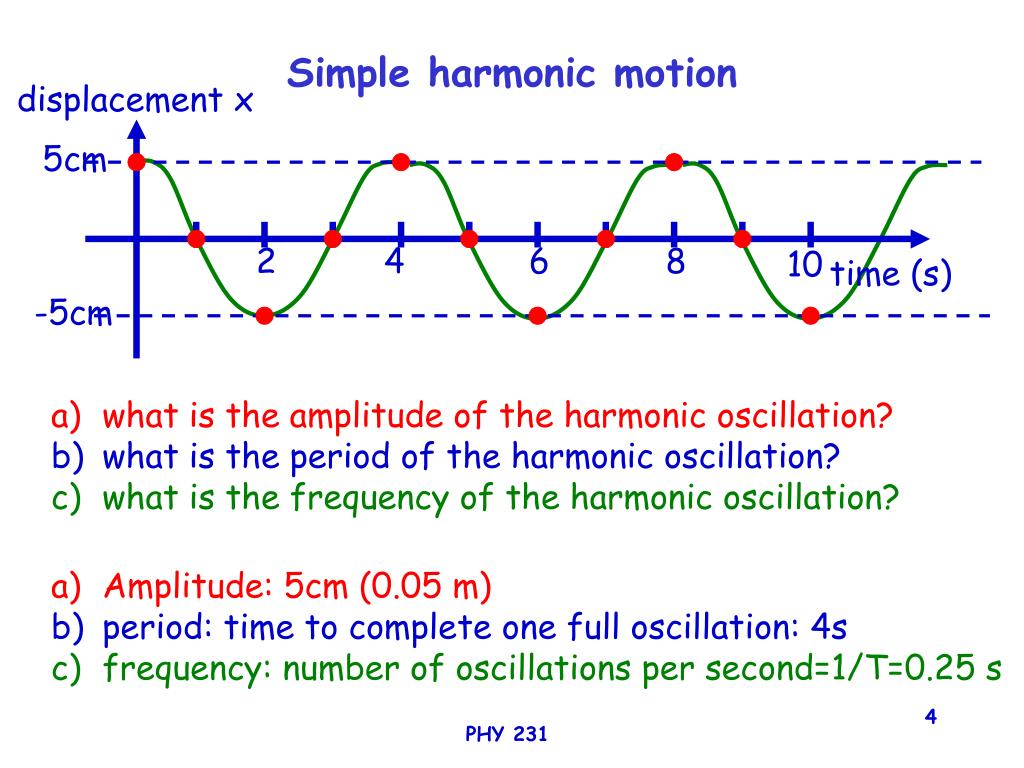
Imagine that kid on the swing again. The amplitude is simply the maximum displacement from the equilibrium position. So, if the swing goes out 5 feet to the left and 5 feet to the right, the amplitude is 5 feet. It tells you how "big" the oscillation is. A gentle sway has a small amplitude, while a wild ride has a large amplitude. In SHM, the amplitude tends to stay constant unless something (like friction or air resistance, our pesky energy stealers) gets in the way.
Period: How Long Does One Cycle Take?
The period (T) is the time it takes for one complete oscillation to happen. For our swinging kid, it's the time it takes to go from one extreme, all the way to the other extreme, and then back to the starting point. Think of it as the duration of one full "back and forth." A longer period means the oscillation is slower; a shorter period means it's faster.
Interestingly, for a simple pendulum, the period doesn't depend on the mass of the bob or the amplitude (as long as the amplitude is small). What does it depend on? The length of the string and the acceleration due to gravity. So, a longer pendulum swings slower, and gravity’s pull also influences how fast it swings.
Frequency: How Many Swings Per Second?
The frequency (f) is the number of complete oscillations that happen in one second. It’s the flip side of the period. If the period is 2 seconds (meaning it takes 2 seconds for one swing), the frequency is 0.5 Hz (Hertz). Hertz is just a fancy unit for "cycles per second." So, a higher frequency means the object is oscillating more rapidly.
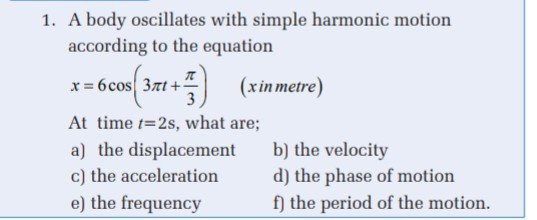
They are mathematically related: f = 1/T and T = 1/f. See? They're best buds! If you know one, you automatically know the other.
The Sine Wave Connection: Why It Looks So Smooth
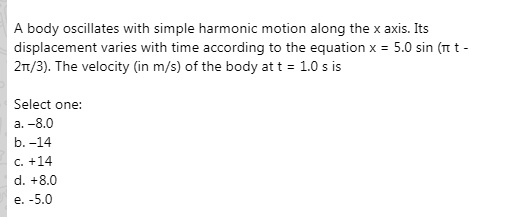
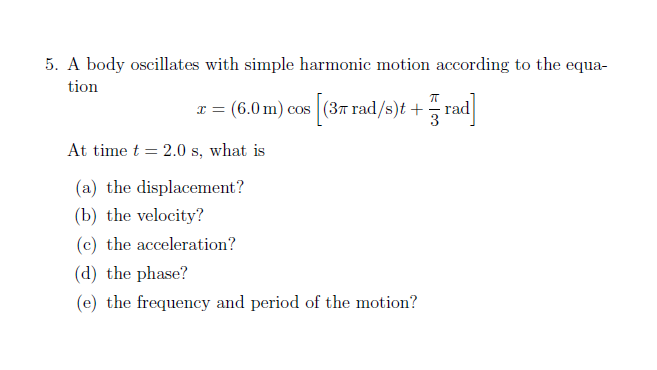
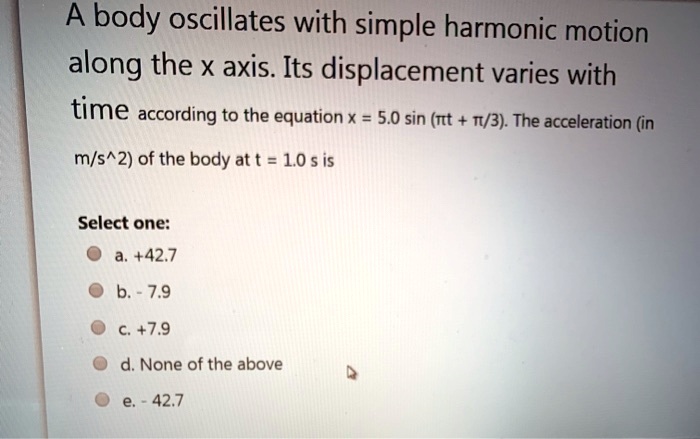
Now, about that "sinusoidal" word. SHM looks exactly like a sine wave (or a cosine wave, which is just a sine wave shifted a bit). If you were to plot the position of an object undergoing SHM over time, you'd get a beautiful, smooth, repeating curve. Why? Because the restoring force is constantly changing its strength and direction in a very regular way, dictated by the object's position.
Imagine the object at its maximum displacement. The restoring force is strongest, pulling it back. As it moves towards equilibrium, the force weakens, but its speed increases. At equilibrium, the force is zero, but the object has its maximum speed. Then, as it moves away from equilibrium on the other side, the restoring force starts pushing it back, slowing it down until it reaches its maximum displacement on that side, where its speed is momentarily zero again.
This continuous acceleration and deceleration, always directed towards equilibrium, results in that smooth, wave-like motion. It's a perfect harmony of movement! It's no wonder this kind of motion is so fundamental in physics. It's elegant, it's predictable, and it describes so many natural phenomena.
Why Does This Matter? Because Everything Oscillates!
Okay, okay, I know what you might be thinking: "This is cool, but why should I care about a swinging weight or a vibrating spring?" Well, my friends, Simple Harmonic Motion is everywhere! Understanding it is like getting a secret decoder ring for the universe.

From the tiny vibrations of atoms to the giant swings of a suspension bridge (which engineers have to account for!), SHM is a foundational concept. It helps us understand everything from how musical instruments produce sound to how light waves travel. It’s even crucial in designing everything from earthquake-resistant buildings to the precise timing mechanisms in your watch!
Think about how we perceive the world. Our ears detect sound waves, which are essentially oscillations in air pressure. Our eyes detect light waves, which are oscillations of electromagnetic fields. The very basis of our sensory experience is tied to this rhythmic, back-and-forth motion.
And when things get too much for SHM, we get into more complex oscillations. But SHM is the building block, the simple, pure form that everything else is built upon. It's the fundamental rhythm of the universe, a constant hum beneath the surface of everything we see and experience.
Embracing the Rhythm
So, the next time you see something swinging, bouncing, or vibrating, give it a little nod of appreciation. You're witnessing a beautiful display of Simple Harmonic Motion! It’s a testament to the elegant order that governs our universe, a constant, predictable dance that brings everything from music to the very fabric of reality to life.
It’s a reminder that even in the midst of chaos, there's an underlying rhythm, a fundamental pulse. And that, my friends, is something truly beautiful to behold. So, go forth and appreciate the wobble, the sway, and the bounce. The world is a lot more harmonious than you might think, just waiting for you to notice its gentle, rhythmic song. Keep your eyes and ears open, and you’ll find this beautiful oscillation everywhere, making the world a wonderfully rhythmic and inspiring place!